.png)
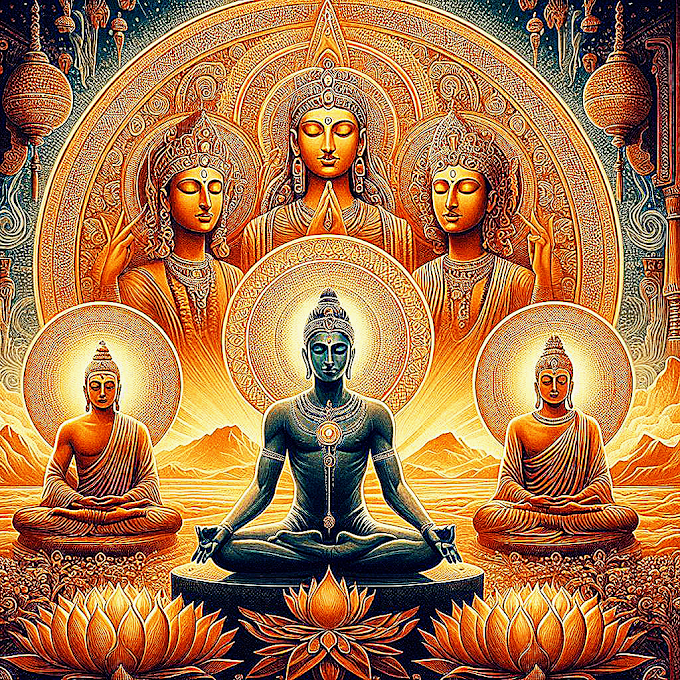
Kaivalya explores the nature, philosophy, and path to ultimate liberation, revealing pure consciousness beyond material bondage.
 |
| Kaivalya in Relation to Triguna and Dharmamegha Samadhi |
Kaivalya (कैवल्य), the ultimate state of liberation in Yoga and Samkhya philosophy, represents the complete isolation (kevala) of Purusha (pure consciousness) from Prakriti (material nature). This state is attained through deep yogic discipline, culminating in Dharmamegha Samadhi, a transcendental state where all karmic impressions are dissolved and the yogi abides in pure awareness.
The concept of Kaivalya is closely related to the dynamics of the three gunas (Triguna)—Sattva (purity, harmony), Rajas (activity, passion), and Tamas (inertia, ignorance)—which constitute Prakriti. Liberation is achieved when the influence of the gunas is transcended, leading to absolute detachment from material existence.
This paper explores the nature of Kaivalya in relation to Triguna and Dharmamegha Samadhi, analyzing their philosophical interconnections as described in Patanjali’s Yoga Sutras, the Samkhya Karika, and Upanishadic texts.
The Concept of Kaivalya
Kaivalya is the final goal of Yoga and Samkhya. It signifies absolute freedom from bondage to Prakriti, allowing Purusha to abide in its pure, independent nature.
1.1 Definition in Yogic and Samkhya Traditions
🔹 Reference: Yoga Sutras (4.34) "Kaivalya is the cessation of the modifications of Prakriti, as Purusha abides in its own nature, free from the gunas."
🔹 Reference: Samkhya Karika (68) "Kaivalya occurs when Purusha ceases to identify with Prakriti, realizing its own pure existence."
Both systems agree that liberation requires complete transcendence of Triguna and the dissolution of mental fluctuations (vrittis).
2. Kaivalya and the Triguna
2.1 Nature of the Gunas
Sattva: Associated with clarity, harmony, and light. It promotes knowledge and serenity but still binds the soul through attachment to goodness.
Rajas: Associated with activity, passion, and restlessness. It binds through desire, ambition, and constant motion.
Tamas: Associated with inertia, ignorance, and darkness. It binds through delusion, laziness, and resistance to change.
According to Samkhya, the entire material universe (Prakriti) is composed of these three gunas in varying proportions. Human experience, emotions, and actions are shaped by their interplay.
2.2 Transcendence of the Gunas
Kaivalya is attained when the yogi transcends the influence of all three gunas.
Beyond Sattva: Even purity and knowledge, though elevated, are still part of Prakriti. Liberation requires detachment from the subtle bondage of goodness.
Beyond Rajas: The yogi must overcome restlessness, ambition, and desire.
Beyond Tamas: Ignorance and inertia must be dissolved through awareness and discipline.
🔹 Reference: Bhagavad Gītā (14.20) "When the embodied being rises above these three gunas, which originate in the body, he is freed from birth, death, old age, and suffering, and attains immortality."
2.3 Philosophical Insight
In Samkhya, liberation occurs when Purusha realizes it is distinct from the gunas.
In Yoga, meditation and discipline dissolve the influence of the gunas, allowing Purusha to abide in its pure nature.
In Vedanta, transcending the gunas leads to realization of unity with Brahman.
3. Dharmamegha Samadhi and Kaivalya
3.1 Definition of Dharmamegha Samadhi
Dharmamegha Samadhi, described in Patanjali’s Yoga Sutras (4.29), is the highest form of meditative absorption.
It is called the “cloud of virtue” because it showers the yogi with transcendental wisdom and dissolves all karmic impressions.
In this state, even the subtlest seeds of karma are destroyed, leaving the yogi free from bondage.
🔹 Reference: Yoga Sutras (4.29) "Through continuous meditation, the yogi transcends all conditioning and attains Dharmamegha Samadhi, leading to Kaivalya."
3.2 Characteristics of Dharmamegha Samadhi
Dissolution of Karma: All past impressions (samskaras) are dissolved.
Transcendence of Gunas: The yogi rises beyond Sattva, Rajas, and Tamas.
Pure Awareness: Consciousness shines in its pure form, free from material identification.
Freedom from Desire: The yogi no longer seeks worldly or spiritual rewards.
3.3 Dharmamegha Samadhi as Gateway to Kaivalya
Dharmamegha Samadhi is the final stage before Kaivalya.
It represents the complete purification of consciousness, preparing Purusha to exist independently of Prakriti.
Once attained, the yogi abides in eternal freedom, beyond samsāra.
4. Experiential Dimensions of Kaivalya
4.1 Absolute Freedom
The yogi experiences freedom from karma, mental fluctuations, and material identification.
Joy and illumination arise from within, independent of external circumstances.
4.2 Transcendence Beyond Samsara
The cycle of birth and rebirth ends.
The yogi remains in pure self-awareness, beyond time and space.
🔹 Reference: Maitri Upanishad (6.22) "One who knows the self as separate from nature attains Kaivalya, beyond time and space."
4.3 Bliss and Equanimity
Kaivalya is described as bliss (ananda) and equanimity (samatva).
The yogi remains detached yet compassionate, embodying serenity and wisdom.
5. Ethical and Practical Implications
5.1 Ethical Living
The pursuit of Kaivalya requires ethical discipline (yama, niyama).
Compassion, truthfulness, and non-violence form the foundation of liberation.
5.2 Detachment from Siddhis
Siddhis (supernatural powers) may arise during practice, but attachment to them hinders liberation.
Patanjali warns that siddhis are distractions; true liberation lies in Kaivalya.
5.3 Modern Relevance
Kaivalya can be interpreted as psychological independence—freedom from compulsions, ego, and external validation.
Transcending the gunas parallels overcoming psychological conditioning, fostering resilience and clarity.
Dharmamegha Samadhi symbolizes ultimate mindfulness, where the mind is completely free from conditioning.
Kaivalya, the ultimate state of liberation in Yoga and Samkhya, represents the isolation of Purusha from Prakriti. It is attained through transcendence of the three gunas and culminates in Dharmamegha Samadhi, where all karmic impressions are dissolved.
Philosophically, Kaivalya emphasizes absolute freedom, detachment, and self-realization. Experientially, it is bliss, illumination, and transcendence beyond samsāra. Ethically, it requires discipline, detachment, and humility.
In modern contexts, Kaivalya can be understood as psychological independence and resilience, offering timeless guidance for seekers of inner freedom. Ultimately, Kaivalya reminds practitioners that liberation lies not in powers or possessions but in the realization of pure consciousness, beyond all bondage and duality.
Triguna: The Three Modes of Prakriti
In Indian philosophical systems—particularly Sāṁkhya, Yoga, and Vedānta—the concept of Triguna forms the foundation for understanding the dynamics of Prakriti (material nature). According to this framework, all manifest existence, including the body, mind, intellect, emotions, and even subtle psychological tendencies, operates through the interplay of three fundamental qualities or forces: Sattva, Rajas, and Tamas.
Patanjali’s Yoga Sutras implicitly rely on this Triguna theory to explain mental fluctuations (vṛttis), bondage, spiritual practice, and ultimately liberation (Kaivalya). While Purusha (pure consciousness) is beyond attributes, Prakriti expresses itself through these three gunas, which together constitute the entire phenomenal universe.
2.1 Nature of Triguna
The word guna literally means strand, quality, or binding force. These gunas are not moral categories but ontological principles that govern all forms of matter and mind. They coexist in varying proportions in every being and object, constantly interacting and transforming.
The Bhagavad Gītā states:
“Sattva, Rajas, and Tamas—these three gunas, born of Prakriti, bind the imperishable soul to the body.”(Bhagavad Gītā 14.5)
This verse highlights a crucial insight: bondage does not arise from the soul itself but from identification with the gunas.
Sattva (सत्त्व): Purity, Clarity, and Illumination
Sattva represents balance, harmony, luminosity, and intelligence. It is characterized by lightness, clarity, contentment, and discernment. In the psychological domain, sattva manifests as:
Calmness and mental stability
Ethical sensitivity and compassion
Truthfulness and self-restraint
Capacity for reflection and wisdom
In spiritual practice, sattva supports:
Meditation and concentration
Discrimination between Purusha and Prakriti (viveka)
Inner joy (ānanda) unconnected to sensory pleasure
However, classical Yoga philosophy emphasizes that even sattva is a binding force. While sattva binds through attachment to knowledge, peace, and happiness, it still keeps consciousness engaged within Prakriti. Thus, sattva is considered a refined bondage, not liberation itself.
Rajas (रजस): Activity, Passion, and Motion
Rajas is the principle of movement, energy, and transformation. It drives desire, ambition, creativity, and restlessness. In the mind, rajas manifests as:
Constant mental activity
Desire for achievement and recognition
Emotional turbulence
Attachment to action and results
Rajas is necessary for worldly functioning and progress, yet it also becomes a major source of suffering when unchecked. It fuels karma, reinforcing the cycle of action, reaction, and rebirth.
In the yogic context, excessive rajas:
Disrupts concentration
Prevents mental stillness
Strengthens egoic identity (ahamkāra)
Thus, yoga does not suppress rajas entirely but refines and disciplines it, channeling its energy toward self-discipline (abhyāsa) and transformation.
Tamas (तमस): Inertia, Ignorance, and Darkness
Tamas is the principle of inertia, resistance, and obscuration. It is associated with heaviness, confusion, lethargy, and ignorance. Psychologically, tamas expresses itself as:
Laziness and lack of motivation
Delusion and misunderstanding
Depression and apathy
Mechanical habits and unconscious living
Tamas is the most obstructive guna in spiritual life, as it veils awareness and resists transformation. However, it also plays a stabilizing role when properly regulated, providing rest and grounding.
In yoga, tamas must be gradually transformed:
Through disciplined routine
Ethical conduct (yama–niyama)
Purification of lifestyle and diet
Awakening awareness through practice
Unchecked tamas leads to stagnation, while refined tamas supports physical stability and rest.
Dynamic Interplay of the Three Gunas
The gunas never exist in isolation. Every thought, action, and experience arises from their dynamic interaction. For example:
Rajas activates tamas into movement
Sattva refines rajas into disciplined action
Tamas clouds sattva into passive knowledge
The mind itself (chitta) is a product of this interplay. In Patanjali’s system, vṛttis are nothing but expressions of fluctuating gunic dominance.
Triguna and Spiritual Evolution
Spiritual growth is not the elimination of gunas but a progressive refinement of their dominance:
Tamas-dominant state – ignorance and inertia
Rajas-dominant state – activity and desire
Sattva-dominant state – clarity and wisdom
Guna-atīta state – transcendence of all gunas
Yoga practice gradually elevates consciousness from tamas to rajas, from rajas to sattva, and finally beyond sattva.
Transcending the Gunas: Guna-Atīta and Kaivalya
The ultimate goal of Yoga is not sattva but freedom from all gunas. This state is known as guna-atīta—one who has gone beyond the gunas.
In this condition:
The mind becomes transparent and non-binding
Actions occur without egoic ownership
Pleasure and pain lose their hold
Purusha abides in its own nature
In Patanjali’s Yoga Sutras, this corresponds to kaivalya, where consciousness stands completely independent of Prakriti. The gunas return to their source, having fulfilled their purpose.
The theory of Triguna offers a comprehensive framework for understanding human psychology, ethical behavior, and spiritual evolution. Sattva, rajas, and tamas govern every layer of existence, from gross matter to subtle thought. Yoga does not reject the gunas but uses them intelligently, transforming their binding power into a pathway toward liberation.
Ultimately, freedom is attained not by perfecting Prakriti but by transcending identification with it. When the practitioner recognizes the gunas as processes rather than the self, the eternal Purusha shines forth—free, untouched, and complete.
The Role of Triguna in Kaivalya
The doctrine of the three gunas (Triguna)—Sattva (purity, harmony), Rajas (activity, passion), and Tamas (inertia, ignorance)—is central to both Samkhya and Yoga philosophy. These gunas constitute Prakriti (material nature) and govern all aspects of human experience, from thought and emotion to action and spiritual progress.
In the pursuit of Kaivalya (absolute liberation), the yogi must transcend the influence of the gunas. While Sattva is considered the most conducive to spiritual growth, even it binds the soul through attachment to subtle joy and knowledge. True liberation requires rising beyond all three gunas, allowing Purusha (pure consciousness) to exist in its independent nature.
3.1 How Triguna Affects the Path to Liberation
Tamas Dominance – Ignorance and Stagnation
Nature of Tamas: Darkness, inertia, delusion, and resistance to change.
Effects: Leads to ignorance, attachment, laziness, and spiritual stagnation. A person dominated by Tamas is bound by confusion and apathy, unable to progress on the path of liberation.
Philosophical Insight: Tamas obscures the light of consciousness, keeping Purusha entangled in Prakriti.
Rajas Dominance – Desire and Ego
Nature of Rajas: Activity, restlessness, passion, and ambition.
Effects: Creates desires, ego, and attachment to action. While Rajas can motivate progress, it binds the soul through craving and agitation.
Philosophical Insight: Rajas keeps the mind restless, preventing the stillness required for meditation and self-realization.
Sattva Dominance – Wisdom and Purity
Nature of Sattva: Clarity, harmony, knowledge, and detachment.
Effects: Cultivates wisdom, purity, and serenity. It is the most favorable guna for spiritual practice, fostering meditation and self-awareness.
Philosophical Insight: Despite its benefits, Sattva still binds the soul through attachment to subtle happiness and knowledge. Liberation requires transcending even Sattva.
🔹 Reference: Bhagavad Gītā (14.20) "When the embodied being transcends these three gunas, he attains Kaivalya, free from birth, death, and suffering."
Expanded Understanding
Dual Role of Sattva: While Sattva elevates the practitioner, it must ultimately be transcended. Attachment to purity and joy is still bondage.
Balance of Gunas: Spiritual practice involves cultivating Sattva to overcome Tamas and Rajas, then transcending Sattva itself.
Modern Relevance: The gunas can be seen as psychological tendencies—Tamas as lethargy, Rajas as restlessness, and Sattva as clarity. Liberation requires transcending these tendencies to realize inner freedom.
3.2 The Process of Transcending Triguna
Overcoming Tamas
Method: Knowledge (jnana) and discipline (abhyasa).
Practice: Study of scriptures, ethical living, and disciplined routines dissolve ignorance and inertia.
Philosophical Context: Awareness dispels darkness, allowing the yogi to rise above delusion.
Overcoming Rajas
Method: Meditation and self-restraint (tapas).
Practice: Concentration, breath control (pranayama), and moderation reduce restlessness and desire.
Philosophical Context: Stillness of mind dissolves agitation, preparing the yogi for deeper absorption.
Overcoming Sattva
Method: Deep absorption (samadhi).
Practice: Sustained meditation dissolves even subtle ego and attachment to joy.
Philosophical Context: In Nirvikalpa Samadhi, the yogi transcends all conditioning, including Sattva, realizing Purusha’s independence.
🔹 Reference: Yoga Sutras (4.33) "When the evolution of Prakriti ceases and its gunas are transcended, Kaivalya is attained."
Prakriti Laya – Return of Gunas to Potential State
At liberation, the gunas return to their potential state (Prakriti Laya).
They no longer affect Purusha, which abides in pure consciousness.
This marks the complete cessation of material influence, allowing absolute freedom.
3.3 Philosophical Interconnections
Samkhya Perspective
Liberation occurs when Purusha realizes its distinction from Prakriti.
The gunas, being constituents of Prakriti, must be transcended for Purusha to exist independently.
Yoga Perspective
Patanjali emphasizes meditation and discipline as means to transcend the gunas.
Dharmamegha Samadhi, the highest absorption, dissolves karmic impressions and transcends even Sattva.
Vedantic Perspective
While Vedanta emphasizes union with Brahman, it also acknowledges the need to transcend the gunas.
The Bhagavad Gītā describes liberation as rising beyond Sattva, Rajas, and Tamas.
3.4 Experiential Dimensions of Transcending Gunas
Bliss and Equanimity
The yogi experiences bliss (ananda) and equanimity (samatva), free from dualities.
Joy arises from within, independent of external circumstances.
Detachment and Freedom
The yogi remains detached from pleasure, pain, success, and failure.
Consciousness abides in its pure essence, unaffected by material fluctuations.
Transcendence of Duality
Liberation involves transcending opposites such as light and darkness, activity and rest, joy and sorrow.
The yogi realizes the eternal nature of Purusha, beyond dualities.
3.5 Ethical and Practical Implications
Ethical Discipline
Yama and Niyama (ethical restraints and self-disciplines) form the foundation for transcending the gunas.
Compassion, truthfulness, and non-violence purify the mind and elevate Sattva.
Detachment from Siddhis
Siddhis (supernatural powers) may arise during practice, but attachment to them binds the soul.
True liberation lies in transcending powers and focusing on Kaivalya.
Modern Relevance
The gunas can be interpreted as psychological tendencies:
Tamas as lethargy and ignorance.
Rajas as restlessness and ambition.
Sattva as clarity and serenity.
Spiritual practice involves cultivating awareness to transcend these tendencies, fostering resilience and inner freedom.
The role of Triguna in Kaivalya is central to understanding liberation in Yoga and Samkhya philosophy. Tamas binds through ignorance, Rajas through desire, and Sattva through subtle joy. While Sattva fosters wisdom and purity, it must ultimately be transcended.
The process of transcending the gunas involves knowledge and discipline to overcome Tamas, meditation and restraint to overcome Rajas, and deep absorption (samadhi) to transcend Sattva. At liberation, the gunas return to their potential state (Prakriti Laya), no longer affecting Purusha.
Philosophically, Kaivalya represents absolute freedom—where Purusha abides in its pure essence, beyond samsāra. Practically, it offers timeless guidance for ethical living, mental clarity, and spiritual fulfillment. In modern contexts, transcending the gunas can be understood as overcoming psychological conditioning, fostering resilience, mindfulness, and inner peace.
Ultimately, Kaivalya is not merely detachment from material existence but the realization of the soul’s eternal independence, beyond the binding influence of the gunas.
Dharmamegha Samadhi: The Final Stage Before Kaivalya
4.1 Definition and Meaning
Dharmamegha Samadhi (धर्ममेघ समाधि), literally translated as the “cloud of virtue” Samadhi, is described in Patanjali’s Yoga Sutras as the highest meditative state immediately preceding Kaivalya, the ultimate liberation. It is the culmination of yogic practice where all accumulated karma, latent impressions (samskaras), and mental afflictions (kleshas) dissolve completely.
🔹 Reference: Yoga Sutras (4.29) "For one who is completely detached, even from knowledge, Dharmamegha Samadhi arises, leading to liberation."
This Samadhi is unique because it represents detachment not only from worldly desires but also from spiritual attainments themselves. The yogi becomes free from attachment to knowledge, virtue, and even the aspiration for liberation. In this state, the mind ceases to generate fluctuations, and consciousness shines in its purest form.
Expanded Insights
Cloud of Virtue: The metaphor of a cloud signifies abundance and showering. Just as a rain cloud nourishes the earth, Dharmamegha Samadhi showers the yogi with transcendental wisdom and dissolves karmic seeds.
Freedom from Samskaras: All past impressions that bind the soul to samsāra are eradicated. This is the final purification of consciousness.
Beyond Knowledge: Even attachment to scriptural knowledge or meditative insights is transcended. The yogi rests in pure awareness, beyond intellectual constructs.
Philosophical Context: In Samkhya-Yoga, liberation requires transcending the gunas. Dharmamegha Samadhi represents the point at which the gunas cease to function, allowing Purusha to exist independently.
4.2 How Dharmamegha Samadhi Leads to Kaivalya
At lower stages of Samadhi, subtle desires and attachments may still persist. Even in advanced meditative states, the yogi may retain a subtle longing for liberation or attachment to bliss. Dharmamegha Samadhi dissolves these final traces, preparing the practitioner for Kaivalya.
🔹 Reference: Yoga Sutras (4.30) "In Dharmamegha Samadhi, all afflictions and karmas are completely dissolved, revealing the highest truth."
Key Processes Leading to Kaivalya
Dissolution of Desire
At earlier stages, the yogi may still desire liberation or spiritual attainment.
In Dharmamegha Samadhi, even this desire dissolves. The yogi rests in pure being, beyond striving.
Cessation of Gunas
The three gunas (Sattva, Rajas, Tamas) cease to function.
Prakriti returns to its latent state (Prakriti Laya), no longer influencing Purusha.
Nirvikalpa State
The mind ceases to create thoughts or distinctions.
Consciousness abides in its pure, undifferentiated nature.
Isolation of Purusha
Purusha rests in its true nature, completely isolated from Prakriti.
This isolation (Kaivalya) is absolute freedom, beyond karma, ego, and samsāra.
More Insights
Transcendence of Afflictions (Kleshas): Ignorance, egoism, attachment, aversion, and fear of death are dissolved.
Freedom from Karma: Both accumulated karma (sanchita) and future karma (agami) are nullified. The yogi is no longer bound by cause and effect.
Revelation of Highest Truth: The yogi realizes the eternal nature of Purusha, beyond time, space, and duality.
Philosophical Context: Dharmamegha Samadhi is the final gateway to Kaivalya. It represents the culmination of yogic discipline, where the practitioner transcends even the subtlest bonds of existence.
4.3 Experiential Dimensions of Dharmamegha Samadhi
Bliss and Illumination: The yogi experiences inner bliss (ananda) and illumination (jyoti), independent of external circumstances.
Equanimity: Complete detachment from pleasure and pain, success and failure.
Transcendence of Duality: The yogi transcends opposites such as joy and sorrow, light and darkness.
Compassion and Serenity: Though detached, the yogi embodies compassion and serenity, reflecting the purity of consciousness.
4.4 Ethical and Practical Implications
Detachment from Siddhis: Supernatural powers may arise during practice, but attachment to them hinders liberation. Dharmamegha Samadhi requires detachment even from spiritual attainments.
Ethical Discipline: Yama and Niyama (ethical restraints and self-disciplines) remain foundational, ensuring purity of mind and conduct.
Practical Guidance: For modern practitioners, Dharmamegha Samadhi symbolizes ultimate mindfulness—freedom from conditioning, ego, and desire.
4.5 Comparative Insights
Samkhya-Yoga: Dharmamegha Samadhi represents the cessation of Prakriti’s influence. Kaivalya is isolation of Purusha.
Vedanta: Liberation is union with Brahman. Dharmamegha Samadhi parallels the dissolution of individuality in non-dual realization.
Buddhism: Nirvana parallels Dharmamegha Samadhi, representing cessation of desires and karmic seeds.
Jainism: Kevala Jnana (absolute knowledge) parallels Kaivalya, representing the soul’s independence.
Dharmamegha Samadhi is the highest meditative state described in Patanjali’s Yoga Sutras, immediately preceding Kaivalya. It is the “cloud of virtue” that showers transcendental wisdom, dissolves karmic impressions, and transcends the gunas. In this state, even the desire for liberation dissolves, and Purusha rests in its pure nature, completely isolated from Prakriti.
Philosophically, Dharmamegha Samadhi represents the culmination of yogic discipline and the final purification of consciousness. Experientially, it is bliss, illumination, and equanimity. Ethically, it requires detachment from powers and attainments, focusing solely on liberation.
In modern contexts, Dharmamegha Samadhi can be understood as ultimate mindfulness and psychological freedom—where the mind is completely free from conditioning, ego, and desire. Ultimately, it is the gateway to Kaivalya, the highest truth of Yoga and Samkhya philosophy, reminding practitioners that liberation lies in transcending all bonds and realizing pure consciousness.
Kaivalya: The Final State
In the yogic vision articulated by Patanjali, Kaivalya represents the ultimate culmination of human spiritual evolution. It is not merely a mystical experience or a heightened state of consciousness but a permanent ontological freedom, where Purusha (pure consciousness) stands completely independent of Prakriti (material nature). Kaivalya is the goal toward which all yogic disciplines—ethical restraint, physical practice, breath regulation, sense withdrawal, concentration, meditation, samadhi, samyama, and mental transformation—are directed.
Unlike temporary states of absorption, kaivalya is irreversible. It marks the end of bondage, suffering, and ignorance, and the full realization of one’s true nature as unchanging, eternal awareness.
5.1 Characteristics of Kaivalya
Kaivalya is described not through what it contains, but through what it transcends. It is freedom not within the world, but freedom from the binding mechanisms of existence.
1. Freedom from Triguna
One of the most defining characteristics of kaivalya is complete transcendence of the three gunas—sattva, rajas, and tamas.
In ordinary existence:
Sattva binds through attachment to knowledge, peace, and happiness
Rajas binds through action, desire, and restlessness
Tamas binds through ignorance, inertia, and delusion
Even the most refined spiritual states prior to liberation remain conditioned by sattva. However, in kaivalya:
The gunas cease to influence consciousness
Prakriti returns to its dormant, unmanifest state
The mind (chitta) becomes functionally redundant
Patanjali describes this state as the “return of the gunas to their source after fulfilling their purpose”, leaving Purusha in its own essential nature. Consciousness no longer identifies with qualities, processes, or experiences. It simply is.
This is known as the state of guna-atīta—beyond all qualities.
2. Cessation of Karma and the End of Rebirth
Kaivalya also signifies the complete exhaustion of karma. In yogic philosophy, bondage persists because of karmic seeds (bīja) stored in the subconscious, which compel future births and experiences.
Through sustained practice and discriminative wisdom:
Gross karmas (manifest actions) are neutralized
Subtle karmas (latent impressions or samskāras) are dissolved
The root cause—ignorance (avidyā)—is destroyed
In kaivalya:
No new karma is produced (absence of ego and doership)
Old karmas lose their potency
The causal chain of rebirth is permanently broken
Thus, kaivalya is often described as freedom from samsāra, the endless cycle of birth, death, and rebirth. The soul is no longer compelled to assume another body, as there is no unfulfilled desire, ignorance, or karmic momentum remaining.
This freedom is not annihilation, but absolute autonomy of consciousness.
3. Eternal Self-Awareness (Purusha-Jñāna)
At the heart of kaivalya lies direct and irreversible self-realization. The practitioner no longer knows about the self but abides as the Self.
In this state:
The false identity with body, mind, intellect, and ego collapses
The distinction between knower, knowing, and known dissolves
Awareness rests in itself without object or effort
The realization may be expressed as:
“I am not the body, not the mind, not the doer—I am Purusha: pure, witnessing consciousness.”
This is not a thought or affirmation but an existential certainty, free from doubt or fluctuation. Unlike intellectual knowledge, this awareness is non-conceptual and permanent.
The Kaivalya Upanishad echoes this truth by affirming that when the self realizes its identity beyond all distinctions and limitations, it attains the highest freedom—kaivalya.
4. Dissolution of Ego and Duality
In kaivalya, the ego (ahamkāra)—the sense of “I am the doer, I am the experiencer”—is completely dissolved. With the disappearance of ego:
Dualities such as pleasure–pain, success–failure, self–other lose meaning
There is no psychological suffering, fear, or attachment
Experience may continue at the level of the body, but without identification
Importantly, kaivalya is not unconsciousness. Rather, it is pure awareness without fragmentation. There is clarity without content, presence without object.
5. Kaivalya as Absolute Independence
The literal meaning of kaivalya is aloneness or absolute independence. This does not imply isolation but rather freedom from dependence on anything external or internal.
In this state:
Consciousness does not rely on sensory input
Happiness does not depend on circumstances
Identity is not shaped by roles or relationships
Purusha abides in its own nature—self-luminous, self-sufficient, untouched by change.
6. Kaivalya vs. Temporary Samadhi
A crucial distinction in yogic philosophy is between temporary samadhi and final liberation:
Samadhi may still involve subtle identification with sattva
Bliss or stillness may come and go
Residual impressions may remain
Kaivalya, however:
Is irreversible
Is free from all impressions
Represents the complete fulfillment of yoga
Thus, kaivalya is not merely the peak of meditation but the completion of the yogic journey.
Kaivalya stands as the final and highest goal of Yoga, representing total freedom from the gunas, karma, ego, and suffering. It is the state where Purusha realizes itself as eternally free, independent, and complete, no longer entangled in the mechanisms of Prakriti.
This liberation is not achieved by escape from the world but by perfect discernment, deep discipline, and unwavering awareness. When ignorance dissolves, bondage ends—not through effort, but through insight.
Comparative Analysis: Kaivalya, Moksha, and Nirvana
The concepts of Kaivalya (Yoga & Samkhya), Moksha (Vedanta), and Nirvana (Buddhism) represent the highest ideals of liberation across three major philosophical traditions of India. While they share the common goal of transcending suffering and bondage, their metaphysical foundations, processes, and final states differ significantly. Understanding these distinctions provides a deeper appreciation of how each tradition conceptualizes ultimate freedom.
Nature of Liberation
Kaivalya (Yoga & Samkhya): Kaivalya is defined as the isolation of Purusha from Prakriti. Liberation occurs when consciousness (Purusha) realizes its independence from material nature (Prakriti) and abides in its pure essence. It is not union but separation, emphasizing the eternal distinction between spirit and matter.
🔹 Reference: Yoga Sutras (4.34) "Kaivalya is the cessation of the modifications of Prakriti, as Purusha abides in its own nature, free from the gunas."
Moksha (Vedanta): Moksha is defined as union with Brahman, the supreme non-dual reality. Liberation occurs when the individual self (Atman) realizes its identity with Brahman, dissolving all distinctions. Moksha emphasizes unity and oneness, transcending duality.
🔹 Reference: Kaivalya Upanishad (Verse 24) "Knowing oneself as identical with the supreme Brahman, one attains Kaivalya, beyond birth and death."
Nirvana (Buddhism): Nirvana is defined as the cessation of suffering and existence. Liberation occurs when craving (tanha) and clinging (upadana) are extinguished, leading to the cessation of the cycle of birth and death (samsāra). Nirvana emphasizes emptiness (śūnyatā) and cessation rather than union or isolation.
🔹 Reference: Dhammapada (Verse 203) "Nirvana is the highest happiness."
Cause of Bondage
Kaivalya (Yoga & Samkhya): Bondage arises from the influence of Triguna—Sattva, Rajas, and Tamas—which constitute Prakriti. When Purusha identifies with these gunas, it becomes entangled in samsāra. Liberation requires transcending the gunas.
Moksha (Vedanta): Bondage arises from ignorance (avidya)—the failure to realize that Atman and Brahman are one. Ignorance creates the illusion of individuality and separation. Liberation requires knowledge (jnana) that dissolves this illusion.
Nirvana (Buddhism): Bondage arises from clinging (upadana) and craving (tanha). The Four Noble Truths identify desire as the root of suffering. Liberation requires extinguishing craving and clinging.
Path to Liberation
Kaivalya (Yoga & Samkhya): The path involves Ashtanga Yoga (Eightfold Path of Patanjali) and culminates in Dharmamegha Samadhi.
Ethical discipline (yama, niyama).
Physical discipline (asana, pranayama).
Mental discipline (pratyahara, dharana).
Spiritual discipline (dhyana, samadhi). At Dharmamegha Samadhi, all karmic impressions dissolve, leading to Kaivalya.
Moksha (Vedanta): The path involves knowledge (jnana) and realization of non-duality.
Shravana – Listening to scriptural teachings.
Manana – Reflecting upon them.
Nididhyasana – Deep meditation on the truth. Bhakti (devotion) and Karma (selfless action) are preparatory paths, but ultimate liberation comes through knowledge of Brahman.
Nirvana (Buddhism): The path involves the Noble Eightfold Path:
Right View.
Right Intention.
Right Speech.
Right Action.
Right Livelihood.
Right Effort.
Right Mindfulness.
Right Concentration. Through ethical conduct, meditation, and wisdom, craving and clinging are extinguished, leading to Nirvana.
Final State
Kaivalya (Yoga & Samkhya): The final state is self-existence in pure consciousness. Purusha abides in its independent nature, completely detached from Prakriti. It is eternal witnessing, beyond samsāra.
Moksha (Vedanta): The final state is merging with the Absolute. Atman realizes its identity with Brahman, dissolving individuality. Liberation is unity and oneness.
Nirvana (Buddhism): The final state is cessation of individuality. Craving and clinging are extinguished, and samsāra ends. Nirvana is described as peace, cessation, and the highest happiness.
Comparative Insights
Ontological Difference
Kaivalya: Dualism—Purusha and Prakriti are eternally distinct. Liberation is isolation.
Moksha: Non-dualism—Atman and Brahman are one. Liberation is union.
Nirvana: Non-essentialism—No eternal self. Liberation is cessation of craving and suffering.
Epistemological Approach
Kaivalya: Achieved through discriminative knowledge (viveka) and meditative detachment.
Moksha: Achieved through self-knowledge (jnana) and realization of non-duality.
Nirvana: Achieved through wisdom (prajna) and ethical conduct.
Experiential Dimension
Kaivalya: Experience of pure witnessing consciousness, detached and isolated.
Moksha: Experience of unity, bliss, and dissolution of individuality.
Nirvana: Experience of cessation, peace, and freedom from suffering.
Ethical Implications
Kaivalya: Emphasizes discipline, detachment, and meditation.
Moksha: Emphasizes knowledge, devotion, and surrender.
Nirvana: Emphasizes compassion, mindfulness, and ethical conduct.
Scriptural Parallels
Yoga Sutras (Kaivalya): Liberation is isolation of Purusha.
Upanishads (Moksha): Liberation is unity with Brahman.
Dhammapada (Nirvana): Liberation is cessation of suffering.
Bhagavad Gītā: Integrates both perspectives, describing liberation as detachment from desires and realization of unity with the divine.
Modern Relevance
Kaivalya: Symbolically represents psychological independence—freedom from compulsions, ego, and external validation. It resonates with mindfulness practices emphasizing detachment and inner clarity.
Moksha: Symbolically represents holistic integration—realization of interconnectedness and unity. It resonates with philosophies of universal consciousness and spiritual wholeness.
Nirvana: Symbolically represents cessation of suffering—freedom from craving and clinging. It resonates with modern therapeutic practices emphasizing mindfulness and acceptance.
Together, these concepts inspire seekers to transcend material bondage, cultivate self-awareness, and realize higher truths.
Kaivalya, Moksha, and Nirvana represent three distinct yet interconnected visions of liberation.
Kaivalya (Yoga & Samkhya): Isolation of Purusha from Prakriti, achieved through detachment and meditation.
Moksha (Vedanta): Union with Brahman, achieved through knowledge and realization of non-duality.
Nirvana (Buddhism): Cessation of suffering, achieved through the Noble Eightfold Path.
While Kaivalya emphasizes independence, Moksha emphasizes unity, and Nirvana emphasizes cessation, all culminate in freedom from samsāra and realization of the highest truth.
In modern contexts, these concepts can be interpreted as psychological independence (Kaivalya), holistic integration (Moksha), and cessation of suffering (Nirvana). Together, they offer timeless guidance for resilience, mindfulness, and spiritual fulfillment.
Conclusion
Kaivalya is the highest realization in Yoga and Samkhya, marking the complete transcendence of Triguna and entry into ultimate liberation. Dharmamegha Samadhi is the final meditative state that purifies the mind of all karmic impressions, allowing the yogi to exist as pure Purusha, beyond birth, suffering, and worldly attachments.
To attain Kaivalya, one must:
- Master Triguna, overcoming Tamas, Rajas, and eventually Sattva.
- Reach Dharmamegha Samadhi, where even the desire for liberation dissolves.
- Attain absolute detachment, resting in one’s own pure, eternal self-awareness.
Kaivalya is not just freedom—it is the realization of one's eternal, unconditioned nature.
References
- Yoga Sutras of Patanjali (4.29-34)
- Bhagavad Gītā (14.5, 14.20)
- Samkhya Karika (68)
- Kaivalya Upanishad (Verse 25)
- Maitri Upanishad (6.22)


.png)