.png)
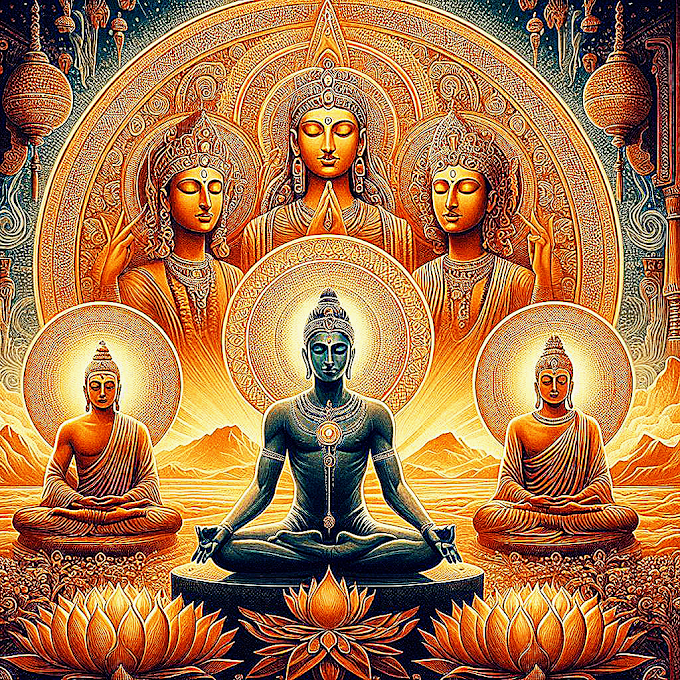
Kaivalya explores the nature, philosophy, and path to ultimate liberation, revealing pure consciousness beyond material bondage.
 |
| Kaivalya: Philosophy and Path to Liberation |
Kaivalya (कैवल्य) is one of the most profound concepts in Hindu philosophy, particularly emphasized in Yoga, Vedanta, and Samkhya traditions. It signifies absolute liberation, isolation, and pure consciousness, where the soul (Purusha) is completely detached from material existence (Prakriti). The term derives from kevala, meaning “alone” or “absolute,” indicating a state where the self remains in its true, independent nature, free from all worldly bondage.
Kaivalya is not merely freedom from suffering but the realization of the soul’s eternal independence. It is the culmination of spiritual practice, where consciousness transcends duality and remains established in its pure essence.
This paper explores the nature of Kaivalya, its interpretation across different Hindu schools, the path to its realization, and its significance in spiritual philosophy, with references to foundational scriptures such as the Yoga Sutras of Patanjali, Bhagavad Gītā, Upanishads, and Samkhya Karika.
1. Defining Kaivalya: The Ultimate Liberation
Kaivalya is often equated with mokṣa (liberation), yet it has a distinct meaning in Yoga and Samkhya philosophy. While mokṣa in Vedantic traditions implies union with Brahman, Kaivalya in Yoga denotes absolute isolation of Purusha from Prakriti, where the self exists in its purest, independent state.
🔹 Reference: The Yoga Sutras of Patanjali (4.34) defines Kaivalya as: "Purusha, having realized its own nature, remains established in its pure consciousness, completely free from Prakriti."
This state of absolute detachment results in freedom from the cycle of birth and rebirth (samsāra).
Distinction from Mokṣa
Vedanta: Mokṣa is union with Brahman, the supreme reality.
Yoga/Samkhya: Kaivalya is isolation of Purusha, where consciousness exists independently, free from material entanglement.
Bhagavad Gītā: Liberation is described as freedom from desires and union with the divine will.
Thus, Kaivalya emphasizes independence and isolation, while mokṣa emphasizes union and oneness.
1.1 Etymological Meaning
Kevala (केवल): Means "pure," "absolute," or "alone."
Kaivalya: Refers to the state of being alone in self-awareness, beyond duality.
It signifies complete self-sufficiency, where the realized soul no longer depends on material existence.
Philosophical Implications
Isolation: The soul exists independently, free from the influence of Prakriti.
Purity: Consciousness remains in its pure essence, untouched by material impurities.
Self-Sufficiency: The realized soul is complete in itself, no longer seeking fulfillment in external objects.
2. Interpretations Across Hindu Schools
Yoga Philosophy (Patanjali)
Kaivalya is the culmination of the eightfold path (Ashtanga Yoga).
Through practices of yama, niyama, asana, pranayama, pratyahara, dharana, dhyana, and samadhi, the practitioner refines consciousness.
In samadhi, the mind dissolves, and Purusha realizes its independence from Prakriti.
Samkhya Philosophy
Kaivalya is the isolation of Purusha from Prakriti.
Liberation occurs when the soul realizes its distinction from material nature.
The Samkhya Karika emphasizes discriminative knowledge (viveka) as the path to Kaivalya.
Vedanta Philosophy
While Vedanta emphasizes mokṣa as union with Brahman, Kaivalya is sometimes used interchangeably to describe liberation.
The Upanishads describe liberation as realizing the self’s unity with the absolute, transcending duality.
Bhagavad Gītā
Liberation is described as freedom from desires, attachment, and ego.
Kaivalya is implied in verses that emphasize self-realization and detachment from material existence.
3. Path to Realization of Kaivalya
Discriminative Knowledge (Viveka)
Recognizing the distinction between Purusha (consciousness) and Prakriti (matter).
Through meditation and self-awareness, practitioners realize that the soul is independent of material existence.
Detachment (Vairagya)
Freedom from desires and attachments.
Detachment allows the soul to remain established in its pure essence.
Discipline (Abhyasa)
Consistent practice of meditation, concentration, and ethical living.
Discipline refines consciousness and prepares the mind for realization.
Devotion (Bhakti)
In devotional traditions, Kaivalya is attained through surrender to the divine.
Bhakti dissolves ego and aligns the soul with higher consciousness.
4. Significance of Kaivalya in Spiritual Philosophy
Freedom from Samsāra
Kaivalya liberates the soul from the cycle of birth and rebirth.
The realized soul exists in eternal independence, free from suffering.
Transcendence of Duality
Kaivalya transcends dualities of pleasure and pain, success and failure.
The soul remains established in pure consciousness, beyond opposites.
Ethical Implications
The pursuit of Kaivalya emphasizes ethical living, discipline, and detachment.
Siddhis (supernatural powers) may arise, but Hindu philosophy warns against their misuse, emphasizing Kaivalya as the true goal.
Comparative Insight
In Buddhism, liberation (nirvana) parallels Kaivalya, emphasizing detachment and cessation of suffering.
In Jainism, kevala jnana (absolute knowledge) parallels Kaivalya, representing the soul’s independence.
5. Modern Relevance of Kaivalya
Psychological Interpretation
Kaivalya can be seen as a metaphor for psychological independence.
It represents freedom from external validation, emotional resilience, and self-sufficiency.
Mindfulness and Meditation
Modern mindfulness practices align with Kaivalya, emphasizing awareness, detachment, and clarity.
Meditation fosters inner peace and resilience, reflecting the principles of Kaivalya.
Ethical Guidance
Kaivalya emphasizes humility, detachment, and discipline, providing ethical guidance in modern contexts.
It reminds practitioners to prioritize inner growth over material success.
Spiritual Fulfillment
Kaivalya inspires seekers to pursue self-realization and inner harmony.
It bridges ancient wisdom with contemporary life, offering timeless principles for spiritual growth.
Kaivalya represents the pinnacle of spiritual achievement in Hindu philosophy. Defined as absolute liberation and isolation of Purusha from Prakriti, it emphasizes independence, purity, and self-sufficiency. While mokṣa in Vedanta implies union with Brahman, Kaivalya in Yoga and Samkhya emphasizes isolation and detachment.
The path to Kaivalya involves discriminative knowledge, detachment, discipline, and devotion. Its significance lies in freedom from samsāra, transcendence of duality, and ethical living. In modern contexts, Kaivalya can be interpreted as psychological independence, mindfulness, and resilience.
Ultimately, Kaivalya reminds practitioners that supernatural powers or worldly success are secondary. The true goal of spiritual practice is liberation—absolute freedom, where the soul remains established in its pure essence, beyond all bondage.
Kaivalya in Different Hindu Philosophies
Kaivalya, meaning absolute liberation or isolation, is interpreted differently across Hindu philosophical schools. While all traditions agree that it represents the highest state of freedom, the nuances of its meaning vary depending on the metaphysical framework. Samkhya, Yoga, and Advaita Vedanta each provide unique perspectives on Kaivalya, reflecting their distinct understandings of reality, consciousness, and liberation.
2.1 Kaivalya in Samkhya Philosophy
Samkhya, one of the oldest dualistic schools of Hindu philosophy, views Kaivalya as the complete separation of Purusha (pure consciousness) from Prakriti (matter). Unlike Advaita Vedanta, which sees ultimate reality as non-dual, Samkhya maintains that Purusha and Prakriti are eternally distinct entities.
🔹 Reference: Samkhya Karika (Verse 68) states: "When Purusha ceases to identify with Prakriti, it attains Kaivalya, existing in its own true nature."
Key Insights
Dualism: Samkhya asserts that liberation is achieved when Purusha realizes its independence from Prakriti.
Self-Realization: Kaivalya is not merging with a higher reality but recognizing the eternal distinction between consciousness and matter.
Freedom from Bondage: Bondage occurs when Purusha mistakenly identifies with Prakriti. Liberation is attained when this misidentification ceases.
Philosophical Significance
Kaivalya in Samkhya emphasizes discriminative knowledge (viveka)—the ability to discern between the eternal consciousness and the transient material world.
Liberation is not union but isolation, where Purusha exists in its pure, independent state.
This perspective highlights the importance of intellectual clarity and metaphysical discrimination in achieving freedom.
Modern Relevance
Symbolically, Samkhya’s Kaivalya can be understood as psychological independence—freedom from identifying with external circumstances, roles, or material possessions.
It resonates with modern mindfulness practices that emphasize detachment and awareness of the distinction between observer and observed.
2.2 Kaivalya in Yoga Philosophy (Patanjali’s Yoga Sutras)
Yoga philosophy, as systematized by Patanjali, builds upon Samkhya’s dualism but emphasizes practical methods for attaining Kaivalya. Patanjali dedicates an entire chapter, the Kaivalya Pada, to describing the final stage of liberation.
🔹 Reference: Yoga Sutras (3.56) states: "When the mind is free from all fluctuations (vrittis), Kaivalya is attained."
Path to Kaivalya
Yoga describes Kaivalya as the highest state, achievable through Ashtanga Yoga (Eightfold Path):
Yama – Ethical restraints (non-violence, truthfulness, non-stealing, moderation, non-possessiveness).
Niyama – Self-discipline (cleanliness, contentment, austerity, self-study, devotion).
Asana – Postures that stabilize the body.
Pranayama – Breath control to regulate energy.
Pratyahara – Withdrawal of senses from external distractions.
Dharana – Concentration on a single point.
Dhyana – Meditation, sustained awareness.
Samadhi – Absorption, where the mind dissolves into pure consciousness.
At Samadhi, the final limb, one transcends the mind and realizes Kaivalya.
Philosophical Significance
Kaivalya in Yoga is the culmination of disciplined practice, where the mind becomes still and consciousness realizes its independence.
Patanjali warns that siddhis (supernatural powers) may arise during practice but should not distract from the ultimate goal of Kaivalya.
Liberation is described as absolute freedom from vrittis (mental fluctuations), allowing Purusha to remain in its pure essence.
Modern Relevance
Yoga’s Kaivalya resonates with contemporary practices of meditation and mindfulness, emphasizing discipline, focus, and inner stillness.
It provides a structured path for spiritual seekers, integrating ethical living, physical discipline, and meditative absorption.
In psychological terms, Kaivalya represents freedom from mental turbulence, fostering resilience and clarity.
2.3 Kaivalya in Advaita Vedanta
Advaita Vedanta, a non-dualistic school, interprets Kaivalya differently from Samkhya and Yoga. While Samkhya emphasizes isolation and Yoga emphasizes detachment, Vedanta describes liberation as unity with Brahman, the supreme reality.
🔹 Reference: Kaivalya Upanishad (Verse 24) states: "Knowing oneself as identical with the supreme Brahman, one attains Kaivalya, beyond birth and death."
Key Insights
Non-Dualism: Advaita Vedanta asserts that the individual self (Atman) is identical with Brahman. Liberation is realizing this non-dual truth.
Kaivalya as Oneness: Unlike Samkhya’s isolation, Vedanta’s Kaivalya is union—absolute self-awareness where duality dissolves.
Transcendence of Samsāra: Liberation is freedom from birth and death, attained through knowledge (jnana) and realization of unity with Brahman.
Philosophical Significance
Kaivalya in Vedanta emphasizes self-knowledge (Atma-jnana) as the path to liberation.
The pursuit involves study of scriptures (shruti), reflection (manana), and meditation (nididhyasana).
Liberation is not isolation but realization of non-duality, where the self recognizes its identity with the absolute.
Modern Relevance
Vedanta’s Kaivalya resonates with contemporary spiritual seekers who emphasize unity, interconnectedness, and holistic awareness.
It aligns with philosophies that stress the dissolution of ego and realization of universal consciousness.
Symbolically, it represents psychological integration—transcending dualities and realizing wholeness.
2.4 Comparative Insights
Samkhya vs. Yoga vs. Vedanta
Samkhya: Kaivalya is isolation of Purusha from Prakriti. Liberation is separation.
Yoga: Kaivalya is achieved through disciplined practice, culminating in samadhi. Liberation is detachment.
Vedanta: Kaivalya is unity with Brahman. Liberation is oneness.
Common Threads
All traditions emphasize freedom from bondage and realization of the self’s true nature.
Each school provides unique methods—discriminative knowledge (Samkhya), disciplined practice (Yoga), and self-knowledge (Vedanta).
Despite differences, Kaivalya universally represents the highest spiritual achievement.
Kaivalya, interpreted across Samkhya, Yoga, and Vedanta, represents the pinnacle of spiritual philosophy in Hinduism.
In Samkhya, it is isolation of Purusha from Prakriti.
In Yoga, it is detachment achieved through disciplined practice.
In Vedanta, it is unity with Brahman, the supreme reality.
Though the interpretations differ, the essence remains the same: Kaivalya is absolute liberation, freedom from samsāra, and realization of the self’s true nature.
In modern contexts, Kaivalya can be understood as psychological independence, mindfulness, and holistic awareness. It bridges ancient wisdom with contemporary life, offering timeless principles for resilience, clarity, and spiritual fulfillment.
Path to Kaivalya: The Process of Liberation
The journey to Kaivalya—absolute liberation and pure consciousness—is a gradual process involving mental purification, detachment, and transcendental wisdom. Patanjali’s Yoga Sutras, the Samkhya Karika, and Vedantic texts emphasize that liberation is not attained through ritual or external achievements but through inner transformation. The process requires discriminative knowledge (viveka), overcoming afflictions (kleshas), and disciplined practice through the eightfold path of yoga.
3.1 Discrimination Between Purusha and Prakriti
The first and most essential step toward Kaivalya is viveka (discrimination)—realizing that the self (Purusha) is distinct from the body, mind, and material world (Prakriti).
🔹 Reference: Yoga Sutras (2.15) states: "By deep discernment, the yogi perceives all worldly experiences as suffering and turns towards Kaivalya."
Key Insights
Purusha vs. Prakriti: Purusha is eternal, unchanging consciousness, while Prakriti is dynamic matter subject to change. Liberation occurs when the yogi ceases to identify with Prakriti.
Detachment (Vairagya): Detachment from worldly pleasures and pains is essential for realizing the independence of Purusha.
Philosophical Context: Samkhya philosophy emphasizes that bondage arises from misidentification of Purusha with Prakriti. Discriminative knowledge dissolves this illusion.
Expanded Understanding
Practical Application: Mindfulness practices, meditation, and self-reflection help practitioners observe the distinction between the observer (Purusha) and the observed (Prakriti).
Modern Relevance: In psychological terms, viveka represents the ability to separate one’s true self from roles, possessions, and external circumstances, fostering resilience and authenticity.
3.2 Overcoming Kleshas (Afflictions)
Patanjali identifies five kleshas (afflictions) that obstruct liberation. These are deep-rooted mental impurities that bind the soul to samsāra (the cycle of birth and death).
Avidya (Ignorance) – Mistaking the unreal for the real, the transient for the eternal.
Asmita (Egoism) – Identifying the self with body, mind, or intellect.
Raga (Attachment) – Craving for pleasure and material possessions.
Dvesha (Aversion) – Hatred or avoidance of pain and discomfort.
Abhinivesha (Fear of Death) – Clinging to material existence and fearing dissolution.
🔹 Reference: Yoga Sutras (2.2): "Yoga removes kleshas, leading to the vision of Purusha and attainment of Kaivalya."
Key Insights
Root Cause of Bondage: Avidya is considered the fundamental klesha, giving rise to egoism, attachment, aversion, and fear.
Process of Removal: Through meditation, discipline, and discriminative knowledge, the yogi gradually dissolves these afflictions.
Philosophical Context: The kleshas are seen as obstacles clouding the mind, preventing realization of Purusha’s independence.
Expanded Understanding
Practical Application:
Mindfulness reduces ignorance by fostering awareness.
Selfless service and humility dissolve egoism.
Detachment practices reduce attachment and aversion.
Meditation on impermanence reduces fear of death.
Modern Relevance: The kleshas parallel psychological challenges such as cognitive biases, ego-driven behavior, compulsive desires, avoidance patterns, and existential anxiety. Overcoming them fosters emotional resilience and clarity.
3.3 Ashtanga Yoga: The Eightfold Path to Liberation
Patanjali’s Ashtanga Yoga (Eightfold Path) provides a structured approach to Kaivalya. Each limb refines the practitioner’s body, mind, and spirit, culminating in liberation.
Yama – Ethical restraints (non-violence, truthfulness, non-stealing, moderation, non-possessiveness).
Niyama – Self-disciplines (cleanliness, contentment, austerity, self-study, devotion).
Asana – Physical postures that stabilize the body and prepare it for meditation.
Pranayama – Breath control to regulate life energy (prana).
Pratyahara – Withdrawal of senses from external distractions.
Dharana – Concentration on a single point or object.
Dhyana – Meditation, sustained awareness without distraction.
Samadhi – Absorption, where the mind dissolves into pure consciousness.
🔹 Reference: Yoga Sutras (4.29): "Through continuous meditation, the yogi transcends all conditioning and attains Kaivalya."
Key Insights
Progressive Refinement: Each limb prepares the practitioner for the next, gradually purifying body, mind, and spirit.
Direct Means: Dhyana (meditation) and Samadhi (absorption) are the most direct means to Kaivalya.
Nirvikalpa Samadhi: The highest form of Samadhi, where ego and mind dissolve completely, revealing the self in its purest form.
Expanded Understanding
Practical Application:
Ethical living (yama, niyama) creates a foundation of purity.
Physical discipline (asana, pranayama) stabilizes the body and energy.
Mental discipline (pratyahara, dharana) cultivates focus.
Spiritual discipline (dhyana, samadhi) dissolves ego and reveals Purusha.
Philosophical Context: Ashtanga Yoga integrates ethical, physical, mental, and spiritual practices, providing a holistic path to liberation.
Modern Relevance: The eightfold path parallels modern practices of holistic wellness—ethical living, physical health, mindfulness, concentration, and meditation. It offers a timeless framework for personal growth and resilience.
3.4 Additional Dimensions of the Path to Kaivalya
Role of Bhakti (Devotion)
In devotional traditions, Kaivalya is attained through surrender to the divine.
Bhakti dissolves ego and aligns the soul with higher consciousness.
Role of Jnana (Knowledge)
In Vedanta, Kaivalya is realized through self-knowledge (Atma-jnana).
Study of scriptures, reflection, and meditation reveal the unity of Atman and Brahman.
Role of Karma (Action)
Selfless action (karma yoga) purifies the mind and reduces attachment.
Ethical conduct supports the journey to liberation.
The path to Kaivalya is a disciplined journey involving discrimination between Purusha and Prakriti, overcoming kleshas, and practicing Ashtanga Yoga. Viveka reveals the distinction between consciousness and matter, vairagya fosters detachment, and meditation dissolves ego. The removal of kleshas purifies the mind, while the eightfold path provides a structured approach to liberation.
Philosophically, Kaivalya represents absolute freedom—where Purusha exists in its pure essence, beyond samsāra. Practically, it offers timeless guidance for ethical living, mental clarity, and spiritual fulfillment. In modern contexts, Kaivalya can be understood as psychological independence, resilience, and mindfulness, bridging ancient wisdom with contemporary life.
Ultimately, Kaivalya is not merely the cessation of suffering but the realization of the soul’s eternal independence. It is the pinnacle of yogic philosophy, reminding practitioners that liberation lies not in supernatural powers or material success but in the transcendence of ego and the realization of pure consciousness.
The State of Kaivalya: Characteristics and Experience
Kaivalya, the culmination of yogic and philosophical practice, represents the highest state of liberation in Hindu thought. It is not merely freedom from suffering but the realization of the soul’s eternal independence. In this state, the self (Purusha) exists in its pure essence, completely detached from material nature (Prakriti). The experience of Kaivalya is described in scriptures as absolute freedom, transcendence beyond samsāra, and illumination of consciousness.
4.1 Absolute Freedom (Svatantra Avastha)
Kaivalya is characterized by absolute freedom (svatantra avastha)—a state where the soul is free from karma, mental fluctuations, and material identification.
🔹 Reference: Bhagavad Gītā (5.24): "The one who finds happiness within, whose soul is illumined, attains Brahmanirvana (Kaivalya)."
Key Characteristics of Absolute Freedom
Freedom from Karma: In Kaivalya, the accumulated effects of past actions (karma) no longer bind the soul. The yogi transcends the law of cause and effect, existing beyond karmic cycles.
Freedom from Mind Fluctuations (Vrittis): The mind becomes completely still, free from distractions, desires, and dualities. Consciousness shines in its pure form.
Freedom from Material Identification: The yogi no longer identifies with the body, mind, or external possessions. The self is realized as distinct from Prakriti.
Philosophical Context
In Yoga Sutras (4.34), Patanjali describes Kaivalya as the state where Purusha remains established in its own nature, free from Prakriti.
In Samkhya philosophy, Kaivalya is isolation—Purusha existing independently, uninfluenced by material nature.
In Vedanta, Kaivalya is unity with Brahman, transcending duality and realizing non-dual consciousness.
Expanded Insights
Inner Happiness: The yogi finds joy within, independent of external circumstances. This inner bliss reflects the self’s illumination.
Self-Sufficiency: Kaivalya represents complete self-sufficiency, where the soul no longer depends on external validation or material existence.
Modern Relevance: Absolute freedom can be interpreted as psychological independence—freedom from compulsions, ego-driven desires, and external pressures. It fosters resilience, authenticity, and inner peace.
4.2 Transcendence Beyond Samsara
Kaivalya also signifies transcendence beyond samsāra, the cycle of birth and rebirth. In this state, the yogi remains in pure self-awareness, unaffected by karma and time.
🔹 Reference: Maitri Upanishad (6.22): "One who knows the self as separate from nature attains Kaivalya, beyond time and space."
Key Characteristics of Transcendence
End of Rebirth: The cycle of samsāra ends. The soul is liberated from the necessity of reincarnation.
Freedom from Karma: Karma no longer affects the liberated soul. Actions may occur, but they do not bind.
Beyond Time and Space: The yogi transcends temporal and spatial limitations, existing in eternal consciousness.
Pure Self-Awareness: The soul remains established in its true nature, unaffected by external influences.
Philosophical Context
In Samkhya Karika (Verse 68), Kaivalya is described as the state where Purusha ceases to identify with Prakriti, existing in its own true nature.
In Kaivalya Upanishad (Verse 24), liberation is described as realizing oneness with Brahman, transcending birth and death.
In Bhagavad Gītā (6.29), the yogi perceives the self in all beings and all beings in the self, reflecting transcendence beyond individuality.
Expanded Insights
Transcendence of Duality: The yogi transcends opposites such as pleasure and pain, success and failure. Consciousness remains unaffected by dualities.
Immortality of the Soul: Kaivalya reveals the eternal nature of Purusha, beyond death and decay.
Modern Relevance: Transcendence beyond samsāra can be interpreted as freedom from existential anxiety. It represents psychological resilience, acceptance of impermanence, and realization of inner stability.
4.3 Experiential Dimensions of Kaivalya
Bliss and Illumination
The experience of Kaivalya is described as inner bliss (ananda) and illumination (jyoti).
The yogi perceives the self as radiant, eternal, and complete.
Detachment and Equanimity
The liberated soul remains detached from worldly experiences, maintaining equanimity in all circumstances.
This detachment is not indifference but transcendence, where the soul is unaffected by external fluctuations.
Unity and Isolation
In Vedanta, Kaivalya is unity with Brahman, dissolving individuality.
In Samkhya and Yoga, Kaivalya is isolation of Purusha, existing independently.
Despite differences, all traditions agree that Kaivalya represents the highest state of freedom.
4.4 Ethical and Practical Implications
Ethical Living
The pursuit of Kaivalya emphasizes ethical living, discipline, and detachment.
Yama and Niyama (ethical restraints and self-disciplines) form the foundation of liberation.
Detachment from Siddhis
Siddhis (supernatural powers) may arise during practice, but Hindu philosophy warns against attachment to them.
True liberation lies in transcending powers and focusing on self-realization.
Guidance for Modern Life
Kaivalya provides timeless guidance for modern seekers:
Inner Freedom: Cultivate independence from external validation.
Resilience: Transcend dualities and remain centered in self-awareness.
Mindfulness: Practice meditation and detachment to realize inner peace.
The state of Kaivalya is characterized by absolute freedom (svatantra avastha) and transcendence beyond samsāra. It represents liberation from karma, mind fluctuations, and material identification. The yogi remains in pure self-awareness, unaffected by time, space, and dualities.
Scriptures such as the Bhagavad Gītā, Maitri Upanishad, Yoga Sutras, and Samkhya Karika describe Kaivalya as the pinnacle of spiritual achievement. Philosophically, it is interpreted as isolation (Samkhya, Yoga) or unity with Brahman (Vedanta). Experientially, it is bliss, illumination, and detachment.
In modern contexts, Kaivalya can be understood as psychological independence, resilience, and mindfulness. It inspires seekers to transcend ego, cultivate inner freedom, and realize the eternal nature of consciousness.
Ultimately, Kaivalya is not merely the cessation of suffering but the realization of the soul’s eternal independence. It is the highest goal of Hindu philosophy, reminding practitioners that liberation lies in self-realization, beyond all bondage and duality.
Kaivalya vs. Moksha: Key Differences
Though often used interchangeably, Kaivalya and Moksha represent distinct philosophical interpretations of ultimate liberation in Hindu thought. Both signify freedom from bondage and the cycle of birth and death (samsāra), but their metaphysical underpinnings differ according to the schools of philosophy. Kaivalya is emphasized in Samkhya-Yoga, while Moksha is central to Vedanta.
Definition
Kaivalya (Yoga): Kaivalya is defined as the absolute isolation of Purusha from Prakriti. In this state, consciousness (Purusha) exists independently, free from identification with material nature (Prakriti). Liberation is achieved when the yogi realizes that the self is distinct from body, mind, and external reality.
🔹 Reference: Yoga Sutras (4.34): "Purusha, having realized its own nature, remains established in pure consciousness, completely free from Prakriti."
Moksha (Vedanta): Moksha is defined as union with Brahman, the supreme non-dual reality. In Advaita Vedanta, liberation occurs when the individual self (Atman) realizes its identity with Brahman. Moksha is not isolation but dissolution of individuality into infinite consciousness.
🔹 Reference: Kaivalya Upanishad (Verse 24): "Knowing oneself as identical with the supreme Brahman, one attains Kaivalya, beyond birth and death."
Philosophy
Kaivalya (Samkhya-Yoga): Samkhya-Yoga is a dualistic philosophy. It posits two eternal realities: Purusha (consciousness) and Prakriti (matter). Bondage arises when Purusha identifies with Prakriti. Liberation (Kaivalya) is achieved when Purusha realizes its independence.
Moksha (Advaita Vedanta): Advaita Vedanta is a non-dual philosophy. It asserts that Atman and Brahman are one. Bondage arises from ignorance (avidya) of this truth. Liberation (Moksha) is attained through knowledge (jnana) that dissolves the illusion of duality.
Process
Kaivalya (Yoga): The process involves detachment and meditative realization. Patanjali’s Ashtanga Yoga (Eightfold Path) provides a structured approach:
Yama – Ethical restraints.
Niyama – Self-disciplines.
Asana – Postures.
Pranayama – Breath control.
Pratyahara – Withdrawal of senses.
Dharana – Concentration.
Dhyana – Meditation.
Samadhi – Absorption.
At the highest stage, Nirvikalpa Samadhi, the yogi transcends mind and ego, realizing Purusha’s independence.
🔹 Reference: Yoga Sutras (2.15): "By deep discernment, the yogi perceives all worldly experiences as suffering and turns towards Kaivalya."
Moksha (Vedanta): The process involves knowledge of Brahman (Jnana). Liberation is attained through:
Shravana – Listening to scriptural teachings.
Manana – Reflecting upon them.
Nididhyasana – Deep meditation on the truth.
Bhakti (devotion) and Karma (selfless action) are also emphasized as preparatory paths, but ultimate liberation comes through realization of non-duality.
🔹 Reference: Bhagavad Gītā (6.29): "The yogi sees the self in all beings and all beings in the self."
Final State
Kaivalya (Yoga): The final state is absolute isolation. Purusha exists in its purest, independent nature, completely detached from Prakriti. Consciousness remains as the eternal witness, free from bondage, karma, and samsāra.
Moksha (Vedanta): The final state is union with Brahman. The individual self merges with infinite consciousness, dissolving all distinctions. Liberation is realization of oneness, where Atman and Brahman are identical.
Comparative Insights
Ontological Difference
Kaivalya: Dualism—Purusha and Prakriti are eternally distinct. Liberation is separation.
Moksha: Non-dualism—Atman and Brahman are one. Liberation is union.
Epistemological Approach
Kaivalya: Achieved through discriminative knowledge (viveka) and meditative detachment.
Moksha: Achieved through self-knowledge (jnana) and realization of non-duality.
Experiential Dimension
Kaivalya: Experience of pure witnessing consciousness, detached and isolated.
Moksha: Experience of unity, bliss, and dissolution of individuality.
Ethical Implications
Kaivalya: Emphasizes discipline, detachment, and meditation.
Moksha: Emphasizes knowledge, devotion, and surrender.
Scriptural Parallels
Yoga Sutras (Kaivalya): Liberation is isolation of Purusha.
Upanishads (Moksha): Liberation is unity with Brahman.
Bhagavad Gītā: Integrates both perspectives, describing liberation as detachment from desires and realization of unity with the divine.
Modern Relevance
Kaivalya: Symbolically represents psychological independence—freedom from compulsions, ego, and external validation. It resonates with mindfulness practices that emphasize detachment and inner clarity.
Moksha: Symbolically represents holistic integration—realization of interconnectedness and unity. It resonates with philosophies of universal consciousness and spiritual wholeness.
Both concepts inspire seekers to transcend material bondage, cultivate self-awareness, and realize higher truths.
Kaivalya and Moksha represent two distinct yet complementary visions of liberation in Hindu philosophy.
Kaivalya (Yoga/Samkhya): Absolute isolation of Purusha from Prakriti, achieved through detachment and meditation.
Moksha (Vedanta): Union with Brahman, achieved through knowledge and realization of non-duality.
While Kaivalya emphasizes separation and independence, Moksha emphasizes unity and oneness. Both culminate in freedom from samsāra, transcending karma, and realizing the eternal nature of the self.
In modern contexts, Kaivalya can be understood as psychological independence, while Moksha can be seen as holistic integration. Together, they offer timeless guidance for spiritual growth, resilience, and fulfillment.
Conclusion
Kaivalya is the highest state of spiritual liberation, where one attains absolute freedom from material existence. While different traditions interpret it uniquely, the core idea remains the same: a realized being transcends all limitations and abides in eternal self-awareness.
Kaivalya is not just liberation but the ultimate realization of one’s eternal, unchanging nature.
References
- Yoga Sutras of Patanjali (Kaivalya Pada, 4.34)
- Samkhya Karika (Verse 68)
- Bhagavad Gītā (5.24)
- Kaivalya Upanishad (Verse 24)
- Maitri Upanishad (6.22)
FAQ
Q1. What is the Kaivalya Pada?
Ans: Kaivalya Pada is the fourth and final chapter of Patanjali’s Yoga Sutras, describing the state of ultimate liberation (Kaivalya). It explains how the yogi transcends the mind and material limitations to realize pure, independent consciousness, free from all bondage.
Q2. What is the attainment of kaivalya?
Ans: The attainment of Kaivalya, as described in Patanjali’s Yoga Sutras, is the state of absolute liberation where the self (purusha) abides in its pure, independent nature. It signifies freedom from all mental fluctuations and material bondage, realizing consciousness as distinct from matter.
Q3. What is the term for the ultimate liberation in Indian philosophy?
Ans: The term for ultimate liberation in Indian philosophy is Moksha, signifying freedom from the cycle of birth and death (samsara). It is the realization of the self’s true nature, beyond material bondage, leading to eternal peace and union with the Absolute.
Q4. What is the concept of kaivalya in Jainism?
Ans: In Jainism, Kaivalya refers to the state of absolute knowledge (Kevala Jnana) attained when the soul is completely freed from karmic bondage. It marks spiritual perfection, where the soul exists in pure consciousness, infinite knowledge, and bliss, leading ultimately to liberation (Moksha).
Q5. Does kaivalya mean liberation?
Ans: Yes, Kaivalya in Indian philosophy signifies liberation, specifically the state of absolute freedom of the self (purusha) from material and mental bondage. It is described as pure, independent consciousness, beyond the cycle of birth and death, and the ultimate goal of yoga.
Q6. Which god's name is Kaivalya?
Ans: Kaivalya is not the name of a god; it is a philosophical term in Indian traditions meaning ultimate liberation or absolute independence of the self (purusha) from material bondage. In Patanjali’s Yoga Sutras, liberation is associated with Īśvara (a special purusha), but Kaivalya itself refers to the state of pure consciousness, not a deity’s name.
Q7. How to attain Kaivalya?
Ans: Kaivalya is attained through disciplined practice of yoga, where concentration, meditation, and absorption (Samyama) dissolve all mental fluctuations. This leads the self (purusha) to realize its pure, independent nature, free from material bondage and cycles of birth and death.
Q8. What is the origin of Kaivalya?
Ans: The concept of Kaivalya originates in Indian philosophy, particularly in Patanjali’s Yoga Sutras, where it denotes the ultimate state of liberation and pure consciousness. Rooted in the dualistic framework of Samkhya, it describes the complete separation of the self (purusha) from material nature (prakriti).


.png)