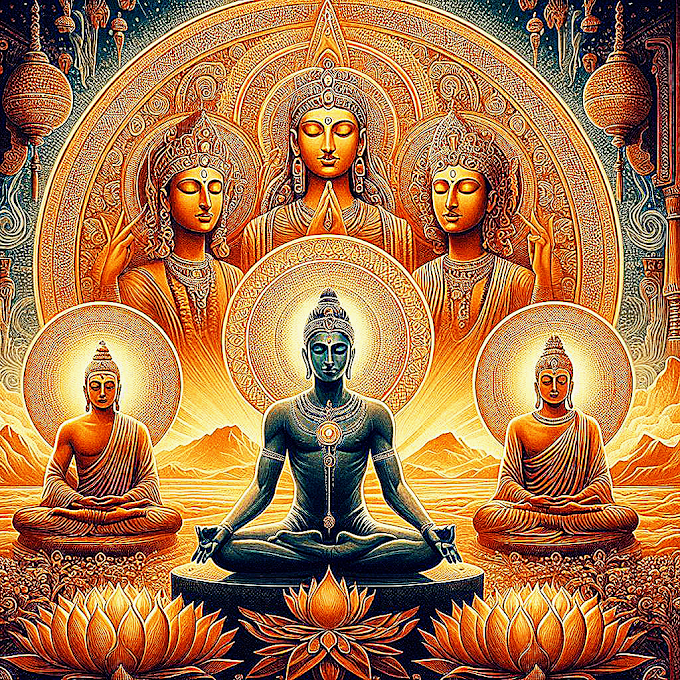
The Concept of Yoga in the Indian Epics explores yoga’s deep spiritual, ethical, and practical teachings through the Mahābhārata and Rāmāyaṇa.
.png) |
| The Concept of Yoga in the Indian Epics |
Yoga, in its deepest sense, is not merely a physical discipline or a set of meditative techniques—it is a holistic spiritual philosophy that integrates body, mind, and soul into the pursuit of liberation (mokṣa). While the Upaniṣads and Yoga Sūtras of Patañjali provide systematic, philosophical blueprints for understanding yoga, the great Indian epics—the Mahābhārata and the Rāmāyaṇa—breathe life into these principles by weaving them into grand narratives of human struggle, dharma, and divine intervention.
In the Mahābhārata, yoga emerges not as an isolated practice, but as a way of being amidst the turbulence of worldly duties. The Bhagavad Gītā, a jewel within the epic, defines yoga in many dimensions: as Karma Yoga (the yoga of selfless action, Gītā 2.47), Jñāna Yoga (the yoga of knowledge, Gītā 4.38), and Bhakti Yoga (the yoga of devotion, Gītā 9.22). Krishna’s exhortation—yogaḥ karmasu kauśalam (“Yoga is skill in action,” Gītā 2.50)—captures the epic’s vision of yoga as the art of living wisely and harmoniously, even on the battlefield of life. The Anugītā and Śānti Parva extend these teachings into contemplative, renunciate dimensions, showing yoga as both inner detachment and outer discipline.
The Rāmāyaṇa, in contrast, embodies yoga through the lives of its characters, where steadfastness in dharma, mastery over the senses, and surrender to the Divine become the yogic path. Rāma’s unwavering adherence to truth (satya) and duty, even in exile, reflects the yogic ideal of equanimity in the face of suffering. Hanumān’s devotion to Rāma exemplifies Bhakti Yoga in its purest form—selfless service rooted in spiritual love. The episode of Rāma’s meditative stillness before battle and the yogic powers (siddhis) displayed by sages like Viśvāmitra and Vasiṣṭha further illustrate yoga as both inner realization and outer capacity.
Together, these epics transform the abstract principles of yoga into lived experiences. They present yoga not merely as ascetic withdrawal but as dynamic engagement with life—whether in the righteous warfare of the Mahābhārata or the moral steadfastness of the Rāmāyaṇa. In doing so, they ensure that yoga remains not only a metaphysical concept but also a timeless, practical guide for seekers in every age.
Yoga in the Mahābhārata: A Multifaceted Discipline
The Mahābhārata, one of the longest and most intricate epics in world literature, is a vast ocean of dharma, philosophy, and spiritual insight. Within its expansive narrative, yoga is presented not as a single, rigid path but as a living, adaptable discipline—an integration of action (karma), knowledge (jñāna), devotion (bhakti), and meditation (dhyāna). The epic recognizes that seekers differ in temperament, capacity, and life circumstances, and thus offers a spectrum of yogic approaches.
The Bhagavad Gītā: Yoga as Spiritual Integration
The Bhagavad Gītā (Bhīṣma Parva, chapters 23–40), embedded within the Mahābhārata, is perhaps the most influential synthesis of yogic thought in the Indian tradition. On the battlefield of Kurukṣetra, Krishna redefines yoga—not as withdrawal from worldly life but as conscious, disciplined engagement with it, guided by spiritual awareness.
1. Karma Yoga — The Yoga of Selfless Action
Krishna instructs Arjuna:
“Karmanye vadhikāras te mā phaleṣu kadācana”
(“You have the right to action alone, never to its fruits,” Gītā 2.47)
Through Karma Yoga, the practitioner performs their svadharma (personal duty) without attachment to success or failure. This discipline purifies the mind by dissolving the ego’s claim over results.
2. Jñāna Yoga — The Yoga of Knowledge
The Gītā affirms that the highest wisdom (jñāna) burns away the bonds of karma:
“Na hi jñānena sadṛśam pavitram iha vidyate”
(“There is nothing as purifying in this world as knowledge,” Gītā 4.38)
Here, yoga is an inner process of discernment (viveka), leading to the realization of the Self’s unity with Brahman.
3. Bhakti Yoga — The Yoga of Devotion
Krishna declares:
“Ananyāś cintayanto māṁ… yoga-kṣemaṁ vahāmy aham”
(“Those who think of Me with undivided devotion… I carry their needs and protect what they have,” Gītā 9.22)
Bhakti Yoga is characterized by complete surrender to the Divine, dissolving the separation between the devotee and God through love and trust.
4. Dhyāna Yoga — The Yoga of Meditation
The Dhyāna Yoga chapter (Gītā 6) lays out the discipline of seated meditation:
“Yogī yuñjīta satatam ātānm rāhasi sthitaḥ”
(“The yogi should constantly engage in meditation, seated in solitude,” Gītā 6.10)
This path cultivates concentration, inner stillness, and direct realization of the Self.
Krishna’s concise definitions—samatvam yoga ucyate (“Yoga is equanimity,” Gītā 2.48) and yogaḥ karmasu kauśalam (“Yoga is skill in action,” Gītā 2.50)—capture the Gītā’s revolutionary vision: yoga is not an escape from life but the art of living it with balance, awareness, and mastery.
By weaving these diverse strands into a single tapestry, the Mahābhārata elevates yoga from a solitary ascetic discipline to a multidimensional way of life—equally relevant to kings, warriors, householders, and renunciates.
 |
| The Concept of Yoga in the Indian Epics |
Mokṣadharma Parva: Yogic Techniques and Liberation
Beyond the Gītā, the Mokṣadharma Parva of the Mahābhārata delves into yogic techniques such as prāṇāyāma, sense control (indriya-nigraha), meditation (dhyāna), and renunciation (sannyāsa). It presents yoga as a path to mokṣa, liberation from the cycle of birth and death. The text emphasizes the importance of citta-vṛtti nirodha—stilling the fluctuations of the mind—as the gateway to self-realization.
As noted in Prekshaa’s analysis, yoga is also equated with mental concentration (cittaikāgrata) and mastery over the senses, echoing the teachings of the Kaṭhopaniṣad. The metaphor of the chariot—where the senses are horses, the mind is the reins, and the intellect is the charioteer—illustrates the yogic journey toward the inner Self (pratyagātma).
Interpreting Yoga in the Mahābhārata: From Vivekananda to Aurobindo
Swami Vivekananda: Yoga as Practical Spirituality and Heroic Action
Swami Vivekananda approached the Mahābhārata, and particularly the Bhagavad Gītā, not as a distant scripture for ascetics alone, but as a living manual for the practical application of yoga in the modern world. His interpretation was deeply rooted in the belief that spirituality and worldly engagement are not contradictory, but complementary. In his lectures on the Gītā, Vivekananda repeatedly emphasized that renunciation is not the abandonment of work, but the renunciation of attachment to its results.
Vivekananda saw Arjuna’s dilemma at Kurukṣetra as the universal human conflict — the paralysis that comes when one’s personal emotions clash with one’s higher duty (svadharma). The yoga that Krishna teaches here, according to Vivekananda, is not a call to retreat to forests and caves, but to stand in the very heart of life’s battles with an awakened spiritual consciousness.
In this reading, the Gītā’s presentation of Karma Yoga — “Karmanye vadhikāras te mā phaleṣu kadācana” (“You have the right to action alone, never to its fruits,” Gītā 2.47) — becomes the foundation for a fearless, service-oriented life. Vivekananda interpreted Karma Yoga not merely as work without selfishness, but as an act of worship, turning every duty into an offering to the Divine.
 |
| The Concept of Yoga in the Indian Epics |
Furthermore, Vivekananda was deeply drawn to the Gītā’s integration of the yogic paths:
- Karma Yoga (selfless action) gives strength of character and detachment.
- Jñāna Yoga (knowledge) sharpens discrimination (viveka) and reveals the unity of the Self with Brahman.
- Bhakti Yoga (devotion) opens the heart and aligns the will with the Divine.
- Dhyāna Yoga (meditation) stills the mind and centers consciousness in the Self.
He often quoted Krishna’s declaration:
“Samatvam yoga ucyate” — “Equanimity is called yoga” (Gītā 2.48)
to show that true yoga is the balance of mind in success and failure, joy and sorrow — the very attitude needed for social reformers, leaders, and anyone facing the storms of life.
For Vivekananda, the Mahābhārata was also a national epic of strength, a reminder that spirituality in India has always been active, not passive. The ideal yogi is not the one who runs away from the world but the one who stands in the marketplace with unshakable inner peace. As he said, “The Gītā is not for the cowards; it is for the strong who can work without selfish motives.” In this light, yoga becomes the science of transforming daily struggle into a means of spiritual growth, precisely the spirit the Mahābhārata dramatizes through its characters.
Sri Aurobindo: Yoga as Evolutionary Transformation
While Vivekananda read the Mahābhārata as a call to integrate spiritual ideals into active life, Sri Aurobindo expanded the vision further, seeing the epic as a cosmic and symbolic drama of humanity’s spiritual evolution. In his Essays on the Gita and other writings in the Renaissance Journal Series, Aurobindo emphasized that the Gītā does not present yoga as a single method or doctrine, but as a comprehensive discipline guiding the transformation of human consciousness toward the Divine.
For Aurobindo, Krishna is not merely a divine incarnation who instructs Arjuna on the ethics of duty — He is the Eternal Teacher (Jagadguru), the indwelling Divine Consciousness that calls humanity to rise from its present state of divided ego-consciousness to a supramental, God-centered existence. Arjuna’s moral crisis, therefore, becomes a symbol of the human soul’s evolutionary struggle — the tension between the pull of the ego’s preferences and the call of the soul’s higher dharma.
Aurobindo read the battlefield of Kurukṣetra as both an outer historical event and an inner battlefield — the field (kṣetra) of human life itself, where conflicting forces of desire, ignorance, truth, and aspiration meet. Yoga, in this interpretation, is the method of aligning one’s individual will with the Divine Will, so that action becomes an instrument of cosmic purpose rather than personal gain.
Yoga as Integral Transformation
Aurobindo’s central insight is that the Gītā’s teaching is integral yoga — not the exclusive pursuit of one path, but the harmonious fusion of Karma, Jñāna, and Bhakti, each elevated and completed by the others. He points to Krishna’s counsel in Gītā 18.66:
“Sarva-dharmān parityajya mām ekaṁ śaraṇaṁ vraja”
(“Abandon all forms of dharma and take refuge in Me alone”)
as the culminating truth — the surrender of the ego to the Divine as the highest yoga.
For Aurobindo, this surrender does not mean passivity; it means becoming a conscious channel for the Divine Shakti in the world. The yogi becomes a center of evolutionary force, working for the transformation of earthly life itself.
The Evolutionary Vision
Aurobindo’s interpretation of yoga in the Mahābhārata is tied to his broader philosophy of spiritual evolution. He sees human history — and by extension, the epic’s narrative — as a progressive unfolding of consciousness. The struggle of the Pāṇḍavas and Kauravas reflects the larger struggle between forces that promote divine order (dharma) and forces that resist it.
Krishna, as the Divine Avatar, intervenes not simply to secure a political victory, but to set in motion a shift in human consciousness. The battlefield becomes a laboratory of transformation, where the seeker is tested until the ego is dissolved and the divine nature can emerge. In this way, yoga is not an escape from the world’s chaos but the very means of redeeming and transforming it.
Aurobindo also drew attention to the Anugītā in the Āśvamedhika Parva, where Krishna reiterates key yogic principles after the war, suggesting that the end goal of yoga is not merely moral action or personal liberation, but the establishment of a divine life on earth. This ties the epic’s teaching directly to his own vision of a Supramental transformation — the emergence of a humanity rooted in divine consciousness.
Synthesis: From Heroic Action to Cosmic Transformation
When we place Vivekananda and Aurobindo’s readings side by side, a powerful continuum emerges:
- Vivekananda calls the seeker to heroic action in the world, free from selfishness and fear.
- Aurobindo calls the seeker to integral transformation, where action becomes part of an evolutionary process toward a divine world-order.
Both agree that the Mahābhārata, and particularly the Bhagavad Gītā, offers yoga not as monastic withdrawal but as engaged spirituality — an approach that sanctifies the arena of life as the very place of liberation.
Through their interpretations, we see that the Mahābhārata’s yoga is not confined to meditation halls or ascetic retreats. It is the yoga of kings and warriors, of householders and sages, of every human soul caught in the battle between ignorance and truth. It is the art of living in the world without being bound by it, and the science of transforming that world into an expression of the Divine.
Yoga in the Rāmāyaṇa: Dharma, Devotion, and Spiritual Allegory
The Rāmāyaṇa, though more linear in narrative than the Mahābhārata, is no less profound in its yogic symbolism. Across its seven kāṇḍas (books), the epic presents a seamless integration of ethical action, spiritual discipline, and devotional surrender, offering what can be called the dharmic dimension of yoga. If the Mahābhārata dramatizes the battlefield of the mind, the Rāmāyaṇa unfolds the pilgrimage of the soul through trials of righteousness, love, loyalty, and sacrifice.
 |
| The Concept of Yoga in the Indian Epics |
Rāma: The Embodiment of Dharma Yoga
Śrī Rāma, the ideal king (maryādā-puruṣottama) and avatāra of Viṣṇu, personifies Dharma Yoga — the path of aligning one’s life with truth (satya), duty (svadharma), and compassion (dayā). His life is not just a moral tale but a demonstration of yogic self-mastery in action.
When ordered to spend fourteen years in exile, Rāma accepts the command without resentment, saying to Kaikeyī:
“Na me pāpaṁ pratiyātam, pitṛ-vākyaṁ na laṅghitam”
(“Let no sin come to me; my father’s word shall not be broken”)
This acceptance mirrors the Bhagavad Gītā’s samatvam — equanimity in the face of gain or loss (Gītā 2.48) — and shows that for Rāma, yoga is not separate from dharma; rather, dharma is yoga lived in the world.
Rāma’s unwavering commitment to truth and justice, even when it causes personal loss, reflects the yogic principle of niṣkāma karma — selfless action free from personal attachment.
Hanumān: The Quintessence of Bhakti Yoga
Hanumān stands as perhaps the most beloved symbol of Bhakti Yoga in the Indian tradition. His strength (bala), fearlessness (abhaya), and humility (vinaya) are all grounded in his single-pointed devotion (ananya-bhakti) to Rāma. In the Sundara Kāṇḍa, before leaping across the ocean to Lanka, he invokes Rāma’s name — showing that for the Bhakta Yogi, divine remembrance (nāma-smaraṇa) is the source of all power.
Many yogic traditions also regard Hanumān as a mahāsiddha, accomplished in Haṭha Yoga. His control over breath (prāṇāyāma), mind (manonigraha), and body mirrors the yogic mastery outlined in the Yoga Sūtras. His giant leap over the ocean is often read symbolically as the yogi’s crossing over the sea of illusion (māyā) toward divine union (mokṣa).
Hanumān’s famous declaration in the Rāmcaritmānas —
“Deha-buddhyā tvad dāso’smi, jīva-buddhyā tvad aṁśakaḥ”
(“By body-consciousness, I am Your servant; by soul-consciousness, I am a part of You”)
perfectly captures the Bhakti Yoga doctrine: to serve the Divine outwardly while realizing inwardly one’s essential unity with Him.
Yogic Themes Interwoven in the Rāmāyaṇa
Beyond its central characters, the Rāmāyaṇa is woven with numerous yogic ideals that appear in the form of narrative episodes and archetypes:
- Renunciation (Vairāgya) — Rāma’s exile is a powerful metaphor for detachment from worldly comforts. Just as a yogi voluntarily withdraws from sensory indulgence, Rāma steps away from the luxuries of Ayodhyā to uphold righteousness.
- Tapas and Meditation (Dhyāna Yoga) — The sages encountered by Rāma, such as Vasiṣṭha, Viśvāmitra, and Agastya, embody the transformative power of austerity (tapas) and meditative concentration. Viśvāmitra’s journey from king to Brahmarṣi mirrors the yogic ascent from worldly ambition to spiritual realization.
- Unity of Self and Dharma — Rāma’s life demonstrates that true yoga is the harmony between the individual will and the cosmic order (ṛta). His choices reflect the yogic state in which ethical conduct flows naturally from an inner alignment with truth.
- Devotion as Liberation — The relationship between Rāma and his devotees — Hanumān, Sabari, Vibhīṣaṇa — reflects the Bhakti Yoga insight that loving surrender is itself a liberating force, capable of transcending social and karmic limitations.
Interpreting Yoga in the Rāmāyaṇa: From Vivekananda to Aurobindo
Swami Vivekananda: Rāmāyaṇa as a Manual of Dharma in Action
For Swami Vivekananda, the Rāmāyaṇa was not just a story of ancient kings, wars, and miracles — it was a living scripture of applied yoga in daily life, especially through the path of dharma (Dharma Yoga) and devotion (Bhakti Yoga). He regarded Rāma as the supreme example of how spiritual ideals must be upheld even in the most challenging circumstances, and Hanumān as the embodiment of selfless service and unwavering loyalty to the Divine.
Vivekananda often highlighted that Rāma’s yoga was not about renunciation in the ascetic sense — he did not retreat from his duties as a prince, husband, and leader. Instead, Rāma’s renunciation was internal: the detachment from personal desires, even when those desires were in harmony with social norms. His acceptance of exile without bitterness — “pitṛ-vākyaṁ na laṅghitam” (“My father’s word shall not be broken”) — illustrates what the Bhagavad Gītā calls niṣkāma karma (selfless action), where one’s duty is performed without attachment to results (Gītā 2.47).
Swami Vivekananda often used Hanumān as a model for his disciples, saying that the ideal spiritual aspirant should have the strength of the lion and the heart of a child. Hanumān’s yoga was one of total surrender (śaraṇāgati), but it was an active surrender. He did not simply pray to Rāma for liberation; he acted as the Divine’s instrument in the world — leaping over the ocean, burning Lanka, bringing the sañjīvanī herb to save Lakṣmaṇa. This is Bhakti Yoga in action: love translated into tireless service.
Vivekananda also pointed to the Araṇya Kāṇḍa and Kiṣkindhā Kāṇḍa as yogic allegories of strength, loyalty, and purity. The forest exile, he said, is the yogi’s retreat from worldly distractions; the alliance with Sugrīva and Hanumān represents the gathering of inner and outer forces needed for the spiritual quest; the bridge to Lanka (setu-bandha) is the building of concentration that allows the aspirant to cross the ocean of illusion (māyā).
In this reading, the Rāmāyaṇa becomes a handbook for righteous living: Rāma as the steadfast dharmayogi, Hanumān as the tireless bhaktiyogi, and Sītā as the soul’s pure devotion and endurance. Vivekananda’s message is clear — yoga is not withdrawal but the purification of one’s duties, relationships, and actions until they become offerings to the Divine.
 |
| The Concept of Yoga in the Indian Epics |
Sri Aurobindo: Rāmāyaṇa as Spiritual Allegory and Evolutionary Yoga
Sri Aurobindo’s interpretation deepens and expands this view, moving from the ethical and devotional dimensions of yoga to a cosmic and psychological reading. In his writings on Indian epics, he regards the Rāmāyaṇa not merely as an account of divine incarnation but as an archetypal drama of the soul’s journey toward union with the Divine, a theme echoed throughout The Concept of Yoga in the Indian Epics.
Characters as Archetypes of the Inner Journey
In Aurobindo’s framework, every principal figure of the Rāmāyaṇa represents a force or principle within the seeker’s inner life:
- Rāma — the Divine Will, Truth, and guiding Light of dharma (ṛta). He is not only an avatāra in the external sense but also the indwelling īśvara (Lord) in the human heart. His decisions, however painful, are governed not by preference but by the higher law.
- Sītā — the jīva (individual soul), pure and luminous, yet susceptible to separation from the Divine due to the forces of illusion and desire. Her abduction by Rāvaṇa symbolizes the soul’s captivity in the lower nature.
- Rāvaṇa — the titanic ego, brilliant yet dominated by lust, pride, and ambition. He personifies the asuric (anti-divine) energies that seek to control the soul.
- Hanumān — the force of divine devotion and energy (śakti) that bridges the gulf between the finite human and the infinite Divine. He is the aspirant’s faith, courage, and power of action.
The Journey from Ayodhyā to Lanka: The Soul’s Pilgrimage
In this vision, the Rāmāyaṇa becomes an inward map of the yogic path.
- Ayodhyā (Harmony and Origin) — The city of Ayodhyā,
symbolizing the ordered state of consciousness in alignment with dharma, represents the soul’s original harmony before the disturbances of desire and ignorance.
- Exile (Araṇya-vāsa) — Detachment and Preparation
The exile into the forest is the yogi’s deliberate withdrawal from the distractions of worldly life (vairāgya). Here, Rāma meets sages like Atri, Agastya, and Śarabhaṅga, whose tapas (austerity) reflects the yogic disciplines of purification and concentration.
- Abduction of Sītā — The Fall into Ignorance
Rāvaṇa’s capture of Sītā is the soul’s descent into bondage. The seeker, separated from the Divine consciousness, must now undergo trials to restore that union.
- Alliance with Hanumān and the Vānaras — Awakening of Aspiration
The meeting with Hanumān is the awakening of the dynamic, devotional force that enables the yogi to act with courage and faith. The vānaras, half-divine beings, represent the yet-unrefined but aspiring energies of the human nature.
- Building the Bridge to Lanka (Setu-bandha) — Concentration and Will
The bridge over the sea of illusion (māyā-sāgara) is built plank by plank, stone by stone — just as the yogi builds concentration and resolve through steady practice (abhyāsa).
- Battle with Rāvaṇa — The Inner War
The climactic battle is the yogi’s confrontation with the ego and the hostile forces. Victory comes only when the seeker’s entire being is surrendered to the Divine Will.
- Return to Ayodhyā — Restoration and Divine Life
The soul, reunited with the Divine, returns to its rightful place — ruling the kingdom of consciousness with wisdom, love, and truth.
Yoga as Transformation, Not Escape
Aurobindo emphasizes that the yoga of the Rāmāyaṇa is not about escaping the world into solitary meditation. Just as in the Mahābhārata, the arena of transformation is life itself. The trials Rāma faces — political intrigue, personal loss, war — are not obstacles to yoga but the very conditions through which yoga matures.
This vision aligns with the teaching in the Mahābhārata (Śānti Parva) that the highest yoga is the harmonization of spiritual realization with the fulfillment of one’s duties. Aurobindo sees Rāma as a yogī-king, whose life is the balance of transcendence and immanence, renunciation and rule.
The Integral Yogic Message of the Rāmāyaṇa
From Aurobindo’s perspective, the Rāmāyaṇa’s enduring power lies in its integral yogic message:
- Like Rāma, the seeker must anchor themselves in dharma, guided by the Divine Will rather than personal preference.
- Like Sītā, the soul must preserve its purity through trials, holding to the remembrance of the Divine.
- Like Hanumān, the aspirant must combine humility with boundless energy in service of the Divine.
- And like the battle against Rāvaṇa, the inner war must be fought until all forces hostile to the Divine are transformed or dissolved.
This reading turns the Rāmāyaṇa into a universal spiritual handbook — a companion for the yogi navigating the exile of ignorance, the battles of self-mastery, and the return to the kingdom of the spirit.
Synthesis: Vivekananda and Aurobindo in Dialogue
When seen together, Vivekananda and Aurobindo’s interpretations form a continuum of meaning:
- Vivekananda gives us the Rāmāyaṇa as a practical dharma-yoga manual — a guide for living with strength, devotion, and moral clarity in the world.
- Aurobindo offers the Rāmāyaṇa as a cosmic allegory of integral yoga — a vision of the soul’s evolutionary journey toward divine consciousness.
Both converge on the insight that yoga, as dramatized in the Rāmāyaṇa, is not confined to ashrams or forests; it is woven into the very fabric of life’s trials and triumphs.
The Rāmāyaṇa’s Yogic Legacy
The Rāmāyaṇa does not teach yoga through explicit philosophical discourse, as the Gītā does, but through the living example of its characters and the moral arc of its story. It shows that yoga is not confined to forest hermitages or meditation halls but is lived in palaces, battlefields, and exile alike. Its message is timeless: the practice of yoga is the art of living in harmony with truth, devotion, and self-mastery, transforming the ordinary journey of life into a path toward the eternal.
Philosophical Depth and Practical Relevance
The Indian epics portray yoga not as an isolated ascetic discipline confined to forests and hermitages, but as a dynamic art of living amidst the complexity of worldly duties. In The Concept of Yoga in the Indian Epics, it is emphasized that the great narratives of the Mahābhārata and Rāmāyaṇa dramatize yoga as an integrated way of life—an ever-active balance between inner mastery and outer engagement.
At the heart of this vision are four interwoven principles:
Indriya-nigraha (control of the senses):
In the Mahābhārata, the discipline of sense-control is repeatedly presented as the first step toward dharmic action. Vidura, in his celebrated Vidura-nīti, warns that an uncontrolled mind and senses lead even the mightiest heroes to downfall. Arjuna’s dialogue with Krishna in the Bhagavad Gītā (2.58–2.68) vividly illustrates this—likening the yogi to a tortoise withdrawing its limbs, symbolizing mastery over sensory temptations while still engaging in the world.
Citta-vṛtti-nirodha (stilling the fluctuations of the mind):
This Patanjalian ideal is embodied in the epic through moments of profound inner steadiness in the midst of chaos. In the Rāmāyaṇa, Rama’s unwavering composure when exiled to the forest reflects not passivity, but a yogic mind free from agitation. In the Mahābhārata, Bhishma, lying on the bed of arrows, delivers the Śānti Parva discourses in a state of mental serenity—demonstrating that yoga’s inner stillness can be attained even on a battlefield.
Ātma-jñāna (self-knowledge):
The epics repeatedly show that dharma without self-knowledge can become mechanical, and renunciation without self-awareness can turn escapist. Yudhishthira’s long journey toward understanding the nature of truth and justice—tested through the dice game, exile, and moral dilemmas—represents a gradual flowering of ātma-jñāna. The Gītā (4.39) affirms that the man of faith who has mastered his senses and is devoted to truth attains knowledge, and with it, supreme peace.
Īśvara-praṇidhāna (surrender to the Divine):
The highest culmination of yoga in the epics is a willing alignment of human will with divine purpose. In the Mahābhārata, Arjuna’s act of laying down his bow in despair (Gītā 1.47) is not weakness—it is the necessary breaking of ego that allows Krishna’s divine guidance to flow in. Similarly, in the Rāmāyaṇa, Hanuman’s every act—whether leaping across the ocean or bowing before Sita—is suffused with a total surrender that transforms service into spiritual heroism.
 |
| The Concept of Yoga in the Indian Epics |
Through these living examples, the epics demonstrate that yoga is not merely a meditative withdrawal but a disciplined engagement with life, guided by higher principles. Heroes and sages do not only preach these ideals; they embody them through action (karma), wisdom (jñāna), and devotion (bhakti).
As The Concept of Yoga in the Indian Epics points out, this integration is what gives epic yoga its enduring relevance: it is simultaneously a philosophical doctrine, a moral compass, and a practical methodology for navigating the tensions between personal desire, social responsibility, and spiritual aspiration. The battlefield (Kurukṣetra), the forest exile, the royal court, and the hermitage—all become sacred spaces where yoga is tested, refined, and ultimately realized.
Conclusion: Yoga as a Living Tradition
The concept of yoga in the Indian epics is vast, nuanced, and deeply transformative. It is not confined to postures or techniques but encompasses the entire spectrum of human experience—from ethical dilemmas and emotional struggles to divine communion and liberation.
Through the Mahābhārata and Rāmāyaṇa, yoga is revealed as a sacred technology of consciousness, a path that integrates karma, jñāna, and bhakti into a unified pursuit of truth. Sri Aurobindo’s interpretations further illuminate this vision, showing that yoga is not a retreat from life but a deeper engagement with it—an evolutionary ascent from the human to the divine.
In today’s world, where yoga is often reduced to fitness routines, the Indian epics invite us to rediscover its original essence: a journey of the soul, a discipline of transformation, and a celebration of the eternal Self.
Reference
- Primary Texts (Epic and Yogic Scriptures)
-
Mahābhārata
-
Critical Edition by Bhandarkar Oriental Research Institute
-
Bhagavad Gītā (within Mahābhārata), especially chapters 2, 3, 6, and 12
-
Rāmāyaṇa
-
Valmiki Rāmāyaṇa, translated by Robert P. Goldman (Clay Sanskrit Library)
-
Rāmāyaṇa Kāṇḍas on Dharma, Bhakti, and Yoga
-
Yoga Sūtras of Patañjali
-
Upanishads (e.g., Katha, Chandogya, Brihadaranyaka)
- Secondary Sources and Scholarly Works
-
R. K. Sharma, “Yoga in the Indian Epics” — Journal of Indian Philosophy
-
David Frawley, “Yoga and the Indian Tradition” (Motilal Banarsidass, 1999)
-
K. S. R. Murthy, “Philosophy of the Mahābhārata” (Motilal Banarsidass, 1987)
-
Sri Aurobindo, “Essays on the Gita” (Pondicherry: Sri Aurobindo Ashram, 1942)
-
Swami Vivekananda, “The Complete Works of Swami Vivekananda” (Advaita Ashrama)
-
Bibek Debroy (translator), “The Mahābhārata” (Penguin Classics, 2010)
-
Alain Daniélou, “The Myths and Gods of India”
Articles and Essays
-
The Concept of Yoga in the Indian Epics — available in collected volumes or university theses focusing on yoga philosophy and epic literature (check JSTOR or Project MUSE for academic papers).
-
Articles in International Journal of Hindu Studies and Journal of Indian Philosophy often cover yoga themes in epics.
FAQ
Q1. What is the concept of yoga in ancient India?
Ans: Yoga in ancient India was a holistic discipline aimed at uniting the individual self (ātman) with the universal consciousness (Brahman). It encompassed paths like karma, jñāna, bhakti, and rāja yoga to cultivate self-mastery, inner peace, and liberation.
Q2. Is yoga mentioned in Mahabharata?
Ans: Yes, yoga is mentioned in the Mahābhārata, especially in the Bhagavad Gītā, where it’s defined as a path to unite the individual ātman with the universal Brahman. It includes karma, jñāna, bhakti, and rāja yoga as means to attain liberation.
Q3. How many types of yoga are there in India?
Ans: India traditionally recognizes four main types of yoga: Karma Yoga (action), Jñāna Yoga (knowledge), Bhakti Yoga (devotion), and Rāja Yoga (meditation). Each offers a distinct path to spiritual liberation based on temperament and practice.
Q4. What are the key concepts of yoga philosophy?
Ans: Yoga philosophy centers on union of the self (ātman) with the universal consciousness (Brahman) through disciplined practice. Its core principles include sense control (indriya-nigraha), mental stillness (citta-vṛtti-nirodha), self-knowledge (ātma-jñāna), and surrender to the Divine (īśvara-praṇidhāna).
Q5. What is Indian yoga called?
Ans: Indian yoga is traditionally called "Yoga" (योग), derived from the Sanskrit root yuj, meaning "to unite" or "to join." It refers to the union of the individual self (ātman) with the universal consciousness (Brahman).
Q6. What is the history of yoga and its benefits?
Ans: Yoga originated in ancient India over 5,000 years ago as a spiritual discipline for self-realization and union with the Divine. Its benefits include enhanced physical health, mental clarity, emotional balance, and liberation from suffering.


.png)


.png)