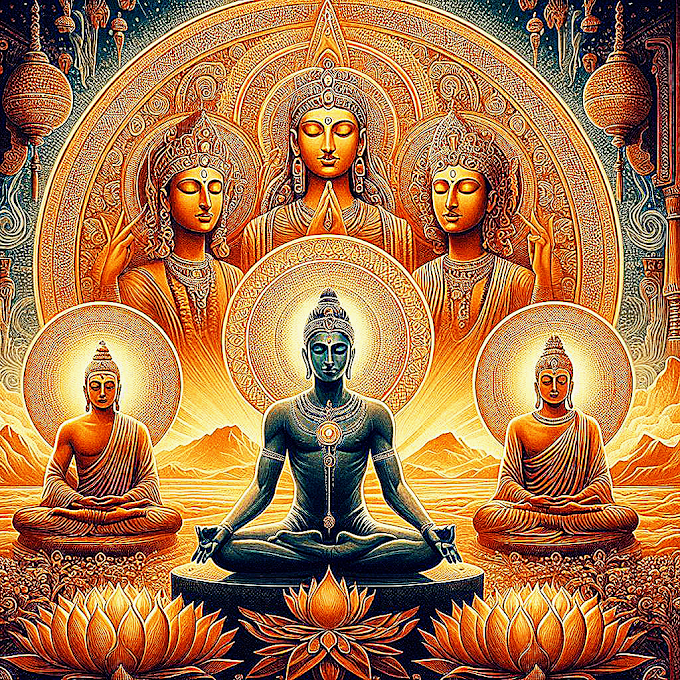
.png)
Explore yoga in the Upanishads, a spiritual path using prana and meditation to unite the self (Ātman) with ultimate reality (Brahman) for liberation.
.png) |
| Yoga in the Upanishads: The Path of Unification |
The Path of Unification: Yoga in the Upanishads
In the modern lexicon, "yoga" often evokes images of physical postures, wellness routines, and lifestyle branding. Yet, to trace yoga back to its textual roots in the Upanishads is to rediscover a discipline of staggering spiritual ambition and metaphysical depth. Far from being a mere system of physical fitness, yoga in the Upanishads is a sacred science of inner transformation—a methodical path (sādhanā) for realizing the ultimate truth of existence: the non-dual identity of the individual self (Ātman) with the absolute reality (Brahman).
The Upanishads, especially the twenty Yoga Upanishads, articulate a holistic framework where mastery over body, breath, and mind is not the goal but the gateway. These faculties are refined and harnessed to transcend empirical consciousness and attain mokṣa—liberation from the cycle of birth and death (saṃsāra). As the Kaṭha Upaniṣad declares, yoga is “the firm control of the senses,” a vigilant turning inward that culminates in the highest state of stillness and awareness.
Drawing from the Yoga Upanishads—including texts like Yogatattva, Amṛtabindu, Nadabindu, and Yogakundalini—we find a structured spiritual technology that integrates breath control (prāṇāyāma), subtle body purification, sound meditation (nāda yoga), and deep absorption (samādhi). These texts do not merely theorize; they offer precise techniques for awakening dormant energies, piercing psychic centers (chakras), and merging the finite with the infinite.
The Upanishadic yogi is not a seeker of bodily perfection but a voyager into the depths of consciousness. Through disciplined practice, the yogi purifies the nāḍīs (energy channels), awakens Kuṇḍalinī, and ascends through the Suṣumṇā to unite with Śhiva—the pure consciousness at the crown. Meditation on OṂ, as elaborated in the Māṇḍūkya Upaniṣad, becomes the sonic vehicle for transcending the waking, dreaming, and deep sleep states to reach turīya, the fourth and ineffable state of pure awareness.
In essence, the yoga of the Upanishads is a journey from fragmentation to unity, from illusion to truth. It is a razor’s edge path, demanding unwavering discipline and inner vigilance. But for those who walk it, it promises the highest attainment: the freedom of immortality, the bliss of merging with Brahman.
The Philosophical Bedrock: From Classical to Yoga Upanishads
The philosophical foundation of yoga is firmly rooted in the early, principal Upanishads—texts that form the spiritual core of Vedānta. These ancient dialogues explore the nature of reality and consciousness, culminating in the central tenet: the essential oneness of Ātman (the individual self) and Brahman (the absolute reality). The Chāndogya Upaniṣad famously declares Tat Tvam Asi ("That Thou Art"), a mahāvākya that encapsulates the radical non-duality at the heart of yogic inquiry.
Yet this truth is obscured by māyā—the cosmic illusion—and its individual manifestation, avidyā (ignorance), which causes one to misidentify with the transient body-mind complex. The result is saṃsāra, the relentless cycle of birth, death, and rebirth, fueled by attachment and delusion. Liberation (mokṣa) is not merely intellectual understanding but the direct, experiential realization of one's true nature—a state beyond thought, form, and separation.
The Kaṭha Upaniṣad (2.3.10–11) offers one of the earliest definitions of yoga in this context:
“When the five senses of perception, together with the mind, cease from their normal activities and the intellect itself stands still, that, they say, is the highest state. This firm control of the senses, they call Yoga. One must then be vigilant; for yoga is acquired and lost.”
Here, yoga is not a posture but a profound stillness—a turning inward (pratyāhāra) and a mastery of attention (dhāraṇā), culminating in the dissolution of duality.
While the classical Upanishads articulate the metaphysical why of the spiritual quest, the later Yoga Upanishads—twenty in number—focus on the how. These specialized texts, such as the Yogatattva, Yogakundalini, Amṛtabindu, and Nadabindu Upanishads, serve as practical manuals for inner transformation. They systematize the philosophical insights into a structured, multi-limbed path (aṣṭāṅga yoga), detailing techniques like:
- Prāṇāyāma: Breath control to purify the subtle body and regulate life force.
- Nāda Yoga: Meditation on inner sound vibrations to transcend mental fluctuations.
- Kuṇḍalinī Awakening: Activation of latent spiritual energy through disciplined practice.
- Chakra Navigation: Mapping and energizing psychic centers along the Suṣumṇā nāḍī.
- Samādhi: Absorption into pure consciousness, the final goal of yogic practice.
These texts, as translated by G. Srinivasa Ayyangar, preserve the Sanskrit originals alongside English commentary, offering a rare glimpse into the esoteric dimensions of yoga that predate and complement later systems like Patañjali’s Yoga Sūtras.
In essence, the Yoga Upanishads bridge the gap between metaphysical insight and embodied practice. They transform yoga from a philosophical aspiration into a lived reality—a sacred technology for awakening, liberation, and union with the infinite.
 |
| Yoga in the Upanishads: The Path of Unification |
The Anatomy of the Path: The Limbs of Upanishadic Yoga
In the vast landscape of yogic literature, the Yoga Upanishads stand as luminous beacons of esoteric wisdom. Composed between 100 BCE and 1100 CE, these twenty specialized texts form a bridge between the metaphysical insights of the principal Upanishads and the practical methodologies of later yogic systems like Hatha and Raja Yoga. Unlike the Yoga Sūtras of Patañjali, which codify yoga into eight limbs (aṣṭāṅga), the Yoga Upanishads present a more fluid, integrative approach—one that blends breath, sound, energy, and consciousness into a cohesive path toward liberation.
1. Prāṇāyāma: Mastery of the Life-Force
At the heart of Upanishadic yoga lies Prāṇa—the vital life-force that animates all beings and connects the physical body to the subtle mind. The Yogatattva Upaniṣad offers detailed instruction on Prāṇāyāma, describing its three phases: pūraka (inhalation), kumbhaka (retention), and rechaka (exhalation). Of these, kumbhaka is considered the most potent, as it stills the breath and, by extension, the mind.
The Amṛtabindu Upaniṣad (Verse 6) declares:
“The mind is of two kinds: pure and impure. The impure is driven by desire; the pure is free from desire. The mind alone is the cause of bondage and liberation.”
This teaching underscores the transformative power of breath regulation—not merely as a physiological exercise, but as a gateway to mental purification and spiritual awakening. When the breath is stilled, the fluctuations of the mind (vṛttis) subside, creating space for inner silence and clarity.
READ MORE:
2. The Subtle Body: Nāḍīs and Chakras
The Yoga Upanishads describe a sophisticated energetic anatomy, comprising 72,000 nāḍīs (channels) through which Prāṇa flows. Among these, three are paramount:
- Iḍā: The left channel, lunar and cooling
- Piṅgalā: The right channel, solar and heating
- Suṣumṇā: The central channel, dormant in ordinary consciousness
As long as Prāṇa flows unevenly through Iḍā and Piṅgalā, the mind remains tethered to duality. The goal of Prāṇāyāma is to harmonize these channels, thereby awakening Suṣumṇā. Once activated, Prāṇa ascends through this central channel, piercing the chakras—psychic centers that represent stages of consciousness and spiritual potential.
The Yogakundalini Upaniṣad offers a vivid account of this ascent, describing the awakening of Kuṇḍalinī, the coiled serpent energy at the base of the spine (Mūlādhāra chakra). As Kuṇḍalinī rises through the Suṣumṇā, she pierces each chakra until she unites with Śhiva—pure consciousness—at the crown (Sahasrāra). This energetic union mirrors the philosophical realization of Ātman merging with Brahman.
3. Dhyāna and Dhāraṇā: The Yoga of Sound and Light
With the subtle body purified and the breath stabilized, the yogi turns inward through dhāraṇā (concentration) and dhyāna (meditation). A central technique in the Yoga Upanishads is Nāda Yoga—the yoga of inner sound. The Nadabindu Upaniṣad instructs practitioners to sit in a stable posture, adopt specific mudrās, and listen for subtle internal sounds that arise as consciousness deepens.
These sounds evolve from gross to subtle:
- Oceanic roar
- Flute-like tones
- Bell chimes
- Bee hum
- Silence
Eventually, all sounds dissolve into the Praṇava—the sacred syllable OṂ. The Māṇḍūkya Upaniṣad analyzes OṂ as the embodiment of four states of consciousness:
- A: Waking
- U: Dreaming
- M: Deep sleep
- Silence: Turīya, the transcendent fourth state
Meditating on OṂ becomes a direct method for experiencing these states and realizing the non-dual awareness that underlies them all. This is the essence of Pranava Yoga—a path that uses sound as a vehicle for transcendence.
 |
| Yoga in the Upanishads: The Path of Unification |
Samādhi: The Crown of Yogic Practice
In the sacred architecture of Upanishadic yoga, Samādhi stands as the pinnacle—the final and most sublime limb of the spiritual ascent. It is not merely a meditative state, but the culmination of a transformative journey through breath, energy, sound, and consciousness. The Yogatattva Upaniṣad describes Samādhi as the union of jīva (individual soul) and paramātman (supreme soul), a state in which all mental modifications (vṛttis) cease and the yogi abides in pure awareness.
Unlike trance or unconscious stillness, Samādhi is a luminous state of blissful self-realization. It is the experiential confirmation of the great mahāvākyas of Vedānta—Tat Tvam Asi (“That Thou Art”) and Aham Brahmāsmi (“I am Brahman”). In this state, the yogi does not merely understand these truths intellectually; they become a living embodiment of them.
The Tejobindu Upaniṣad elaborates that in Samādhi, the yogi transcends the limitations of the body, mind, and senses. The ego dissolves, and the distinction between the meditator, the object of meditation, and the act of meditation vanishes. What remains is turīya—the fourth state of consciousness described in the Māṇḍūkya Upaniṣad—a state beyond waking, dreaming, and deep sleep. It is pure, non-dual awareness.
This realization is not accidental. It is the fruit of disciplined practice: the regulation of Prāṇa through Prāṇāyāma, the purification of the nāḍīs, the awakening of Kuṇḍalinī, and the deepening of Dhyāna through Nāda Yoga. Each step prepares the aspirant to enter Samādhi, where the finite merges with the infinite.
The Kaṭha Upaniṣad offers a sobering reminder:
“This path is as difficult as walking on the sharp edge of a razor.” It demands unwavering vigilance, inner purity, and surrender. But for those who persevere, Samādhi is not just liberation from saṃsāra—it is the realization of immortality, the return to one’s eternal nature.
In the context of the twenty Yoga Upanishads, Samādhi is not an abstract ideal but a lived reality. These texts, as translated by G. Srinivasa Ayyangar, preserve both the Sanskrit originals and the philosophical commentaries that illuminate the path. They reveal that yoga is not a practice confined to the mat or the monastery—it is a sacred technology of consciousness, a razor’s edge path to the Self.
Integration and Legacy
The Yoga Upanishads do not present yoga as a rigid system but as a living, evolving discipline. They synthesize elements of Mantra Yoga, Laya Yoga, Hatha Yoga, and Raja Yoga, offering a multidimensional path that engages body, breath, sound, and consciousness. Their teachings laid the groundwork for later texts like the Hatha Yoga Pradīpikā, which echoes many Upanishadic principles.
In a world where yoga is often reduced to postures and fitness, the Yoga Upanishads invite us to rediscover its original purpose: the inner journey toward truth, unity, and liberation. They remind us that yoga is not merely something we do—it is something we become.
The Yoga of the Upanishads: A Razor’s Edge to Immortality
In the sacred corridors of the Upanishads, yoga is not merely a practice—it is a revelation. It is a journey from the tangible to the intangible, from the fragmented self to the indivisible whole. The Yoga Upanishads, a collection of twenty profound texts nestled within the broader Vedantic tradition, offer a roadmap for this inner pilgrimage. They do not concern themselves with physical prowess or external rituals, but with the alchemy of consciousness.
This yoga begins with the body and breath—not to glorify them, but to transcend them. Through Prāṇāyāma, the yogi harnesses the life force (Prāṇa) and purifies the subtle channels (nāḍīs) that weave through the energetic body. The Tejobindu Upanishad and Amritabindu Upanishad speak of the mind as both the source of bondage and liberation, emphasizing the need for unwavering focus and inner stillness.
Meditation (Dhyāna) becomes the gateway to Samādhi, a state of absorption where duality dissolves. The Nādabindu Upanishad introduces the concept of inner sound (Nāda) as a vehicle for transcendence, while the Yogashikha Upanishad explores the awakening of Kundalini, the dormant spiritual energy coiled at the base of the spine.
The ultimate goal is not self-improvement, but self-erasure—the dissolution of the ego into the infinite ocean of Brahman. As the Kaṭha Upaniṣad warns, this path is “as difficult as walking on the sharp edge of a razor.” It demands discipline, vigilance, and surrender. Yet for those who persevere, it offers the highest reward: mokṣa, the liberation from the cycle of birth and death, and the realization of one’s true nature as pure, undivided consciousness.
The Yoga Upanishads are not relics of a forgotten past—they are living texts, whispering timeless truths to those ready to listen. They remind us that yoga is not something we do, but something we become. It is the art of returning home to the Self.
FAQ
Q1. What is the concept of yoga in the Upanishads?
Ans: In the Upanishads, yoga is a spiritual discipline aimed at realizing the non-dual unity of Ātman (self) and Brahman (absolute reality). It involves inner purification through breath, mind control, and meditation to attain liberation (mokṣa).
Q2. What is the main concept of the Upanishads?
Ans: The main concept of the Upanishads is the realization of the ultimate unity between the individual soul (Ātman) and the universal consciousness (Brahman). They emphasize self-knowledge, inner experience, and liberation from the cycle of rebirth.
Q3. What is the main concept of yoga?
Ans: The main concept of yoga is the union of body, mind, and spirit to achieve inner peace and self-realization. It involves disciplined practices like meditation, breath control, and ethical living to transcend ego and attain liberation.
Q4. How many Upanishads are there in yoga?
Ans: There are 20 Yoga Upanishads among the 108 Upanishads listed in the Muktika anthology. These focus specifically on yogic philosophy, techniques, and spiritual practices.
Q5. What are the main Upanishads?
Ans: The main or principal Upanishads—often referred to as the Mukhya Upanishads—are traditionally considered the most philosophically significant. These include:
| Upanishad Name | Associated Veda |
|---|---|
| Isha (Īśāvāsya) | Shukla Yajur Veda |
| Kena | Sama Veda |
| Katha | Krishna Yajur Veda |
| Prashna | Atharva Veda |
| Mundaka | Atharva Veda |
| Mandukya | Atharva Veda |
| Taittiriya | Krishna Yajur Veda |
| Aitareya | Rig Veda |
| Chandogya | Sama Veda |
| Brihadaranyaka | Shukla Yajur Veda |
These ten are widely studied and form the foundation of Vedantic philosophy.
Q6. What is the golden rule of yoga?
Ans: The golden rule of yoga is Ahimsa, or non-violence—practicing with compassion toward yourself and others.
It means honoring your body, avoiding harm, and embracing mindfulness over perfection.


.png)