.png)
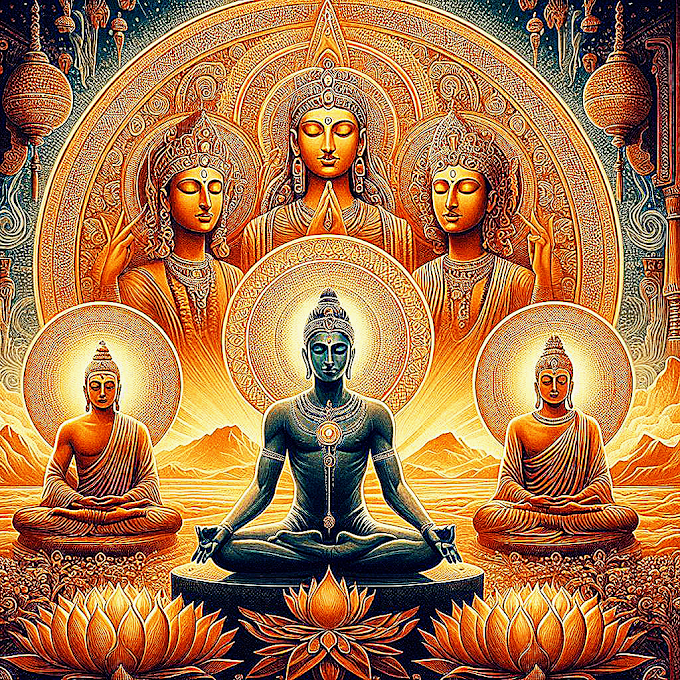
Explore the concept of Yoga in the Puranas, tracing its evolution from Upanishadic philosophy to devotional and mythic expressions of union.
.png) |
| The Concept of Yoga in the Puranas: A River’s Journey |
In the vast and intricate tapestry of Indian spiritual thought, Yoga stands not merely as a practice, but as a profound paradigm—a luminous thread weaving together metaphysics, mythology, psychology, and lived devotion. Far beyond the modern emphasis on physical postures and wellness routines, Yoga's true origins lie in the sacred pursuit of ultimate reality, the timeless yearning to transcend the ephemeral and merge with the eternal.
This spiritual odyssey unfolds across two majestic rivers of scripture: the Upanishads and the Puranas. The Upanishads, austere and contemplative, offer the metaphysical blueprint of Yoga. They probe the nature of consciousness, the illusion of separateness, and the disciplined inward journey toward moksha—liberation from the cycle of birth and death. Here, Yoga is the silent fire of self-inquiry, a razor-edged path of renunciation and realization.
In contrast, the Puranas bring this esoteric wisdom into the vibrant realm of story, symbol, and devotion. Through mythic narratives, divine archetypes, and ritual frameworks, they democratize Yoga, making its transformative power accessible to all—householders, ascetics, kings, and seekers alike. The Puranic vision of Yoga is embodied in the lives of deities and devotees, illustrating not just the goal of union, but the myriad ways to approach it: through bhakti (devotion), karma (action), and jnana (knowledge).
Together, these traditions reveal a multidimensional understanding of Yoga—not as a fixed doctrine, but as an evolving, inclusive path that honors both the solitary silence of the forest sage and the communal rhythm of temple bells. By examining the Upanishads and Puranas in concert, we uncover a holistic and deeply human vision of Yoga: a timeless bridge between the finite and the infinite, the seeker and the sought, the self and the source.
The Upanishadic Blueprint: Yoga as the Science of Consciousness
The Upanishads, forming the philosophical bedrock of Hinduism and the foundation of Vedānta, present Yoga not merely as a system of techniques, but as the very culmination of spiritual realization—a state of union between the individual self (Ātman) and the ultimate reality (Brahman). This realization is encapsulated in the mahāvākyas, or “great sayings,” which distill the essence of Upanishadic wisdom. Among the most celebrated is Tat Tvam Asi (“That Thou Art”) from the Chāndogya Upaniṣad (6.8.7), affirming that the innermost essence of the individual is none other than the infinite.
Yet this truth remains obscured by avidyā (ignorance), which binds the soul to the transient body-mind complex and perpetuates saṃsāra—the cycle of birth, death, and rebirth. Yoga, in the Upanishadic context, is the practical and experiential methodology to pierce this veil of illusion and awaken to the Self.
 |
| The Concept of Yoga in the Puranas: A River’s Journey |
The Kaṭha Upaniṣad (2.3.10–11) offers one of the earliest and most profound definitions of Yoga:
“Yadā pañcāvatiṣṭhante jñānāni manasā saha / buddhiś ca na vicestiṣṭhati tam āhuḥ paramāṃ gatim // Tāṃ yogam iti manyante sthirām indriya-dhāraṇām / apramattas tadā bhavati yogaḥ hi prabhavāpyayau //”
“When the five senses, along with the mind, are at rest, and the intellect ceases to function, that is said to be the highest state. This firm restraint of the senses is called Yoga. One must be vigilant, for Yoga comes and goes.”
This passage frames Yoga as nirodha—the cessation of mental fluctuations and sensory activity. It is not action, but stillness; not acquisition, but realization. The emphasis on vigilance (apramattaḥ) underscores Yoga’s dynamic nature—it is a state that must be cultivated and maintained.
The Śvetāśvatara Upaniṣad (2.12–15) further elaborates on the yogic path, describing the meditative posture and breath control necessary for inner absorption:
“Holding the body steady, with the three (head, neck, and trunk) erect, and focusing the mind and senses inward, the wise should direct their thoughts to the heart. The yogi should restrain breath through the nose, and with controlled mind, seek the light of the Self.”
Here, Yoga is presented as a disciplined inward journey, where posture (āsana), breath (prāṇāyāma), and concentration (dhāraṇā) converge to reveal the inner light (jyotiḥ), the Self.
The Muṇḍaka Upaniṣad (3.2.6) offers a poetic vision of the culmination of Yoga:
“When the seer sees the brilliant Self—creator of all, source of all, beyond all desires—then he is freed from all bonds.”
This is the fruit of Yoga: liberation (mokṣa) through direct realization of the Self as the formless, desireless, eternal source.
Even the Bṛhadāraṇyaka Upaniṣad (4.4.23) echoes this theme:
“He who knows ‘I am Brahman’ becomes all. Even the gods cannot prevent him from becoming that, for he has become their very Self.”
Such declarations reveal that Yoga, in the Upanishadic vision, is not a path of becoming something new, but of remembering what one truly is. It is the science of consciousness—of turning inward, stilling the mind, and dissolving the illusion of separateness.
In sum, the Upanishads do not merely describe Yoga; they embody it. Through their dialogues, metaphors, and meditative insights, they guide the seeker from the noise of the world to the silence of the Self. Yoga is the bridge, the method, and the state—leading from ignorance to illumination, from bondage to bliss.
The Technology of Liberation: Insights from the Yoga Upanishads
While the principal Upanishads lay the metaphysical foundation of Vedānta, the twenty Yoga Upanishads serve as esoteric manuals for the inner ascent. Composed between the classical and medieval periods, these texts bridge the philosophical and the practical, offering precise instructions on the yogic technology of liberation (mokṣa). They systematize the spiritual path into a science of consciousness, detailing the anatomy, energy dynamics, and meditative processes that lead to union with the Self.
1. Prāṇāyāma and the Energetic Body
At the heart of this yogic technology is Prāṇa—the vital life-force that animates both cosmos and consciousness. The Yogatattva Upaniṣad (verses 34–40) emphasizes that the mind (manas) and prāṇa are intimately linked: “Where the mind goes, prāṇa follows; where prāṇa flows, the mind is drawn.” Thus, mental stillness is best achieved by regulating the breath.
The Upanishad outlines the threefold process of prāṇāyāma:
- Pūraka (inhalation)
- Kumbhaka (retention)
- Rechaka (exhalation)
These are not mere respiratory exercises but energetic purifiers. The Yogatattva Upaniṣad declares that through disciplined prāṇāyāma, the 72,000 nāḍīs—subtle channels of energy—are cleansed, preparing the body for higher states of awareness.
The Haṁsa Upaniṣad (verse 3) elaborates on the dual currents:
- Iḍā (left, lunar, cooling)
- Piṅgalā (right, solar, heating)
When these are balanced, the central channel, Suṣumṇā, is activated. This channel is the gateway to transcendence, allowing consciousness to rise beyond duality.
2. The Ascent of Kuṇḍalinī
The awakening of Suṣumṇā initiates the ascent of Kuṇḍalinī, the dormant divine energy coiled at the base of the spine. The Yogakuṇḍalinī Upaniṣad (verses 1.82–1.100) vividly describes this process: Kuṇḍalinī, once awakened through breath, mantra, and concentration, pierces the six chakras—each representing a psycho-spiritual threshold.
 |
| The Concept of Yoga in the Puranas: A River’s Journey |
As she ascends:
- The Mūlādhāra chakra awakens stability and grounding.
- The Svādhiṣṭhāna chakra unlocks creative and emotional energies.
- The Maṇipūra chakra ignites willpower and transformation.
- The Anāhata chakra opens the heart to compassion and unity.
- The Viśuddha chakra refines expression and truth.
- The Ājñā chakra reveals intuitive insight.
Finally, at the Sahasrāra chakra—the thousand-petaled lotus at the crown—Kuṇḍalinī merges with Śiva, pure consciousness. This union is the physiological mirror of the metaphysical truth: Ātman is Brahman. The Tripurātapā Upaniṣad (verse 18) affirms: “When Kuṇḍalinī reaches the crown, the yogi becomes one with the Supreme.”
3. Dhyāna and the Dissolution in Sound (Nāda Yoga)
With the energetic body purified, the yogi enters the subtler realms of dhyāna (meditation). The Nādabindu Upaniṣad (verses 21–30) introduces Nāda Yoga—the Yoga of inner sound. In deep meditation, the practitioner hears the anāhata nāda—the “unstruck sound” that arises spontaneously from silence.
The progression of sounds is symbolic:
- Ocean roar → Bell chime → Flute note → Bee hum
Each sound draws the mind inward, refining its focus until it dissolves into the source of all vibration: OṂ, the Praṇava. The Māṇḍūkya Upaniṣad (verses 1–12) decodes OṂ as:
- A: Waking state (jāgrat)
- U: Dreaming state (svapna)
- M: Deep sleep (suṣupti)
- Silence after OṂ: Turīya—the fourth, transcendent state
Meditating on OṂ is thus a direct path to Turīya, the non-dual awareness beyond time, space, and causality.
4. Samādhi: The Final Integration
The culmination of this yogic technology is Samādhi—the absorption of the individual consciousness into the universal. The Amṛtanāda Upaniṣad (verse 10) describes it as the state where “the triad of knower, knowing, and known dissolves into one luminous reality.” It is the experiential validation of the Upanishadic quest.
The Tejobindu Upaniṣad (verse 16) declares:
“When the mind becomes no-mind, and the Self alone shines, that is liberation.”
In this state, the yogi transcends all dualities, all limitations, and abides in the eternal Self—free, blissful, and whole.
 |
| The Concept of Yoga in the Puranas: A River’s Journey |
The Puranic Tapestry: Yoga as a Lived, Devotional Reality
If the Upanishads chart the razor’s edge of ascetic realization, the Puranas unfurl a vast and inclusive landscape where Yoga becomes a lived, embodied, and devotional reality. Composed over centuries, these encyclopedic texts weave mythology, cosmology, and ethics into narratives that democratize spiritual wisdom. In the Puranic worldview, Yoga is not confined to forest hermitages or philosophical abstraction—it is embedded in the rhythms of daily life, accessible to all, regardless of caste, gender, or station.
Bhakti Yoga: The Supreme Path of the Heart
The Bhāgavata Purāṇa (Skandha 1, Chapter 2, Verse 6) declares:
“Sa vai puṁsāṁ paro dharmo yato bhaktir adhokṣaje / ahaituky apratihatā yayātmā suprasīdati”
“The highest dharma for all humanity is that which leads to loving devotion (bhakti) to the transcendent Lord. Such devotion must be causeless and uninterrupted, and it brings complete satisfaction to the soul.”
This verse sets the tone for the entire Purāṇa, which elevates Bhakti Yoga as the most potent and appropriate path for the Kali Yuga. Through its rich tapestry of stories, the Bhāgavata illustrates that pure love for the Divine surpasses even the most rigorous ascetic practices.
The tale of Prahlāda (Skandha 7) exemplifies this. Despite being born into a demonic lineage, Prahlāda’s unwavering devotion to Lord Viṣṇu transcends fear, persecution, and even death. His famous declaration—“naivodvije para duratyayāt” (“I do not fear the terrible cycle of birth and death”)—reveals that bhakti transforms the devotee into a fearless vessel of divine grace.
Even more exalted is the devotion of the gopīs of Vṛndāvana (Skandha 10). Their love for Kṛṣṇa is described as parama-puruṣārtha—the highest goal of life. The Rāsa Līlā is not mere dance; it is a mystical enactment of Yoga, where the soul (jīva) merges with the Supreme (Paramātman) in ecstatic union. The Bhāgavata (10.33.36) affirms:
“Anvayād vyatirekābhyāṁ bhaktiḥ paramayā śivā / rāga-rūpāpi na kāmātmā yathā rāsa-vilāsinām”
“The devotion of the gopīs, though appearing as passionate love, is pure and auspicious, free from selfish desire—it is Yoga in its highest form.”
Karma and Dharma Yoga: Sanctifying Action in the World
The Viṣṇu Purāṇa (Book 3, Chapter 7) teaches that Yoga is not limited to renunciation but can be practiced through righteous action:
“Yat karma kurute yena dharmārtha-kāma-mokṣaḥ / sa yogaḥ kathitaḥ puṁsām sarva-bhūta-hitaḥ smṛtaḥ”
“That action which leads to dharma, artha, kāma, and mokṣa, and benefits all beings, is called Yoga.”
This aligns with the Bhagavad Gītā (3.19), which, though part of the Mahābhārata, shares the Puranic ethos:
“Tasmād asaktaḥ satataṁ kāryaṁ karma samācara / asakto hy ācaran karma param āpnoti pūruṣaḥ”
“Therefore, perform your duty without attachment. By doing so, one attains the Supreme.”
The Garuḍa Purāṇa (Chapter 112) reinforces this by stating that offering every action to God purifies the heart and leads to liberation. Thus, Karma Yoga becomes a sacred art of living—where every act, from cooking to governance, becomes a step toward the Divine.
Laya Yoga and the Primordial Yogi
The Śiva Purāṇa presents Lord Śiva as the Ādiyogī, the original yogi who embodies both stillness and dynamism. In the Rudra Saṁhitā, Śiva is described as seated in deep meditation atop Mount Kailāsa, his mind dissolved in cosmic awareness. This is Rāja Yoga perfected—where the mind is stilled and merged with the Absolute.
Yet Śiva’s Tāṇḍava, the cosmic dance, is equally yogic. It symbolizes Laya Yoga—the dissolution of the ego and the universe into pure consciousness. The Śiva Purāṇa (Rudra Saṁhitā, Chapter 6) states:
“Yoginām paramo yogī śivaḥ sarva-jña īśvaraḥ / tāṇḍavaṁ kurute nityaṁ layaṁ prāpya svayaṁ vibhuḥ”
“Among yogis, Śiva is the supreme. He performs the Tāṇḍava eternally, having attained the state of dissolution.”
The Liṅga Purāṇa (Part 1, Chapter 88) emphasizes meditation on the Śiva Liṅga as a gateway to the Nirguṇa Brahman—the formless, infinite reality. It teaches that by contemplating the Liṅga, the mind transcends duality and merges with the boundless Self.
Yoga as Devotion, Action, and Dissolution
In the Puranic vision, Yoga is not a monolith but a multifaceted jewel:
- Through Bhakti, it becomes the ecstatic surrender of the heart.
- Through Karma, it becomes the sanctification of daily life.
- Through Laya, it becomes the dissolution of the finite into the infinite.
The Puranas thus transform Yoga from an elite discipline into a universal path—one that embraces the farmer, the householder, the king, and the ascetic alike. It is not merely a practice but a way of being, where every breath, every story, and every act becomes a step toward liberation.
READ MORE:
Conclusion: A Unified River of Wisdom
The journey of Yoga from the Upanishads to the Puranas is not a tale of divergence, but of harmonious evolution—a sacred continuum that adapts to the seeker’s temperament while preserving the essence of liberation. The Upanishads are the glacial source: austere, crystalline, and intensely focused. They offer the metaphysical blueprint and esoteric science for those who seek to ascend the peaks of self-realization through inner stillness and discriminative knowledge.
Texts like the Bṛhadāraṇyaka Upaniṣad (1.4.10) declare:
“Aham Brahmāsmi” — “I am Brahman.”
This mahāvākya encapsulates the Upanishadic goal: the dissolution of the ego and the realization of the Self as the infinite, formless reality. The Kaṭha Upaniṣad (2.3.10–11) defines Yoga as the firm restraint of the senses and mind, leading to the highest state of consciousness.
From these heights, the Puranas emerge as the great river—carrying the same life-giving wisdom into the fertile plains of human society. They democratize Yoga, embedding it in myth, ritual, and devotion. The Bhāgavata Purāṇa (1.2.6) proclaims:
“Sa vai puṁsāṁ paro dharmo yato bhaktir adhokṣaje” — “The highest dharma is that which leads to loving devotion to the Lord.”
Here, the path is not through negation, but through affirmation—of love, surrender, and divine relationship. The devotee does not say “I am That,” but “I am Thine.” The gopīs of Vṛndāvana, in their ecstatic longing for Kṛṣṇa, embody the pinnacle of Bhakti Yoga, where every emotion becomes a vehicle for transcendence.
The Viṣṇu Purāṇa and Garuḍa Purāṇa bring Yoga into the realm of ethical action, teaching that Karma Yoga—selfless service performed without attachment—is itself a path to liberation. The Śiva Purāṇa and Liṅga Purāṇa guide the seeker through Laya Yoga, dissolving the mind into the formless through meditation on the Liṅga and the cosmic dance of Śiva.
Together, these traditions reveal a unified vision: Yoga is not a singular method but a universal framework for spiritual evolution. Whether through the silent absorption of Dhyāna, the disciplined offering of Karma, or the ecstatic surrender of Bhakti, the destination remains the same—mokṣa, the blissful union with the Divine.
As the Māṇḍūkya Upaniṣad (verse 12) concludes:
“Amātraḥ caturthaḥ — sa ātmā — sa vijñeyaḥ” “The fourth state, beyond sound, is the Self—it is to be known.”
And as the Bhāgavata Purāṇa (10.14.8) echoes through the voice of Brahmā:
“Jñāne prayāsam udapāsya namanta eva” “Give up intellectual pride and simply bow in devotion.”
Thus, the Upanishadic sage stills the mind to know, and the Puranic devotee opens the heart to love. Both dissolve the ego. Both awaken the Self. Both flow into the same ocean of truth.
Yoga, in its fullest expression, is this river of wisdom—originating in silence, flowing through story, and arriving in bliss.
Scriptural References
Upanishads
- Chāndogya Upaniṣad (6.8.7) – Tat Tvam Asi (“That Thou Art”)
- Kaṭha Upaniṣad (2.3.10–11) – Definition of Yoga as sensory and mental stillness
- Bṛhadāraṇyaka Upaniṣad (1.4.10) – Aham Brahmāsmi (“I am Brahman”)
- Śvetāśvatara Upaniṣad (2.12–15) – Meditation posture and breath control
- Muṇḍaka Upaniṣad (3.2.6) – Realization of the Self as liberation
- Māṇḍūkya Upaniṣad (verses 1–12) – Analysis of OṂ and the four states of consciousness
- Amṛtanāda Upaniṣad (verse 10) – Description of Samādhi
- Tejobindu Upaniṣad (verse 16) – Mind dissolution and Self-realization
- Yogatattva Upaniṣad – Detailed instructions on prāṇāyāma and nāḍī purification
- Yogakuṇḍalinī Upaniṣad – Description of Kuṇḍalinī awakening and chakra ascent
- Nādabindu Upaniṣad – Nāda Yoga and inner sound meditation
- Haṁsa Upaniṣad – Energetic anatomy and breath dynamics
- Tripurātapā Upaniṣad – Kuṇḍalinī’s union with the Supreme
Puranic References
- Bhagavata Purana
Skandha 1.2.6 – Supreme dharma as bhakti
Skandha 7 – Story of Prahlāda
Skandha 10.33.36 – Gopīs’ devotion as pure Yoga
Skandha 10.14.8 – Brahmā’s prayer on surrender over intellectual pride
- Vishnu Purana
Book 3, Chapter 7 – Yoga through righteous action and dharma
- Garuda Purana
Chapter 112 – Karma Yoga and ethical purification
- Shiva Purana
Rudra Saṁhitā, Chapter 6 – Śiva as the supreme yogi and Tāṇḍava as cosmic dissolution
- Linga Purana
Part 1, Chapter 88 – Meditation on the Liṅga and Nirguṇa Brahman
FAQ
Q1. What is the nature of yoga in the Puranas?
Ans: In the Puranas, yoga is portrayed as a sacred path to unite the individual soul with the divine, emphasizing devotion (bhakti), ethical living, and meditative discipline. It integrates spiritual practice with mythic narratives to inspire inner transformation.
Q2.What is the concept of yoga in Vedas?
Ans: In the Vedas, yoga is conceived as a disciplined path to unite the individual self (ātman) with the supreme reality (Brahman), rooted in the Sanskrit root yuj, meaning “to join” or “to unite.” It emphasizes inner harmony through ritual, meditation, and cosmic alignment, laying the philosophical groundwork for later yogic systems.
Q3. What is the concept of yoga according to Bhagavad Gita?
Ans: In the Bhagavad Gītā, yoga is the disciplined path to spiritual liberation through selfless action (Karma Yoga), devotion (Bhakti Yoga), and knowledge (Jñāna Yoga). It teaches equanimity, detachment from outcomes, and union with the divine Self.
Q4. What are the five concepts of yoga?
Ans: The five core concepts of yoga, as taught in the Sivananda tradition, are:
Proper Exercise (Asanas) – Enhances flexibility, strength, and circulation
Proper Breathing (Prāṇāyāma) – Energizes and purifies the body
Proper Relaxation (Śavāsana) – Releases tension and restores vitality
Proper Diet – Promotes health and mental clarity
Positive Thinking & Meditation – Cultivates inner peace and spiritual awareness
Q5. What are the four stages of yoga as discussed in the Upanishads?
Ans: The Upanishads describe four progressive stages of yoga practice:
Ārambhāvasthā – The initial stage of discipline and mantra recitation
Ghaṭa – The stage of intense effort and integration of body and mind
Paricaya – Acquaintance with deeper yogic states and subtle energies
Niṣpatti – Final realization and union with the Supreme Self.
Q6. Who introduced the concept of yoga?
Ans: The concept of yoga was introduced in ancient India, with its earliest mentions found in the Rig Veda. According to mythology, Lord Shiva is revered as the Adi Yogi, the first teacher of yoga.


.png)