.png)
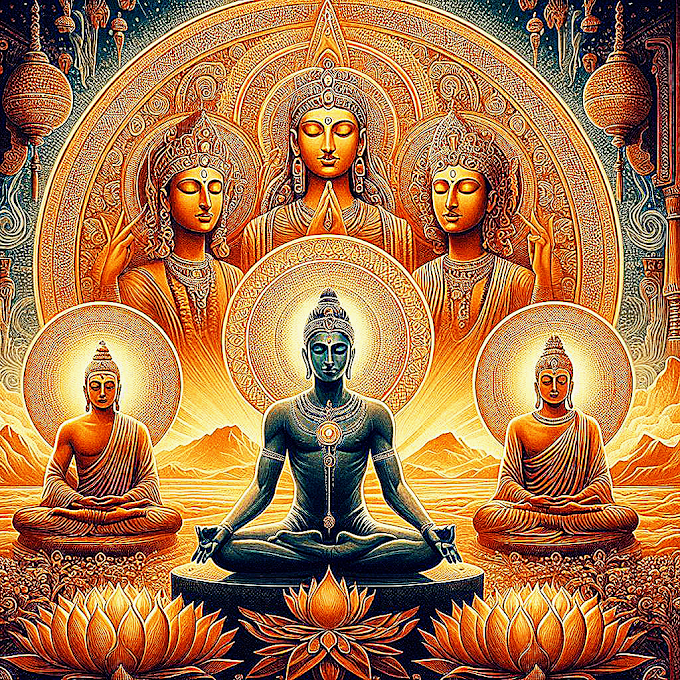
Samyama in Yoga: an integrated practice uniting concentration, meditation, and absorption to cultivate deep insight and mastery.
 |
| Samyama in Yoga: Concentration, Meditation, Absorption |
Samyama is a pivotal concept in Patanjali’s Yoga Sutras, particularly in the Vibhuti Pada and Kaivalya Pada. It refers to the integrated practice of dharana (concentration), dhyana (meditation), and samadhi (absorption), forming a comprehensive approach to gaining deep insights, spiritual growth, and supernormal powers (siddhis). Samyama is a tool for penetrating the subtle layers of existence and ultimately achieving liberation (kaivalya).
This article explores the concept, stages, and applications of samyama as outlined in the Vibhuti Pada and Kaivalya Pada, delving into its transformative potential for spiritual realization.
In the classical system of Patanjali’s Yoga Sutras, the journey toward liberation is not merely ethical or physical but profoundly psychological and experiential. Among the most refined practices described is samyama, an advanced yogic discipline that integrates dharana (concentration), dhyana (meditation), and samadhi (absorption) into a single, seamless process. Introduced primarily in the Vibhuti Pada (Chapter 3) and culminated philosophically in the Kaivalya Pada (Chapter 4), samyama represents the pinnacle of inner yogic practice.
Unlike preliminary yogic techniques aimed at purification and stability, samyama functions as a direct instrument of knowledge (prajna). Through it, the practitioner gains profound insight into the nature of reality, the workings of the mind, and the distinction between consciousness (Purusha) and matter (Prakriti). While the Vibhuti Pada elaborates on the extraordinary capacities (vibhutis or siddhis) that arise through samyama, Patanjali consistently emphasizes that these are secondary outcomes. The ultimate purpose of samyama remains discriminative wisdom (viveka khyati) and liberation (kaivalya).
Definition and Meaning of Samyama
2.1 Etymology and Philosophical Significance
The Sanskrit term samyama is derived from two roots:
Sam – complete, total, or integrated
Yama – restraint, mastery, or disciplined control
 |
| Samyama in Yoga: Concentration, Meditation, Absorption |
In samyama, cognition shifts from discursive thinking to direct perception. The mind ceases to function as a mediator and instead becomes a transparent instrument reflecting reality as it is. This marks a radical transformation of knowing—from intellectual understanding to experiential insight.
2.2 Patanjali’s Description in the Yoga Sutras
Patanjali defines samyama succinctly in Sutra 3.4:
This definition highlights several critical points:
Sequential Integration – Dharana, dhyana, and samadhi are not isolated techniques but stages of a single continuum.
Simultaneity – In samyama, these three operate together rather than separately.
Depth of Absorption – The object of meditation is known fully, internally, and non-dually.
Samyama therefore represents a qualitative shift in meditative practice, where effort gives way to spontaneous absorption and insight.
3. Structural Components of Samyama
3.1 Dharana: Fixing the Mind
Dharana is the deliberate act of binding the mind to a chosen object—whether external (a symbol, form, or point in space) or internal (a concept, chakra, or principle). At this stage, effort is required, as the mind naturally resists sustained focus due to habitual fluctuations (vrittis).
Dharana establishes:
Mental stability
Direction of awareness
Reduction of distraction
Without dharana, deeper meditative absorption is impossible.
3.2 Dhyana: Continuous Flow of Awareness
When concentration becomes uninterrupted and effortless, it matures into dhyana. Here, awareness flows continuously toward the object without interruption by thoughts, judgments, or distractions.
Key features of dhyana include:
Reduced sense of effort
Diminishing egoic interference
Increased clarity and calm
Dhyana refines perception, allowing subtler aspects of the object to reveal themselves.
3.3 Samadhi: Absorptive Union
Samadhi represents the culmination of this inward progression. In this state:
The distinction between meditator, meditation, and object dissolves.
The mind loses its separate identity and reflects only the object.
Awareness becomes luminous, still, and unified.
When samadhi arises in conjunction with dharana and dhyana on the same object, samyama is fully established.
4. Samyama in the Vibhuti Pada: Knowledge and Powers
The Vibhuti Pada details the transformative capacities that arise when samyama is applied to different objects—such as time, the body, the senses, or the mind. These include heightened perception, intuitive knowledge, and extraordinary abilities.
However, Patanjali repeatedly cautions that:
These powers are by-products, not goals.
Attachment to them reinforces ego and bondage.
They can obstruct the path to liberation if misunderstood.
Thus, samyama is not about domination over nature but clarity of consciousness.
5. Samyama in the Kaivalya Pada: Toward Liberation
In the Kaivalya Pada, the emphasis shifts from powers to freedom. Samyama becomes a tool for dissolving ignorance (avidya) and residual impressions (samskaras). Through sustained discriminative insight, the practitioner realizes the complete distinction between Purusha and Prakriti.
At this stage:
The mind ceases to generate karma.
The seeds of future experience are exhausted.
Consciousness abides in its own nature.
Samyama thus culminates not in mastery over the world, but in freedom from identification with it.
6. Psychological and Spiritual Significance
From a psychological perspective, samyama represents:
Peak attentional integration
Complete reduction of mental noise
Direct experiential knowing
Spiritually, it signifies:
Transcendence of ego
Direct realization of consciousness
Preparation for kaivalya
It is the bridge between method and realization, between practice and freedom.
7. Relevance of Samyama in Modern Context
In modern life, samyama offers a powerful antidote to fragmentation, distraction, and overstimulation. While few may pursue its classical depth, its principles can be meaningfully applied through:
Deep focused attention
Sustained mindfulness
Non-reactive awareness
These cultivate clarity, emotional regulation, insight, and inner freedom—even amidst complexity.
Samyama stands as one of the most profound contributions of Patanjali’s Yoga Sutras—a complete science of inner integration. By uniting concentration, meditation, and absorption, it transforms the mind from a source of bondage into an instrument of liberation. Ultimately, samyama reveals that true knowledge is not acquired, but remembered—as consciousness resting in its own limitless nature.
Samyama in the Vibhuti Pada
The Vibhuti Pada (Chapter 3) of Patanjali’s Yoga Sutras represents a significant turning point in the yogic journey. Here, Patanjali moves beyond preparatory practices and introduces samyama as a powerful inner discipline capable of unlocking extraordinary knowledge and transforming consciousness. This chapter does not glorify supernatural abilities for their own sake; rather, it demonstrates the latent capacities of a fully integrated mind and clarifies their role in the broader pursuit of liberation.
Samyama in the Vibhuti Pada reveals how disciplined attention can penetrate the deepest layers of reality—physical, psychological, and metaphysical—while simultaneously cautioning the practitioner against egoic misuse of such insights.
3.1 Techniques and Stages of Samyama
Samyama is not a sudden achievement but a progressive refinement of awareness. It unfolds through a seamless continuum of three interrelated stages: dharana, dhyana, and samadhi. While these stages are conceptually distinct, in practice they merge into a single, integrated flow of consciousness.
Dharana: Focused Attention
Dharana marks the intentional binding of the mind to a single object, location, or principle. At this stage, effort is still present, as the mind naturally tends to wander due to habitual patterns (vrittis). The practitioner repeatedly redirects attention back to the chosen focus, cultivating mental discipline and stability.
Common objects of dharana include:
Physical symbols or forms
Subtle inner points of awareness
Abstract principles such as time, causality, or consciousness
Dharana trains the mind to remain one-pointed, laying the structural foundation for deeper absorption.
Dhyana: Uninterrupted Flow of Awareness
When concentration becomes steady and continuous, dharana matures into dhyana. Here, attention no longer jumps between the object and distractions; instead, awareness flows smoothly and effortlessly toward the object, like oil poured in an unbroken stream.
Key features of dhyana include:
Reduced effort and mental strain
Diminishing sense of personal agency
Heightened clarity and subtle perception
Dhyana represents a qualitative shift—from controlling the mind to allowing awareness to sustain itself.
Samadhi: Complete Absorption
Samadhi arises when even the subtle distinction between observer and observed dissolves. The mind becomes so transparent that only the object of contemplation shines forth, free from conceptual overlays. In this state, cognition is replaced by direct experiential knowing.
When dharana, dhyana, and samadhi are applied successively and simultaneously to the same object, samyama is established. The object is no longer merely thought about—it is known from within.
3.2 Development of Siddhis (Supernormal Powers)
One of the most striking aspects of the Vibhuti Pada is its detailed description of siddhis, or extraordinary capacities, that arise through the application of samyama. These abilities are not presented as miracles but as natural outcomes of an exceptionally refined mind.
Patanjali illustrates this through specific examples:
- Sutra 3.16:Samyama on the transformation of time yields insight into past and future events, as the practitioner perceives the underlying patterns governing change.
- Sutra 3.17:Samyama on sound, its meaning, and the idea behind it leads to profound understanding of communication and symbolic expression.
- Sutra 3.49:Through mastery of samyama, the practitioner attains refinement and command over the elemental forces (bhutas), reflecting deep alignment between consciousness and nature.
These siddhis demonstrate that the mind, when freed from distraction and egoic distortion, possesses extraordinary perceptive and cognitive potential. However, Patanjali consistently frames these powers as incidental, not essential.
He offers repeated warnings:
Siddhis can reinforce ego (asmita) if misidentified as personal achievements.
Fascination with powers can divert attention from discriminative wisdom.
Attachment to abilities creates new forms of bondage rather than freedom.
Thus, siddhis are best understood as signposts of progress, not destinations.
3.3 Role of Samyama in Spiritual Growth
Beyond powers and perceptions, the deeper purpose of samyama in the Vibhuti Pada is spiritual maturation. Through sustained samyama, the practitioner gains direct insight into the fundamental structure of existence.
Perception of Subtle Realities
Samyama refines perception beyond gross sensory experience, enabling awareness of:
The subtle workings of the mind
The causal relationships behind experience
The distinction between changing phenomena (Prakriti) and unchanging awareness (Purusha)
This clarity dismantles ignorance (avidya), which Patanjali identifies as the root cause of suffering.
Cultivation of Detachment
As insight deepens, attachment to material identity, sensory pleasure, and psychological constructs naturally weakens. The practitioner begins to witness experience without entanglement, fostering:
Non-reactivity
Emotional equanimity
Inner freedom
Detachment here is not withdrawal from life but freedom from unconscious identification.
Preparation for Liberation
Most importantly, samyama prepares the ground for viveka khyati—uninterrupted discriminative awareness. This discernment allows the practitioner to recognize that:
The mind is an instrument, not the self
Experiences arise and dissolve, but consciousness remains unchanged
In this realization, samyama transcends technique and becomes a state of being, ultimately leading toward kaivalya, the complete freedom of consciousness.
In the Vibhuti Pada, samyama is revealed as a transformative discipline that unlocks the deepest capacities of the human mind while simultaneously pointing beyond them. Though it can yield remarkable abilities, its true value lies in clarity, detachment, and self-knowledge. Patanjali’s teaching is unambiguous: powers may arise, but wisdom liberates. Samyama, when practiced with humility and discernment, becomes not a tool for control, but a gateway to freedom.
Samyama in the Kaivalya Pada
The Kaivalya Pada (Chapter 4) represents the culmination of Patanjali’s yogic philosophy, where the focus shifts from extraordinary capacities to absolute liberation (kaivalya). While the Vibhuti Pada explores the powers that arise through samyama, the Kaivalya Pada clarifies its final spiritual purpose—the complete disentanglement of consciousness (Purusha) from material nature (Prakriti).
Here, samyama is no longer a means for acquiring knowledge or abilities but becomes a refining fire that burns the last traces of ignorance, ego, and karmic conditioning. It functions as a transformative insight that leads the practitioner beyond all forms of bondage into irreversible freedom.
4.1 Connection to Liberation (Kaivalya)
In the Kaivalya Pada, samyama is presented as a direct instrument of liberation, rather than a preparatory or exploratory practice. Liberation (kaivalya) is defined as the state in which Purusha abides in its own true nature, completely independent of the fluctuations, tendencies, and limitations of Prakriti.
Samyama facilitates this liberation by systematically dismantling the three primary causes of suffering:
- Avidya (Ignorance)The fundamental error of mistaking the impermanent for the permanent, the impure for the pure, and the non-self for the self.
- Samskaras (Latent Impressions)Subtle mental residues formed by past experiences and actions, which condition perception and behavior across lifetimes.
- Raga (Attachment)Emotional clinging to pleasurable experiences and identities, reinforcing bondage to becoming and change.
Through sustained samyama, the practitioner no longer merely understands these afflictions intellectually but perceives their mechanisms directly. This insight loosens their grip, allowing consciousness to disengage from habitual identification with the mind.
Importantly, liberation in the Kaivalya Pada is not portrayed as a mystical escape but as a natural consequence of complete clarity. When nothing remains to bind consciousness, freedom arises spontaneously.
4.2 Transcending Dualities and Karmic Impressions
One of the defining insights of samyama in the Kaivalya Pada is the dissolution of dualistic perception. Ordinary experience is structured by opposites—pleasure and pain, success and failure, self and other. These dualities arise from the mind’s tendency to categorize and react, perpetuating karmic engagement.
Transcendence of Dualities
Through samyama, the practitioner begins to perceive:
That opposites are complementary expressions of the same underlying reality
That reactions to pleasure and pain are mental constructions rather than intrinsic truths
That the observer and the observed are distinct in nature
This shift transforms experience from reactive participation to detached witnessing. Pleasure no longer binds, and pain no longer disturbs, because neither is mistaken for the self.
Dissolution of Karmic Impressions
Karmic impressions (samskaras) persist because they are repeatedly activated by identification and desire. Samyama interrupts this cycle in two crucial ways:
- Non-identificationWhen awareness remains established as the witness, impressions may arise, but they fail to generate action or attachment.
- Exhaustion without RenewalOld samskaras lose their potency when they are experienced without emotional investment, and no new samskaras are created.
Over time, the storehouse of latent impressions becomes empty. This is a decisive moment in the Kaivalya Pada: when samskaras are exhausted, karma no longer has a field in which to operate.
Thus, samyama does not suppress karma; it renders it irrelevant.
4.3 Dissolution of Ego and Realization of the Self
The most profound function of samyama in the Kaivalya Pada is the complete dissolution of ego (ahamkara). Ego, in Patanjali’s system, is not mere pride but the fundamental sense of “I am the doer” and “I am the experiencer.”
Ego as the Final Obstacle
Even advanced practitioners may retain subtle egoic identification, such as:
“I am the knower”
“I am liberated”
“I have attained samadhi”
The Kaivalya Pada emphasizes that any sense of ownership or agency belongs to Prakriti, not Purusha. Samyama exposes this subtle confusion by revealing that:
Actions occur through the gunas
Experiences arise in the mind
Awareness itself remains untouched and inactive
As this insight stabilizes, ego collapses—not through effort, but through irrelevance.
Realization of Purusha
With the dissolution of ego, consciousness rests in itself. This is the direct realization of Purusha as pure witnessing awareness, characterized by:
Absolute stillness
Complete independence
Absence of desire, fear, and striving
There is no longer a practitioner striving for liberation; liberation stands revealed as the ever-present reality.
Kaivalya: Complete Freedom
Kaivalya is described as the state where:
The gunas return to their source, having fulfilled their purpose
Consciousness remains alone, complete, and self-luminous
No further rebirth is possible, as the causes of manifestation are extinguished
This is not annihilation but perfect isolation of awareness from limitation. Life may continue outwardly, but inwardly there is no bondage, no becoming, and no return.
In the Kaivalya Pada, samyama transcends technique and becomes transformative wisdom. It dissolves ignorance, neutralizes karma, and annihilates ego, not through suppression but through insight. Unlike earlier stages where samyama reveals hidden powers, here it reveals freedom itself.
Patanjali’s final message is uncompromising: liberation does not arise from accumulating experiences, abilities, or knowledge, but from seeing clearly and completely. When samyama matures into unwavering discernment, the distinction between seeker and sought vanishes, and what remains is Purusha in its absolute freedom—kaivalya.
Significance of Samyama in Yoga
Samyama occupies a unique and decisive position in Patanjali’s yogic system. While Ashtanga Yoga outlines a progressive discipline for mastering body, breath, senses, and mind, samyama represents the integrative culmination of mental mastery. By uniting dharana (concentration), dhyana (meditation), and samadhi (absorption), samyama transforms fragmented attention into direct insight. Its significance lies not merely in extraordinary knowledge or abilities, but in its power to reveal reality as it truly is, leading the practitioner toward ultimate freedom.
5.1 Contribution to Self-Awareness and Insight
Refinement of Awareness
At its core, samyama refines awareness from ordinary perception to penetrative insight. In normal cognition, the mind is scattered, reactive, and conditioned by memory, desire, and fear. Samyama arrests this dispersion by bringing the mind into a single, unwavering stream of awareness.
This refined awareness enables the practitioner to:
Observe mental processes without identification
Distinguish between consciousness and its contents
Recognize subtle layers of conditioning shaping perception
Through this process, self-awareness deepens beyond personality and biography into existential clarity.
Development of Intuitive Knowledge (Prajñā)
Samyama sharpens prajñā, a form of intuitive intelligence distinct from analytical reasoning. This intelligence does not arise through inference or conceptual thought, but through direct perception of truth.
As samyama matures, the practitioner gains insight into:
The impermanent nature of thoughts, emotions, and identities
The mechanics of suffering and attachment
The distinction between the observer (Purusha) and the observed (Prakriti)
This intuitive knowing dissolves confusion at its root. Instead of reacting to life, the practitioner understands it from within.
Insight into the Structure of Reality
Samyama also reveals the interconnected nature of existence. By applying sustained awareness to various aspects of experience—time, causality, the elements, or the mind itself—the practitioner recognizes that all phenomena arise according to lawful patterns governed by nature.
This realization produces:
Humility, as the ego’s sense of control weakens
Reverence for the intelligence inherent in existence
Freedom from superstition and blind belief
Thus, samyama cultivates wisdom grounded in direct experiential truth, not doctrine.
5.2 Preparation for Kaivalya and Ultimate Freedom
Detachment from Worldly Entanglements
One of the most transformative outcomes of samyama is natural detachment. Unlike forced renunciation, detachment arising from samyama is effortless because it is rooted in understanding.
As insight deepens:
Sensory pleasures lose their compulsive hold
Success and failure are seen as transient mental events
Social roles and identities are recognized as functional, not essential
This detachment does not lead to withdrawal from life, but to freedom within engagement. The practitioner participates in the world without being bound by it.
Exhaustion of Karmic Patterns
Samyama plays a crucial role in dissolving karma. Karma persists because actions are driven by unconscious impressions (samskaras) reinforced through identification. Samyama interrupts this cycle by bringing full awareness into every layer of experience.
As a result:
Old samskaras arise but no longer compel action
New samskaras are not created due to non-attachment
Mental reactions lose their momentum
Over time, karmic conditioning becomes exhausted, clearing the path toward liberation.
Dissolution of the Egoic Center
The ego (ahamkara) thrives on separation—the sense of “I am the doer” and “I am the experiencer.” Samyama gradually exposes this assumption as false. Through sustained absorption, the practitioner perceives that:
Actions occur through natural forces
Experiences unfold in the mind
Awareness itself remains unchanged
This insight dissolves the ego not by suppression, but by rendering it unnecessary. When ego fades, suffering loses its foundation.
Establishment in Discriminative Wisdom (Viveka)
Samyama stabilizes viveka, the unwavering discernment between the eternal and the transient. This discernment is essential for kaivalya, as liberation depends not on experience but on clear seeing.
With established viveka:
The practitioner no longer mistakes mental states for the self
Pleasure and pain are observed without attachment
The fear of loss, change, and death dissolves
This clarity is irreversible and marks the threshold of ultimate freedom.
Samyama as the Gateway to Kaivalya
Kaivalya—the absolute isolation of consciousness from material limitation—is not achieved through effort alone but through complete understanding. Samyama provides the experiential ground where this understanding matures fully.
At this stage:
The gunas (qualities of nature) cease to bind consciousness
The mind fulfills its purpose and becomes transparent
Awareness rests in its own nature, free and complete
Samyama thus functions as the final bridge between disciplined practice and spontaneous liberation.
The significance of samyama in yoga extends far beyond concentration or mystical ability. It is a transformative discipline of insight, capable of unveiling the deepest truths of existence. By refining awareness, dissolving ego, exhausting karma, and stabilizing discriminative wisdom, samyama prepares the practitioner for the ultimate realization of kaivalya.
In Patanjali’s vision, samyama is not an optional advanced technique but a decisive turning point—where yoga shifts from practice to realization, from effort to freedom, and from becoming to being. Through samyama, the seeker does not attain liberation; liberation is revealed as what has always been.
Practical Applications of Samyama
While samyama is often presented as an advanced meditative discipline reserved for highly accomplished yogis, Patanjali’s system allows for its gradual and practical integration into daily life. When approached progressively, samyama does not remain confined to the meditation seat but becomes a mode of living, characterized by clarity, presence, and inner freedom. Its practical application refines attention, stabilizes the mind, and transforms ordinary actions into opportunities for awareness.
6.1 Techniques for Cultivating Samyama in Daily Life
Foundational Preparation: Establishing the Inner Ground
Before samyama can be cultivated, the practitioner must ensure a supportive inner and outer foundation. Ethical alignment, physical steadiness, and emotional balance are essential, as samyama amplifies the quality of the mind. Without preparation, deep concentration may intensify restlessness rather than clarity.
Key preparatory conditions include:
Regular practice of posture and breath regulation to stabilize the nervous system
Reduction of sensory overload through mindful living
Emotional self-regulation through reflection and self-discipline
These conditions ensure that samyama develops as refinement rather than strain.
Mindful Concentration (Dharana in Daily Contexts)
The first practical step toward samyama is deliberate, mindful concentration. Instead of attempting abstract or complex objects, practitioners begin with simple and tangible anchors of awareness.
Common focal supports include:
The natural rhythm of the breath
A sacred syllable or mantra
A candle flame or symbolic image
A single bodily sensation, such as the heartbeat
The aim is not forceful fixation but gentle yet continuous attention. Each return of awareness strengthens mental discipline and reduces habitual distraction.
Over time, the practitioner learns to:
Recognize wandering thoughts without frustration
Redirect attention calmly and repeatedly
Sustain focus without tension
This stage trains the mind to remain present and unified.
Progressive Meditation (Transition from Dharana to Dhyana)
As concentration stabilizes, effort gradually gives way to effortless continuity. This marks the transition from dharana to dhyana. In practical terms, meditation becomes less about doing and more about allowing awareness to flow.
Indicators of this transition include:
Reduced mental commentary
A sense of temporal expansion or stillness
Decreased awareness of bodily discomfort
Heightened clarity without strain
At this stage, the object of focus remains, but the distinction between observer and observed begins to soften. This continuous flow of awareness is essential for samyama, as it allows absorption to arise naturally rather than being forced.
Emergence of Absorption (Samadhi in Functional Life)
In daily practice, samadhi may not manifest as prolonged absorption but as moments of complete presence. These moments are characterized by:
Total engagement without self-consciousness
Absence of mental resistance
Clarity without emotional turbulence
Such absorption can occur during meditation, creative work, listening, teaching, or even routine tasks. When concentration, meditation, and absorption align—even briefly—functional samyama is present.
Integration into Life Activities
The highest practical application of samyama is its integration into everyday actions. Instead of restricting practice to formal meditation, the practitioner applies the same unified awareness to ordinary life.
Examples include:
Listening fully without preparing a response
Performing work with complete attention and detachment from outcome
Observing emotions as they arise without suppression or indulgence
Engaging in relationships with clarity rather than reactivity
Through this integration, life itself becomes a field for samyama, dissolving the division between spiritual practice and daily living.
6.2 Overcoming Challenges in Practice
Despite sincere effort, practitioners often encounter obstacles while cultivating samyama. These challenges are not failures but natural stages of refinement.
Distractions and Mental Restlessness
One of the most common challenges is persistent distraction. The modern environment, saturated with stimulation, conditions the mind toward fragmentation.
Effective responses include:
Creating a quiet and uncluttered practice space
Practicing at consistent times, preferably early morning or evening
Reducing excessive sensory input before meditation
Accepting distraction as part of the process rather than resisting it
Distraction weakens not through suppression but through patient awareness.
Inconsistency and Loss of Momentum
Irregular practice interrupts the continuity required for samyama. Without consistency, concentration must be rebuilt repeatedly.
To cultivate steadiness:
Establish a realistic daily schedule
Begin with short sessions and gradually increase duration
Anchor practice to routine activities (waking, sleeping, meals)
Focus on regularity rather than intensity
Consistency transforms effort into habit, and habit into inner stability.
Impatience and Expectation
Another subtle obstacle is impatience—the desire for quick results or extraordinary experiences. This expectation strengthens ego and undermines absorption.
Antidotes include:
Understanding that samyama unfolds gradually
Releasing attachment to experiences and outcomes
Cultivating humility and perseverance
Trusting the process rather than measuring progress
True samyama matures through non-striving attentiveness.
Emotional Residues and Subconscious Patterns
As awareness deepens, unresolved emotions and latent impressions may surface. This can create discomfort or confusion.
Skillful responses involve:
Maintaining a witness attitude
Avoiding repression or indulgence
Allowing experiences to arise and dissolve naturally
Seeking guidance when necessary
This purification is not an obstacle but a sign of progress.
The practical application of samyama transforms yoga from a formal discipline into a living wisdom. Through mindful concentration, progressive meditation, and moments of absorption, the practitioner learns to inhabit life with clarity, presence, and freedom. Challenges such as distraction, inconsistency, and impatience are not barriers but refining forces that deepen understanding.
When cultivated patiently and integrated consciously, samyama ceases to be a distant ideal and becomes a natural expression of awareness—quietly reshaping perception, action, and identity. In this way, samyama serves not only as a path to liberation but as a guide for living with depth, balance, and insight in the midst of everyday life.
Relevance of Samyama in Modern Life
In an age defined by speed, information overload, and constant sensory stimulation, the relevance of samyama has become more pronounced than ever. Although rooted in classical yogic philosophy, samyama offers timeless psychological and existential tools for addressing modern challenges such as stress, fragmentation of attention, emotional instability, and loss of meaning. By integrating concentration, meditation, and absorption, samyama provides a systematic framework for inner mastery, allowing individuals to live with clarity, balance, and depth amid complexity.
7.1 Application in Mindfulness and Self-Realization
Alignment with Modern Mindfulness Practices
Modern mindfulness emphasizes present-moment awareness, non-reactivity, and conscious attention—principles that are fundamentally aligned with samyama. However, samyama extends mindfulness beyond momentary awareness into a structured discipline of sustained insight.
While mindfulness often begins with observation, samyama:
Trains attention to remain stable over time
Refines awareness into a continuous stream
Leads to absorption where self-consciousness diminishes
This progression transforms mindfulness from a coping strategy into a path of self-understanding and transformation.
Cultivation of Deep Presence
One of samyama’s most valuable modern applications is its ability to cultivate deep presence. In contemporary life, attention is frequently divided across tasks, devices, and mental narratives. Samyama restores the capacity to be fully present by unifying attention.
This unified presence enables individuals to:
Engage more deeply in work and relationships
Listen without internal commentary
Respond thoughtfully rather than react impulsively
Presence cultivated through samyama is not passive awareness but active clarity, enhancing both inner stability and external effectiveness.
Pathway to Self-Realization in a Secular Context
Although traditionally associated with liberation, samyama can support self-realization even in non-religious contexts. Through sustained inner observation, individuals begin to recognize:
The impermanent nature of thoughts and emotions
The constructed nature of identity
The distinction between awareness and mental content
This recognition fosters psychological freedom, reducing over-identification with roles, achievements, and failures. As a result, self-worth becomes less dependent on external validation and more grounded in inner awareness.
7.2 Contributions to Emotional Resilience and Focus
Strengthening Emotional Regulation
Modern life presents frequent emotional triggers—competition, uncertainty, social comparison, and constant evaluation. Samyama strengthens emotional resilience by creating space between awareness and reaction.
Through disciplined inner focus:
Emotional responses are observed rather than suppressed
Reactivity diminishes without denial
Difficult emotions lose their compulsive power
This capacity allows individuals to experience emotions fully while maintaining inner equilibrium, leading to emotional maturity and stability.
Stress Reduction and Nervous System Balance
Chronic stress often arises from mental fragmentation and continuous engagement with external stimuli. Samyama counteracts this by training the mind to withdraw inward without dissociation.
Regular practice results in:
Reduced cognitive overload
Improved nervous system regulation
Greater tolerance for uncertainty and pressure
Unlike distraction-based relaxation, samyama cultivates calm through clarity and integration, offering sustainable stress management rather than temporary relief.
Enhanced Focus and Cognitive Efficiency
One of the most measurable benefits of samyama in modern contexts is enhanced focus. By unifying attention, samyama counters the decline in concentration caused by multitasking and digital dependence.
Benefits include:
Improved sustained attention
Greater mental efficiency
Reduced decision fatigue
This focused awareness allows individuals to work more effectively in less time, conserving mental energy and reducing burnout.
Improved Decision-Making and Insight
Samyama supports superior decision-making by quieting emotional noise and habitual patterns. When the mind is unified, perception becomes clearer, enabling individuals to:
Discern essential factors from irrelevant details
Anticipate consequences with greater clarity
Act from insight rather than impulse
Decisions made from this state are often more ethical, balanced, and aligned with long-term well-being.
Creativity and Insightful Thinking
Creativity flourishes in a mind that is quiet yet alert. Samyama creates optimal conditions for creative insight by dissolving mental clutter and habitual thought patterns.
As absorption deepens:
New connections emerge spontaneously
Solutions arise intuitively rather than through forced analysis
Innovation flows from clarity rather than pressure
Artists, educators, leaders, and problem-solvers can harness samyama to access original insight and inspired action.
Samyama as a Bridge Between Inner and Outer Life
Perhaps the greatest relevance of samyama today lies in its ability to integrate inner awareness with outer responsibility. It does not demand withdrawal from society but refines the quality of participation.
Through samyama, individuals learn to:
Act without being driven by anxiety or ego
Engage deeply without losing inner freedom
Balance ambition with awareness
This integration supports ethical leadership, compassionate relationships, and meaningful engagement with the world.
In modern life, samyama offers far more than a meditative technique—it provides a comprehensive framework for psychological clarity, emotional resilience, and self-understanding. By refining attention, stabilizing emotions, and deepening insight, samyama equips individuals to navigate complexity with wisdom and composure.
Rooted in ancient yogic insight yet profoundly relevant today, samyama bridges mindfulness and self-realization, inner stillness and effective action. In a world increasingly marked by distraction and fragmentation, samyama restores the human capacity for presence, depth, and freedom, making it not only relevant but essential for conscious living.
Conclusion
Samyama, as described in Patanjali’s Vibhuti Pada and Kaivalya Pada, is a transformative practice that integrates concentration, meditation, and absorption. It offers profound insights, spiritual growth, and the potential for liberation (kaivalya). While the development of siddhis illustrates the mind’s extraordinary potential, the ultimate aim of samyama is to dissolve the ego and realize the self. In modern life, samyama serves as a timeless tool for cultivating mindfulness, focus, and inner peace.
References
- Iyengar, B.K.S. Light on the Yoga Sutras of Patanjali.
- Satchidananda, Swami. The Yoga Sutras of Patanjali: Commentary on the Raja Yoga Sutras.
- Desikachar, T.K.V. The Heart of Yoga: Developing a Personal Practice.
- Saraswati, Swami Satyananda. Four Chapters on Freedom: Commentary on the Yoga Sutras of Patanjali.
- Mohan, A.G. Yoga for Body, Breath, and Mind.
FAQ
Q1. What is Samyama meditation?
Ans: Samyama is the integrated practice of Dharana (concentration), Dhyana (meditation), and Samadhi (absorption), performed together as a single, sustained act to gain deep insight and mastery over the mind. It is a method described in Patanjali’s Yoga Sutras for penetrating the essential nature of an object or experience and cultivating prajñā (discriminative wisdom).
Q2. What are the three types of Samyama?
Ans: Samyama is the integrated practice of Dharana (concentration), Dhyana (meditation), and Samadhi (absorption) performed together as a single, sustained act to gain deep insight and mastery over the mind. It is described in Patanjali’s Yoga Sutras as a method for penetrating the essential nature of an object or experience and cultivating discriminative wisdom, and you can explore Samyama practice.
Q3. What is Samyama according to Patanjali?
Ans: According to Patanjali, Samyama is the combined practice of Dharana (concentration), Dhyana (meditation), and Samadhi (absorption) performed seamlessly as one. It is a powerful method for attaining direct insight and mastery over the mind, leading to higher knowledge and spiritual realization.
Q4. What is the concept of Samyama and Siddhis?
Ans: Samyama, as described by Patanjali, is the combined practice of Dharana, Dhyana, and Samadhi, enabling deep insight and mastery over the mind. Through Samyama, yogis are said to attain Siddhis—extraordinary powers or abilities—which are considered by tradition as by-products of practice rather than its ultimate goal of liberation.
Q5. What are the 9 stages of samatha meditation?
Ans: The nine stages of Samatha meditation describe the progressive calming of the mind: placing, continual placing, patching, close placing, taming, pacifying, complete pacifying, one-pointedness, and balanced placement. These stages gradually refine attention and stability, leading to deep concentration and mental tranquility.
Q6. What are the rules of Samyama?
Ans: The rules of Samyama, as outlined by Patanjali, require the seamless integration of Dharana (concentration), Dhyana (meditation), and Samadhi (absorption) into a single continuous practice. It must be performed with discipline, ethical grounding, and sustained focus to cultivate deep insight and mastery over the mind.
Q7. How long does Samyama meditation take?
Ans: The duration of Samyama meditation is not fixed, as it depends on the practitioner’s level of concentration and depth of practice. Traditionally, it is sustained until Dharana, Dhyana, and Samadhi merge seamlessly, which may take minutes or years of disciplined effort.


.png)