.png)
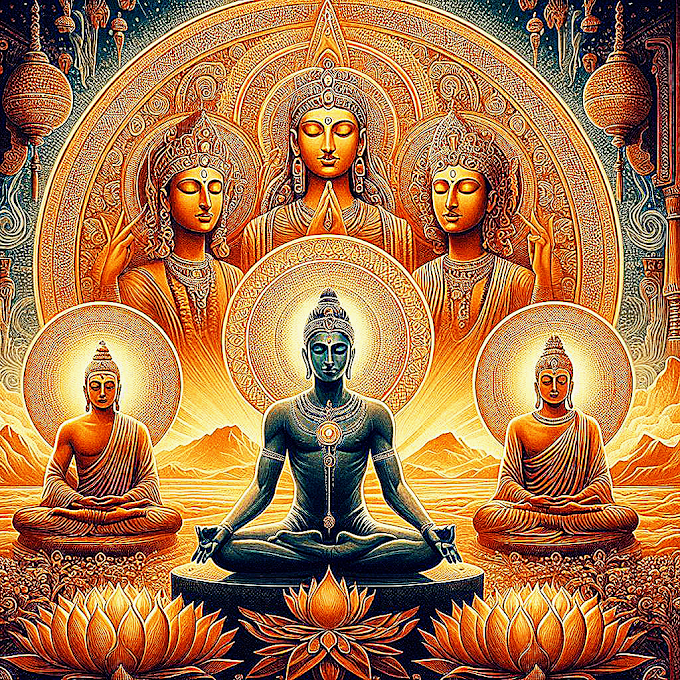
Samadhi is the final stage of yogic practice—pure absorption beyond ego, were consciousness merges with universal truth.
 |
| Samadhi in Yoga: The Culmination of Spiritual Practice |
Samadhi, the eighth and final limb of Patanjali’s Ashtanga Yoga, represents the pinnacle of yogic practice. It is a state of meditative absorption where the practitioner transcends the boundaries of individual identity and merges with pure consciousness. Samadhi is both the goal of yoga and a transformative experience, paving the way for liberation (kaivalya).
This article explores the concept, stages, and significance of samadhi as outlined in Patanjali’s Yoga Sutras, with practical insights into its relevance in spiritual and modern contexts.
Patanjali’s Yoga Sutras presents samadhi as the ultimate destination of the yogic journey. Building upon the earlier limbs of Ashtanga Yoga, samadhi represents the union of the practitioner’s consciousness with the universal. It is not merely an advanced state of meditation but a transformative experience that reveals the true nature of existence and self.
Definition and Meaning of Samādhi
Samādhi occupies a central and culminating position in Patañjali’s Yoga Sūtras. It represents not merely a meditative technique but a state of consciousness in which the fundamental purpose of yoga—liberation from suffering and ignorance—is realized. Understanding samādhi requires moving beyond surface meanings and examining its etymological depth, philosophical significance, and experiential implications within the yogic framework.
2.1 Etymology and Philosophical Significance
The Sanskrit term samādhi is derived from two primary roots:
Sam – together, complete, harmonious, or balanced
Ā-dhā (adhi) – to place, hold, establish, or absorb
Together, samādhi conveys the meaning of complete absorption, perfect integration, or total unification. Linguistically, it suggests a condition in which the mind is so fully established in its object that all distinctions between observer, process of observation, and observed dissolve.
Philosophically, samādhi signifies a radical transformation of consciousness. Unlike ordinary states of knowing—where perception is filtered through thought, memory, emotion, and ego—samādhi represents direct, unmediated awareness. The mind no longer operates as an interpreter but becomes transparent, reflecting reality as it is.
In classical Yoga philosophy, the mind (chitta) is considered a product of Prakṛti and therefore subject to constant fluctuation. These fluctuations obscure the true nature of the Seer (Puruṣa). Samādhi is the condition in which this obscuration ceases entirely. The mind no longer distorts perception but becomes a perfectly clear medium, allowing consciousness to recognize itself.
Thus, samādhi is not an altered state in the psychological sense; rather, it is a return to the original clarity of awareness, free from conditioning, projection, and identification.
2.2 Patanjali’s Description in the Yoga Sūtras
Patañjali defines samādhi succinctly yet profoundly in Sūtra 3.3:
“Tadevartha-mātra-nirbhāsaṁ svarūpa-śūnyam iva samādhiḥ.”
“Samādhi is that state in which only the object shines forth, as if the mind were devoid of its own form.”
This sūtra reveals several essential dimensions of samādhi.
a) “Tad eva artha mātra nirbhāsam” – Only the Object Shines Forth
In samādhi, awareness becomes completely absorbed in the object of meditation. However, this does not imply concentration in the ordinary sense. Rather, it indicates that all mental constructions related to the object disappear. There is no commentary, analysis, memory, or imagination—only pure presence of the object as it is.
This absorption differs fundamentally from intellectual understanding. In samādhi, knowledge is experiential and immediate, not conceptual. The object is not “known about”; it is directly revealed.
b) “Svarūpa śūnyam iva” – As If Devoid of Its Own Nature
The phrase “as if devoid of its own form” is crucial. The mind does not literally cease to exist, but its sense of separateness and agency dissolves. The mind no longer asserts “I am meditating” or “I am observing.”
Ego-identification (asmita) temporarily disappears, creating a condition where:
There is awareness without a sense of doership
Experience occurs without ownership
Knowing happens without a knower
This marks a decisive shift from dualistic perception toward non-dual awareness.
c) Samādhi as the Fulfillment of Yoga
 |
Samadhi in Yoga: The Culmination of Spiritual Practice |
In this state:
Past impressions lose their force
Psychological suffering dissolves
The distinction between inner and outer fades
Thus, samādhi is not an achievement imposed by effort but a spontaneous flowering of stillness once the conditions are established through disciplined practice.
2.3 Samādhi as a State of Integration, Not Escape
A common misunderstanding is that samādhi represents withdrawal from reality. Classical yoga presents the opposite view. Samādhi is a state of perfect integration, where consciousness is no longer fragmented by inner conflict or sensory overload.
In ordinary awareness:
The mind oscillates between past and future
Attention is divided
Perception is colored by likes, dislikes, and fears
In samādhi:
Awareness is unified
Attention is stable and effortless
Experience is free from distortion
This integration brings clarity, insight, and freedom rather than dissociation.
2.4 Samādhi and the Dissolution of Vṛttis
Although samādhi involves the cessation of vṛttis, it is important to understand that not all samādhi states are identical. Some forms retain subtle mental impressions, while others are completely free from them.
Nevertheless, all forms of samādhi share common features:
Reduction or absence of ego-identification
Heightened clarity and presence
Direct perception unmediated by thought
As samādhi deepens, even latent tendencies (saṁskāras) are neutralized, leading eventually to permanent freedom.
2.5 Samādhi as Direct Knowledge (Prajñā)
The knowledge gained through samādhi is fundamentally different from intellectual knowledge. It is described as prajñā—a form of wisdom that arises from direct seeing.
Characteristics of this knowledge include:
Certainty without reasoning
Insight without analysis
Stability without doubt
Such knowledge transforms the practitioner at the deepest level, reshaping perception, behavior, and identity.
Samādhi, as defined by Patañjali, is the state of complete absorption where the mind becomes transparent, ego dissolves, and pure awareness shines unobstructed. Rooted in precise philosophical understanding and experiential depth, samādhi represents both the culmination of yogic practice and the gateway to liberation. It is not an escape from reality but the fullest realization of it—where consciousness recognizes itself beyond all limitation.
Stages of Samādhi in Patañjali’s Yoga Sūtras
Samādhi represents the highest culmination of yogic practice, where the mind transcends its habitual patterns and rests in profound stillness and clarity. Patañjali does not describe samādhi as a single, uniform experience; rather, he presents it as a graded process of inner absorption, evolving from cognitive engagement to complete transcendence of mental activity. These stages reflect the progressive refinement of awareness and the gradual disentanglement of consciousness from the mind.
Broadly, samādhi is classified into two major categories: Samprajñāta Samādhi (cognitive absorption) and Asamprajñāta Samādhi (non-cognitive absorption). Each plays a crucial role in the yogic journey toward liberation.
1. Samprajñāta Samādhi (Cognitive Absorption)
Samprajñāta samādhi is characterized by awareness of an object of meditation. Although the mind becomes highly concentrated and refined, it continues to function in a subtle and purified form. This stage represents deep meditative absorption accompanied by knowledge, discernment, and insight.
In this state:
The practitioner remains conscious of the meditative object
The intellect (buddhi) is active but stabilized
Mental fluctuations are greatly reduced, though not entirely dissolved
Samprajñāta samādhi serves as a critical preparatory stage, purifying the mind and weakening ego-identification.
1.1 Vitarka Samādhi (Deliberative Absorption)
Vitarka represents the initial stage of cognitive absorption, where meditation is focused on gross or tangible objects. These may include physical forms, sacred symbols, mantras, or visualized images.
Key characteristics:
The mind engages in subtle analysis and recognition of the object
Awareness oscillates between the object, its name, and its meaning
Discursive thought is present but disciplined
Although thought has not completely ceased, it becomes orderly and purposeful. Vitarka samādhi stabilizes attention and builds the foundation for deeper absorption.
1.2 Vichāra Samādhi (Reflective Absorption)
As awareness becomes more refined, focus shifts from gross objects to subtle realities, marking the transition to vichāra samādhi. Here, meditation is directed toward abstract principles, subtle elements, or inner processes.
Distinct features include:
Minimal conceptualization
Increased clarity and sensitivity
Reduced identification with sensory experience
In vichāra samādhi, the intellect functions in a purified state, illuminating the subtle dimensions of experience without distraction.
1.3 Ānanda Samādhi (Absorption in Bliss)
With further refinement, the practitioner enters ānanda samādhi, characterized by spontaneous inner joy. This bliss is not sensory or emotional but arises from the deep stillness of the mind.
Notable aspects:
Bliss emerges naturally, without external cause
The sense of effort disappears
Awareness becomes light, expansive, and serene
However, even this bliss is recognized as a phenomenon of the mind, not the ultimate reality. Attachment to this joy can impede further progress if not transcended.
1.4 Asmitā Samādhi (Absorption in I-ness)
Asmitā samādhi represents the subtlest form of samprajñāta samādhi. Here, awareness is centered on the pure sense of “I-am-ness,” devoid of personal identity or psychological content.
Key qualities:
Minimal duality
Awareness of existence without attributes
Near-complete dissolution of ego
Although extremely refined, a subtle sense of individuality remains. This stage prepares the practitioner for the complete transcendence of mental activity in asamprajñāta samādhi.
2. Asamprajñāta Samādhi (Non-Cognitive Absorption)
Asamprajñāta samādhi marks a radical shift from cognitive engagement to objectless awareness. In this state, the mind no longer holds any object, thought, or concept. All mental modifications subside entirely.
Core characteristics:
Absence of object-awareness
Complete stilling of mental activity
Dissolution of ego and individuality
This state is not unconsciousness but pure, luminous awareness, free from all conditioning.
2.1 Transcendence of Mental Activity
In asamprajñāta samādhi, even the most subtle impressions and tendencies are neutralized. The mind becomes inactive, no longer projecting or reflecting experience.
This results in:
Freedom from habitual patterns
Absence of desire, fear, or attachment
Timeless, changeless awareness
The practitioner experiences consciousness as self-existent and self-luminous.
2.2 Dissolution of Samskāras and Ego
A defining feature of asamprajñāta samādhi is the destruction of latent impressions (saṁskāras) that generate future mental activity. Without these seeds, the cycle of conditioning and rebirth is brought to an end.
In this state:
Ego-identification dissolves permanently
The sense of doership vanishes
Consciousness rests in its own nature
This eradication of samskāras distinguishes asamprajñāta samādhi from all previous stages.
2.3 Gateway to Liberation (Kaivalya)
Asamprajñāta samādhi is directly associated with liberation. When consciousness is completely disentangled from the mind and its contents, the practitioner attains kaivalya—the isolation of pure awareness from material nature.
Liberation here is not an experience but a permanent shift in being, characterized by:
Absolute freedom
Unshakeable clarity
Irreversible cessation of suffering
The stages of samādhi outlined by Patañjali present a precise map of inner evolution, guiding the practitioner from structured cognitive absorption to complete transcendence of mental activity. Samprajñāta samādhi refines and purifies the mind, while asamprajñāta samādhi dissolves it altogether, revealing pure consciousness. Together, these stages illuminate the yogic path from disciplined awareness to ultimate liberation.
Types of Samādhi in Patañjali’s Yoga: Sabīja and Nirbīja Samādhi
In Patañjali’s Yoga philosophy, samādhi is not presented as a single, uniform mystical experience but as a graded unfolding of consciousness. Among its most fundamental classifications is the distinction between Sabīja Samādhi (samādhi with seed) and Nirbīja Samādhi (seedless samādhi). This distinction reveals how deeply the mind is still entangled with latent impressions and how far the practitioner has progressed toward absolute liberation.
The term bīja (seed) refers to latent impressions (saṁskāras)—subtle psychological residues formed by past actions, thoughts, and experiences. Whether these seeds remain active or are fully dissolved determines the nature and depth of samādhi.
1. Sabīja Samādhi (Samādhi with Seed)
Sabīja samādhi is a state of deep meditative absorption in which an object of awareness remains present, either in gross or subtle form. Although the mind becomes highly refined and stabilized, it still contains latent impressions capable of producing future mental activity.
This form of samādhi corresponds broadly to samprajñāta samādhi, where consciousness is luminous yet structured.
1.1 Nature and Characteristics of Sabīja Samādhi
In sabīja samādhi:
The mind rests steadily on a chosen object
Awareness is focused and undisturbed
Subtle duality between observer and observed remains
Although mental fluctuations are greatly reduced, they are not entirely extinguished. The practitioner experiences clarity, insight, and inner stillness, but the seed of individuality persists.
Key characteristics include:
Presence of a meditative support (object, concept, or subtle awareness)
Purified intellect functioning without distraction
Temporary suspension of ego, not its total dissolution
1.2 Role of Samskāras in Sabīja Samādhi
Even in profound absorption, latent impressions remain embedded in the causal layers of the mind. These samskāras:
Retain the potential to re-activate mental fluctuations
Sustain the cycle of conditioning and karmic momentum
Prevent complete freedom from duality
Because seeds remain, the practitioner eventually emerges from sabīja samādhi back into ordinary consciousness, though transformed and purified.
1.3 Transformative Benefits of Sabīja Samādhi
Despite its limitations, sabīja samādhi plays a crucial role in spiritual evolution. It:
Refines perception and sharpens discernment
Weakens ego-identification and attachments
Cultivates dispassion (vairāgya)
This state establishes mastery over attention and creates the inner stability necessary for higher realization. Without sabīja samādhi, the leap into seedless absorption is not possible.
1.4 Limitations of Sabīja Samādhi
Sabīja samādhi, though elevated, is still bound by:
Subtle cognitive structures
Residual sense of “I”
Dependence on meditative supports
As long as seeds exist, complete liberation cannot occur. Thus, sabīja samādhi is considered a transitional state rather than the final goal.
2. Nirbīja Samādhi (Seedless Samādhi)
Nirbīja samādhi represents the culmination of yogic realization, where all latent impressions are dissolved and the mind becomes entirely inactive. In this state, consciousness exists without object, support, or structure.
It is synonymous with asamprajñāta samādhi and directly leads to liberation.
2.1 Nature of Nirbīja Samādhi
In nirbīja samādhi:
No object of meditation remains
All mental activity ceases completely
Awareness rests in itself
This is not unconsciousness but pure, self-luminous awareness, free from time, space, and causation.
Key features include:
Absence of duality
Total stillness of the mind
Irreversible freedom from conditioning
2.2 Destruction of Samskāras and Karmic Seeds
The defining feature of nirbīja samādhi is the complete annihilation of samskāras. Without these seeds:
No new mental modifications arise
Karma loses its binding force
Rebirth becomes impossible
The mind no longer functions as a medium of experience; it becomes transparent and inactive.
2.3 Dissolution of Ego and Individuality
In nirbīja samādhi:
The sense of “I” dissolves entirely
Doership and agency disappear
Consciousness is no longer personalized
What remains is Purusha, pure awareness, existing in isolation from Prakriti.
2.4 Nirbīja Samādhi and Kaivalya (Liberation)
Nirbīja samādhi directly culminates in kaivalya, the absolute freedom described in the final chapter of the Yoga Sūtras. Kaivalya is not an experience but a permanent ontological shift.
It is characterized by:
Eternal freedom
Unconditioned awareness
Complete cessation of suffering
Unlike sabīja samādhi, nirbīja samādhi is irreversible.
3. Relationship Between Sabīja and Nirbīja Samādhi
Sabīja samādhi functions as a purificatory and preparatory phase, while nirbīja samādhi represents final emancipation.
| Aspect | Sabīja Samādhi | Nirbīja Samādhi |
|---|---|---|
| Object of awareness | Present | Absent |
| Samskāras | Dormant but active | Completely destroyed |
| Duality | Subtle | Absent |
| Ego | Attenuated | Dissolved |
| Liberation | Not final | Absolute |
The transition from sabīja to nirbīja samādhi occurs through sustained practice and deep dispassion, where even attachment to meditative absorption is relinquished.
The distinction between sabīja and nirbīja samādhi reveals the precision and depth of Patañjali’s yogic psychology. Sabīja samādhi refines the mind and weakens its conditioning, while nirbīja samādhi dissolves the very foundations of mental existence. Together, they represent the final ascent of the yogic path—from refined awareness to absolute freedom, culminating in kaivalya.
Significance of Samādhi in the Yogic Path
Samādhi represents the pinnacle of yogic practice and the ultimate aim of Patañjali’s Ashtāṅga Yoga. It is not merely a heightened meditative experience but a radical transformation of consciousness, wherein the practitioner transcends the limitations of mind, ego, and material identification. Through samādhi, the yogin moves beyond conditioned existence and abides in the truth of pure awareness. Its significance lies in its capacity to dismantle ignorance (avidyā), dissolve egoic structures, and culminate in liberation (kaivalya).
1. Spiritual Transformation and Liberation (Kaivalya)
1.1 Revelation of the True Self (Purusha)
The most profound significance of samādhi is its role in revealing the true nature of the self, known in Yogic philosophy as Purusha. Ordinarily, human consciousness is entangled with Prakriti—the realm of body, senses, mind, and intellect. This misidentification gives rise to suffering, attachment, and repeated cycles of birth and death.
In samādhi, the mind becomes completely transparent, allowing Purusha to be known as distinct from all mental and material processes. Awareness no longer fluctuates with thoughts, emotions, or sensory input. Instead, it rests in its own essential nature—unchanging, luminous, and self-existent.
This direct realization is not conceptual or intellectual; it is experiential certainty, free from doubt and distortion.
1.2 Dissolution of Avidyā (Ignorance)
Ignorance is identified as the root cause of all suffering. It manifests as the confusion between:
The eternal and the transient
The pure and the impure
The self and the non-self
Samādhi eradicates ignorance by removing the very mechanism of misperception—the restless, projecting mind. When mental modifications cease, false identification collapses, and truth stands revealed without mediation.
This dissolution is irreversible in the highest form of samādhi, ensuring permanent freedom.
1.3 Attainment of Kaivalya (Absolute Liberation)
The culmination of samādhi is kaivalya, a state of complete isolation of consciousness from material nature. Kaivalya does not imply withdrawal from existence but freedom from bondage to causation, karma, and rebirth.
In kaivalya:
Consciousness exists independently of mind and matter
The cycle of birth and death ceases permanently
Suffering loses its foundation
This liberation is not an altered state but a final ontological transformation, where awareness abides in its own sovereignty.
Role of Samādhi in Transcending Ego and Dualities
2.1 Dissolution of Ahamkāra (Ego-Sense)
The ego (ahamkāra) is the principle that generates individuality, doership, and possessiveness. It sustains the sense of “I am the body,” “I am the mind,” and “I am the doer.” Even refined spiritual practices may temporarily weaken the ego, but samādhi alone dissolves it at the root.
In samādhi:
The sense of personal identity fades
Doership and ownership vanish
Awareness functions without self-reference
This dissolution does not result in annihilation but in freedom from limitation. What disappears is not existence but false identification.
2.2 Transcendence of Dualities
Human experience is ordinarily structured around opposites:
Pleasure and pain
Success and failure
Attraction and aversion
Self and other
These dualities arise from mental interpretation and ego-based perception. Samādhi transcends such opposites by removing the cognitive framework that generates them.
In deep absorption:
Experience is non-reactive
Awareness remains equanimous
Emotional extremes lose their grip
This transcendence fosters profound inner stability, unaffected by external circumstances.
2.3 Emergence of Non-Dual Awareness
As ego and duality dissolve, the practitioner experiences a state of non-dual awareness, where separation between observer and observed ceases. Consciousness no longer perceives itself as an individual entity confronting the world but as the underlying reality in which all experiences arise.
This unity is not philosophical abstraction but direct realization—a state where:
Inner and outer distinctions collapse
Fragmentation gives way to wholeness
Awareness recognizes itself as universal
3. Psychological and Existential Transformation Through Samādhi
3.1 Freedom from Fear and Insecurity
Fear arises from identification with the perishable—body, possessions, relationships, and status. In samādhi, identification shifts from the transient to the eternal, dissolving existential anxiety.
The practitioner becomes:
Fearless in the face of change
Free from attachment-driven insecurity
Grounded in inner certainty
This freedom extends beyond meditation into all aspects of life.
3.2 End of Suffering (Duḥkha-Nivṛtti)
Suffering is sustained by mental fluctuations, attachments, and aversions. Samādhi cuts suffering at its source by stilling the mind and dissolving the ego that reacts to experience.
Once this root is removed:
Pain may occur, but suffering does not
Experiences are witnessed, not resisted
Inner peace becomes natural and continuous
4. Samādhi as the Fulfillment of the Yogic Path
Samādhi integrates and transcends all previous limbs of yoga. Ethical discipline, physical stability, breath regulation, sense withdrawal, concentration, and meditation all find their culmination here.
Its significance lies in:
Completing the evolutionary journey of consciousness
Transforming knowledge into direct realization
Converting practice into being
Samādhi is not an escape from life but the full awakening to reality as it is, free from distortion and limitation.
The significance of samādhi extends far beyond altered states of consciousness or mystical experience. It represents the final dissolution of ignorance, ego, and duality, revealing the true nature of the self and culminating in kaivalya. Through samādhi, the practitioner attains absolute freedom—freedom from suffering, fear, and rebirth—abiding in pure, unconditioned awareness. It is the crowning achievement of the yogic path and the ultimate expression of human spiritual potential.
Samādhi in Practice
While samādhi represents the highest realization in the yogic path, it is not attained abruptly or accidentally. It emerges from a systematic, disciplined, and integrated practice of the preceding limbs of yoga. Patañjali presents samādhi not as a mystical gift, but as the natural culmination of sustained preparation, purification, and inner refinement. Understanding samādhi in practice therefore requires attention both to the methods that prepare the practitioner and the obstacles that must be consciously transcended.
1. Techniques for Preparing for Samādhi
1.1 Asana (Posture): Establishing Physical and Nervous Stability
Asana forms the physical foundation for samādhi. A body that is restless, tense, or uncomfortable inevitably disturbs the mind. The yogic emphasis on sthira (steadiness) and sukha (ease) ensures that the posture supports prolonged inner absorption without strain.
In practical terms:
Asana develops muscular balance and spinal alignment, allowing energy to flow freely.
It reduces involuntary bodily movements that interrupt meditative continuity.
A stable posture conditions the nervous system toward calm alertness rather than agitation or dullness.
For samādhi, the posture must eventually become effortless and forgotten, allowing awareness to disengage from bodily identification.
1.2 Prāṇāyāma (Breath Regulation): Refining Mental Energy
Breath and mind are deeply interconnected. Irregular breathing sustains mental turbulence, while regulated breathing pacifies the fluctuations of consciousness. Prāṇāyāma functions as a bridge between body and mind, refining vital energy (prāṇa) so that it supports inward absorption.
Through systematic breath regulation:
The sympathetic nervous system calms, reducing restlessness and anxiety.
Mental clarity increases as prāṇa becomes balanced and evenly distributed.
Subtle awareness deepens, preparing the mind for sustained concentration.
Advanced practice leads to spontaneous stillness of breath, a state that naturally supports deeper meditative absorption.
1.3 Pratyāhāra (Withdrawal of the Senses): Turning Awareness Inward
Even with a steady posture and calm breath, the senses can continue to pull awareness outward. Pratyāhāra marks the crucial transition from external discipline to internal mastery. It is not suppression of the senses, but their voluntary withdrawal from compulsive engagement.
In practice:
Sensory impressions lose their power to disturb attention.
Awareness becomes self-referential rather than stimulus-driven.
The practitioner gains mastery over habitual reactivity.
Without pratyāhāra, samādhi remains inaccessible, as sensory distractions continually fragment awareness.
1.4 Dhāraṇā (Concentration): Training the Mind’s Direction
Dhāraṇā disciplines the scattered tendencies of the mind by binding attention to a single locus—whether a mantra, symbol, inner sensation, or subtle principle. This stage is effortful, requiring repeated redirection whenever the mind wanders.
Its practical significance includes:
Strengthening attentional endurance.
Reducing habitual mental dispersion.
Establishing a unified field of awareness.
Dhāraṇā creates the structural stability of consciousness upon which deeper absorption can arise.
1.5 Dhyāna (Meditation): Sustained Inner Flow
When concentration becomes continuous and effortless, it matures into dhyāna. Here, attention no longer jumps between subject and object; instead, awareness flows uninterrupted toward its focus.
Dhyāna refines practice by:
Minimizing effort and mental tension.
Dissolving gross thought patterns.
Allowing consciousness to become increasingly subtle and expansive.
Samādhi arises naturally from this sustained flow, just as a flame becomes steady when protected from wind.
Overcoming Obstacles in Achieving Meditative Absorption
Despite systematic practice, obstacles inevitably arise. Patañjali emphasizes that recognizing and skillfully addressing these hindrances is essential for the stabilization of samādhi.
2.1 Mental Distractions and Fluctuations
The mind carries latent impressions (saṃskāras) formed through past experiences. During meditation, these impressions surface as thoughts, memories, emotions, or fantasies.
Common manifestations include:
Restlessness and impatience
Emotional surges
Daydreaming or dullness
Practical strategies to address these include:
Mindful observation without reaction
Gentle return to the chosen focus
Cultivation of inner witness consciousness
Rather than fighting distractions, the practitioner learns to disengage identification, weakening their influence over time.
2.2 Attachment to Meditative Experiences
One of the subtlest obstacles is attachment to pleasant meditative states—peace, bliss, visions, or heightened awareness. While these experiences indicate progress, clinging to them reinforces egoic identification.
Such attachment:
Prevents deeper absorption
Reinforces subtle duality
Converts practice into expectation
The antidote lies in cultivating vairāgya (non-attachment)—allowing experiences to arise and dissolve without ownership or craving.
2.3 Fear of Ego Dissolution
As meditation deepens, practitioners may encounter a sense of loss of control or identity. This can trigger fear, as the familiar ego structure begins to loosen.
This fear arises because:
The ego equates dissolution with annihilation.
The mind resists its own transcendence.
Understanding that samādhi does not destroy existence but liberates awareness from limitation helps the practitioner surrender safely into deeper absorption.
2.4 Inconsistency and Lack of Discipline
Samādhi requires sustained, long-term commitment. Irregular practice weakens momentum and allows old patterns to resurface.
To overcome this:
Practice must be regular, even if brief.
Discipline should be balanced with compassion.
Progress should be measured in stability, not intensity.
This balance is expressed through abhyāsa (persistent effort) combined with vairāgya (non-attachment).
3. Integration of Abhyāsa and Vairāgya
Patañjali repeatedly emphasizes that samādhi arises from the harmonious integration of effort and letting go.
Abhyāsa provides continuity, discipline, and momentum.
Vairāgya prevents stagnation, ego inflation, and attachment.
Together, they ensure that practice remains:
Steady but relaxed
Intentional but non-grasping
Deep but balanced
This integration transforms meditation from a technique into a state of being.
Samādhi in practice is not an isolated event but the organic flowering of the entire yogic path. Through disciplined preparation—asana, prāṇāyāma, pratyāhāra, dhāraṇā, and dhyāna—the practitioner gradually refines body, breath, senses, and mind. By skillfully overcoming distractions, attachments, and egoic resistance through abhyāsa and vairāgya, consciousness naturally settles into absorption.
Samādhi is therefore not achieved by force, but by removing obstacles to awareness’s natural stillness. When preparation is complete, samādhi arises spontaneously, revealing the depth, clarity, and freedom inherent in consciousness itself.
Relevance of Samādhi in Modern Life
Although samādhi is traditionally presented as the culmination of advanced yogic discipline, its relevance extends far beyond monastic or ascetic contexts. In the modern world—characterized by speed, sensory overload, emotional volatility, and chronic stress—the principles underlying samādhi offer profound psychological, emotional, and spiritual relevance. Rather than being confined to mystical attainment, samādhi represents a mode of conscious living, rooted in clarity, non-reactivity, and inner stability. Its essence can be meaningfully applied to contemporary mindfulness practices, emotional well-being, and spiritual integration in everyday life.
1. Contributions to Mindfulness, Emotional Resilience, and Inner Peace
1.1 Samādhi as the Philosophical Foundation of Mindfulness
Modern mindfulness practices emphasize present-moment awareness, non-judgmental observation, and conscious attention. These principles closely mirror the foundational elements of samādhi, particularly the stabilization of awareness and cessation of mental fluctuations.
From a yogic perspective:
Mindfulness corresponds to the progressive refinement of attention seen in dhāraṇā and dhyāna.
Samādhi represents the completion of mindfulness, where awareness becomes effortless, unified, and undisturbed.
In practical life, this translates into:
Greater attentional stability during work, relationships, and decision-making.
Reduced mental fragmentation caused by multitasking and constant stimulation.
Enhanced clarity in perception, allowing individuals to respond rather than react.
Thus, samādhi provides the ontological depth behind modern mindfulness, transforming it from a technique into a state of being.
1.2 Emotional Regulation and Reduction of Reactivity
One of the most critical challenges of modern life is emotional reactivity—automatic responses driven by stress, fear, attachment, or past conditioning. The yogic psychology underlying samādhi addresses this at its root by dissolving identification with mental and emotional patterns.
Through principles derived from samādhi:
Emotions are observed as transient mental modifications rather than fixed identities.
The practitioner develops psychological distance from habitual reactions.
Inner stability remains intact even amidst external turbulence.
This results in:
Improved emotional intelligence and self-regulation.
Reduced anxiety, anger, and impulsivity.
Greater resilience in the face of personal and professional challenges.
Emotional resilience cultivated through samādhi is not suppression of feelings, but freedom from unconscious entanglement with them.
1.3 Cultivation of Inner Peace in a High-Stimulation Environment
Modern environments constantly stimulate the senses through digital media, noise, information overload, and social pressure. This perpetual stimulation keeps the nervous system in a state of hyper-arousal, undermining inner peace.
Samādhi offers a counterbalance by:
Training awareness to withdraw from compulsive sensory engagement.
Cultivating inner silence independent of external conditions.
Establishing a stable inner reference point.
In daily life, this manifests as:
The ability to remain calm in high-pressure situations.
Reduced dependence on external validation or stimulation.
A sense of contentment that does not fluctuate with circumstances.
Inner peace derived from samādhi is therefore self-sustaining, not dependent on lifestyle changes or isolation from society.
Integration with Contemporary Spiritual Practices
2.1 Samādhi as a Framework for Everyday Meditation
Many contemporary spiritual seekers struggle to integrate meditation into daily life, often perceiving it as separate from worldly responsibilities. Samādhi reframes meditation not as an escape from life, but as a deepening of awareness within life.
This integration occurs when:
Meditation informs how one listens, speaks, works, and relates.
Attention becomes steady during routine activities.
Awareness remains anchored even amid complexity and movement.
In this way, samādhi-inspired practice transforms:
Work into mindful action
Relationships into conscious interaction
Daily challenges into opportunities for inner growth
Meditation becomes continuous rather than compartmentalized.
2.2 Transcending Materialism without Rejecting Modern Life
Modern society often prioritizes productivity, consumption, and external achievement. While these are not inherently negative, over-identification with them leads to dissatisfaction and existential emptiness.
Samādhi introduces a corrective insight:
Fulfillment arises from inner completeness rather than accumulation.
Identity is rooted in awareness, not roles or possessions.
Meaning is experienced through presence, not performance.
This does not require withdrawal from society. Instead, it enables:
Balanced engagement without psychological dependency.
Ethical living grounded in clarity rather than compulsion.
A sense of purpose aligned with inner values.
Samādhi thus supports inner renunciation without outer rejection.
2.3 Supporting Spiritual Growth in Secular Contexts
Even in secular or non-religious settings, the principles of samādhi remain applicable. Its psychological and existential dimensions transcend cultural or doctrinal boundaries.
In contemporary spiritual practice, samādhi:
Encourages inquiry into the nature of self and awareness.
Supports contemplative practices beyond belief systems.
Aligns with therapeutic approaches emphasizing self-observation and presence.
This universality allows samādhi to function as:
A bridge between spirituality and psychology.
A unifying framework for diverse contemplative traditions.
A guide for inner transformation without dogma.
2.4 Ethical and Social Implications
An often-overlooked relevance of samādhi is its ethical impact. As ego-centered perception dissolves, compassion and clarity naturally arise.
This leads to:
Reduced aggression and competition.
Increased empathy and understanding.
Responsible action rooted in awareness rather than impulse.
In modern society, where polarization and reactivity are widespread, samādhi-informed awareness fosters conscious citizenship and humane leadership.
The relevance of samādhi in modern life lies not in replicating ancient ascetic ideals, but in embodying inner stillness amidst complexity. Its principles enrich mindfulness, strengthen emotional resilience, and establish enduring inner peace. By providing a framework for integrating meditation into daily living, samādhi enables individuals to remain centered without disengaging from the world.
In an age defined by speed, distraction, and externalization, samādhi offers a radical alternative: freedom through awareness. It reminds modern humanity that true fulfillment arises not from controlling the world, but from understanding the mind—and ultimately, from resting in the silent clarity of consciousness itself.
Conclusion
Samadhi represents the culmination of the yogic path, uniting the practitioner with pure consciousness and transcending the limitations of the ego and mind. By cultivating concentration, meditation, and detachment, practitioners prepare themselves for this transformative state, achieving inner peace, self-realization, and liberation (kaivalya). In modern life, samadhi offers timeless wisdom for navigating stress, fostering emotional resilience, and reconnecting with the deeper essence of existence.
References
- Iyengar, B.K.S. Light on the Yoga Sutras of Patanjali.
- Satchidananda, Swami. The Yoga Sutras of Patanjali: Commentary on the Raja Yoga Sutras.
- Desikachar, T.K.V. The Heart of Yoga: Developing a Personal Practice.
- Mohan, A.G. Yoga for Body, Breath, and Mind.
- Saraswati, Swami Satyananda. Four Chapters on Freedom: Commentary on the Yoga Sutras of Patanjali.


.png)