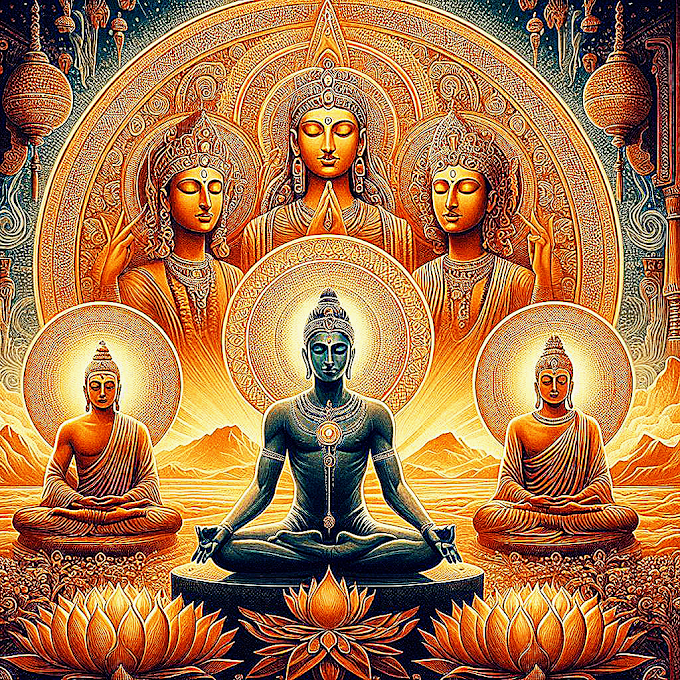
Vichara in the Bhagavad Gita emphasizes self-inquiry, discernment, and reflective wisdom as key tools for spiritual growth and liberation.
.png) |
| Concept of Vichara in the Bhagavad Gita |
Life often sweeps us along in a torrent of obligations, expectations, and unspoken anxieties. In such moments, asking ourselves, “Who really am I? What do I truly value?” feels revolutionary. This act of deep reflection and inner questioning is at the heart of Vichara, a Sanskrit term that conveys contemplative inquiry and self-investigation.
In the Bhagavad Gita, Vichara emerges as the crucible through which Arjuna’s paralyzing doubt becomes clarity. Early in Chapter 2, Verse 3, Arjuna confesses, “My limbs are failing, my mouth is parched, my body trembles” — a raw moment of existential crisis. Krishna’s response in Verses 11–12 reframes the scene: “As a man discards worn garments and puts on new ones, so the embodied self casts off old bodies and enters new ones.” This shift from agitation to insight exemplifies Vichara in action, showing that by questioning our beliefs about pain, success, and identity, we unlock a deeper stability within.
Consider Mira, a young professional juggling tight deadlines and social media pressures. Overwhelmed, she mirrors Arjuna’s battlefield anxiety—her “Kurukshetra” is the office boardroom. One evening, she pauses, journals, and asks: “Am I striving for this promotion out of passion or to silence my insecurities?” This deliberate pause—this moment of Vichara—reveals that her drive stemmed more from fear of judgment than genuine purpose. With that realization, she restructures her goals around projects she truly cares about, regaining both energy and equanimity.
Through its dialogic structure and practical examples—ancient and modern—the Gita teaches that Vichara is not mere navel-gazing but a powerful tool for transforming confusion into clarity, attachment into freedom, and reactive living into enlightened action.
What Is Vichara?
Vichara literally means “deliberation” or “thoughtful examination.” In Yogapedia’s words, it is a form of self-enquiry rooted in Vedanta philosophy that helps practitioners discern between Brahman (universal reality) and Atman (the Self) by continuously observing “I-centered” thoughts and recognizing their unreality.
Two Layers of the Mind
- Chitta: the storehouse of memories, habits, and ego-driven reactions.
- Buddhi: the faculty of pure, dispassionate intelligence that questions every assumption and seeks what is unchanging and true.
 |
| Concept of Vichara in the Bhagavad Gita |
Vichara begins when buddhi takes the lead—refusing to settle for comforting illusions and instead testing every concept, doctrine, and emotion against the criterion of lasting reality.
Scriptural Endorsements
- Yoga Vasistha, one of Vedanta’s most celebrated texts, explicitly recommends Vichara as the most direct path to self-realization and liberation.
- Ramana Maharshi popularized this practice in the modern era by teaching that persistent attention to the question “Who am I?” dissolves all transient thoughts, leaving only the true Self.
These references underscore that Vichara isn’t abstract theorizing but a time-tested method stretching back millennia.
A Practical Example
Imagine Sameer, who constantly worries “I’m not good enough.” Each time anxiety flares, he pauses and asks himself, “Who is saying this? Does this ‘I’ truly exist?” Over several weeks of such inquiry, the intensity of that self-criticism begins to dissolve. What remains is a quieter mind, able to observe challenges without being hijacked by the ego’s narratives. This shift—from automatic reaction to mindful examination—illustrates how Vichara turns inner turmoil into clarity and freedom.
Vichara in the Vedantic and Yogic Tradition
Roots in the Upanishads
The practice of Vichara finds its earliest scriptural foundation in the Upanishads’ mahāvākyas (Great Sayings), which briefly yet powerfully point toward the unity of Self and Reality.
- “Tat tvam asi” (That Thou Art) in the Chāndogya Upanishad invites you to question who the “Thou” is that stands behind every experience.
- “Aham brahmāsmi” (I am Brahman) in the Bṛhadāraṇyaka Upanishad drives the inquiry home: what is this “I” that claims such expansive identity?
 |
| Concept of Vichara in the Bhagavad Gita |
These terse declarations are not answers in themselves but springboards for sustained inquiry—Vichara—in which the intellect and intuition together peel away assumptions until only the unchanging Self remains.
Yoga Vasiṣṭha’s Endorsement
The Yoga Vasiṣṭha, a sprawling Advaita Vedānta text of over 29,000 Sanskrit verses attributed to Valmīki, repeatedly underscores self-investigation as the most direct path to liberation. It weaves fables and dialogues between Sage Vasiṣṭha and Prince Rāma to show how seemingly real “world” and “ego” dissolve when rigorously examined. By aligning the mind with pure awareness and dispassion—key outcomes of Vichara—the text demonstrates how latent impressions (saṃskāras) lose their power over the seeker’s consciousness.
Ramana Maharshi’s Atma Vichara in Practice
In the twentieth century, Bhagavan Ramana Maharshi distilled Vichara into a laser-focused self-enquiry known as ātma-vichāra. His earliest teachings, recorded in the Tamil work Nāṉ Yār? (“Who am I?”), make it clear that the very act of tracing every thought back to its source undermines the sense of a separate ego.
He outlined three “keys” for this inner investigation:
- Put the question “Who am I?” at the forefront of your awareness.
- When thoughts arise, immediately ask “Who knows these thoughts?”
- Once the feeling “I” is discerned, inquire “Where has this 'I' originated from?”
These questions aren’t meant to produce conceptual answers but to redirect attention inward, collapsing the habitual identification with body-mind and revealing the ever-present Self.
A Modern Practitioner’s Journey
Take Meera, a marketing manager plagued by burnout. Each time stress flares, she pauses and applies Ramana’s first key: “Who am I, before this role and these worries?” Over weeks of consistent self-enquiry, Meera notices that the frantic “I” behind her deadlines feels less substantial. The relentless chatter in her mind gradually yields to a quiet center that no task can disturb. Through Vichara, she transforms not just her perspective on work but her whole way of being—finding clarity, calm, and a direct taste of the Self at the heart of everyday life.
Key Aspects of Vichara in the Bhagavad Gita
- Self-Inquiry: Questioning Fear and Doubt
From the Gita’s early dialogue, Krishna confronts Arjuna’s paralysis on Kurukshetra with a pointed Vichara prompt: “Why do you waver, Arjuna?” (2.3). By inviting Arjuna to examine his fear of slaying kin, loss of reputation, and moral confusion, Krishna models how turning the spotlight on one’s own reactions disassembles the stories that cloud clear judgment.
Example: When Rupesh faces a career crossroads, he catches himself thinking, “I’ll fail if I leave my current job.” He pauses and asks, “Whose voice is this?” Over time, this kind of self-inquiry reveals that the fear isn’t about real performance but about losing social approval—and frees him to chart a path aligned with his core interests.
- Discrimination Between Real and Unreal
In Chapter 2, Verse 16, Krishna pronounces the Mahāvākya of Vichara:
“Na asato vidyate bhāvo, na abhilāpo vidyate satām”
(“The unreal has no being; the real never ceases to be.”)
This declaration compels a moment-to-moment discrimination: when loss or gain strikes, discern whether your distress pertains to the fleeting (anitya) or the eternal (nitya).
Example: After her startup fails, Shalini reflects on whether her identity was tied to the enterprise itself (impermanent) or to the skills and purpose she embodies (everlasting). This shift in perspective transforms her grief into renewed resolve.
- Action Without Attachment (Nishkāma Karma)
Chapter 2, Verse 47 delivers the heart of detached engagement:
“Karmanye vadhikāraste mā phaleṣu kadācana”
(“Your right is to perform action, never to its fruits.”)
 |
| Concept of Vichara in the Bhagavad Gita |
Vichara here acts as an internal audit: Am I laboring for praise and reward—or solely to fulfill my duty? By constantly checking motive, one dissolves the tyranny of success and failure and cultivates equanimity on any field of endeavor.
Example: Dr. Anjali resolves each day to serve her patients with full attention, dropping any expectation of accolades. Even when outcomes vary, her practice remains unshaken by praise or criticism.
- Contemplation on the Eternal Self
Verses 2.19–25 explore the indestructibility of the ātman. Through Vichara, the practitioner mentally rehearses—“I am not this body that ages and dies; I am the witness, unchanging”—so repeatedly that this conviction becomes a lived reality rather than a mere doctrine.
Example: Before an important exam, Neelam cultivates the refrain “I witness all thoughts without being bound by them.” Over time, test anxiety loses its grip, and she performs with steady focus.
- Discernment of Duty (Svadharma)
In Chapter 3, Verse 35, Krishna stresses:
“Sreyān svadharmo viguṇaḥ para-dharmāt svanushṭhitāt”
(“Better is one’s own duty, though imperfectly done, than the duty of another well performed.”)
Vichara sharpens the analysis of personal calling versus comfort. When sentiment tempts one to shirk responsibility, this inquiry aligns action with the cosmic order rather than short-term ease.
Example: Aisha, an engineer, wrestles with switching to design, fearing instability. Through Vichara she realizes that fulfilling her innate drive to create is her higher duty—so she embraces the risk and finds greater satisfaction.
- Reflecting on the Three Guṇas
Chapter 14 outlines how Sattva (clarity), Rajas (activity), and Tamas (inertia) color every thought and action. Vichara identifies the dominant guṇa in the moment—“I am restless and ambitious (Rajas)” or “I feel lethargic and confused (Tamas)”—so one can consciously cultivate balance (Sattva) and modulate the other two.
 |
| Concept of Vichara in the Bhagavad Gita |
Example: During a creative block, Jayanta notices creeping lethargy (Tamas). By recognizing it, he adopts a brief walking meditation to revive clarity and shift toward Sattvic calm.
- Contemplation on the Divine Cosmic Form
In Chapter 11, Arjuna beholds Krishna’s viśvarūpa (universal form). Vichara here transcends mere marvel: one studies how every creature, element, and moment of time pulses within that luminous totality. By doing so, the perceived boundary between individual and universe dissolves, igniting both reverence and inner expansiveness.
Example: Meditating on a star-filled sky, Kavita applies Vichara: “If each star is a spark of the same essence, what does my separate ‘I’ signify?” This inquiry yields a profound sense of interconnectedness and humility.
Practical Examples of Vichara in Daily Life
Example 1: Career Crossroads
Imagine you’re offered two jobs: one prestigious but misaligned with your values, the other modest but meaningful. Vichara invites you to journal questions like:
- “What truly motivates me?”
- “How will each role shape my sense of purpose?”
- “Will I feel proud when I look back in ten years?”
Through self-inquiry, the seeming “right” package of salary and status may pale beside a role that nurtures your soul.
Example 2: Navigating Relationship Conflict
When a friend’s words sting, the reactive mind (chitta) wants to blame. Vichara prompts:
- “What fear is surfacing—of rejection, inadequacy?”
- “Whose pain am I feeling—mine or theirs?”
By dissecting the emotion, you step back from knee-jerk defensiveness and choose a compassionate response instead of perpetuating the conflict.
Example 3: Managing Stress
Under looming deadlines, it’s easy to spiral into frantic doing. Pause, breathe, and ask:
- “Which Guna is driving me—Rajas (restlessness)?”
- “Can I recenter through a brief meditation on my breath or on the thought ‘I am the witness’?”
This swift inner check-in turns stress into focused action.
Example 4: Coping with Loss
Facing bereavement or breakup often triggers existential dread. Vichara suggests:
- “What is truly lost? Love as an energetic bond or just its particular form?”
- “How does the body mind’s grief differ from the soul’s unbroken peace?”
Through this lens, grief becomes an occasion to experience the depth and resilience of the Self.
Vichara as a Path to Self-Realization
Over centuries, teachers from Śaṅkara to Ramana Maharshi have shown that intellectual exercise alone cannot reveal the Self—instead, it must flow into one-pointed meditation and direct experience. Vichara charts this very journey through three interlocking stages:
The seeker listens to sacred teachings—scripture, a guru’s guidance, or inner promptings—absorbing their import without resistance. In the Bhagavad Gita, Krishna instructs Arjuna to repeatedly focus on the nature of the Self (Atman) and the impermanence of the body and mind, laying the groundwork for deeper inquiry (2.44).
- Manana (Reflective Inquiry):
Here the intellect (buddhi) probes every assertion, asking “Is this absolute or relative?” This mirrors Tlayt.org’s description of buddhi meeting a “blank wall,” where reason exhausts itself and points beyond logic to direct knowing. By examining each concept—“Am I this thought? Am I this fear?”—the mind uncovers the gap between fleeting ideas and the constant witness behind them.
- Nididhyāsana (Meditative Absorption):
Once the field is cleared by analysis, the practitioner rests undistracted in the awareness that remains. Ramana Maharshi called this ātma-vichāra, or Self-enquiry: persistently tracing every thought back to its source—the “I” that knows, not the content of knowing. As thoughts fade, only the pure sense of “I-I” (self-awareness) stands revealed.
These stages form a spiraling ladder. Each round of Śravaṇa sharpens Manana; each clear insight deepens Nididhyāsana; each silent moment primes the next listening. Over time, the habitual identification with body-mind loosens its grip.
Scriptural and Traditional Anchors
“O Arjuna, fixed in yoga, do your duty, abandoning attachment; established in evenness of mind, enjoy.” Here “evenness of mind” (samaṃ śaraṇaṃ) points to the stable witness that Vichara uncovers through meditation on the Self.
In his Bhaṭṭa Bhāṣya, Śaṅkara emphasizes that mere hearing of the Gita’s truths is insufficient; one must meditate on them (manana) and then realize them experientially (nididhyāsana). This triad is ideal preparation for Self-inquiry.
- Ramana Maharshi’s Ātma-Vichāra
Maharshi wrote, “There are two ways: ask yourself ‘Who am I?’ or submit to the Guru.” When one turns attention away from every object and toward the subject “I,” thoughts collapse and self-awareness shines alone.
A Practical Example
Case Study: Overcoming Meeting Anxiety
Priya, a project manager, froze each time she chaired a high-stakes meeting. Following Vichara’s roadmap:
- Śravaṇa: She revisited Gita 2.44 and a short talk by her mentor on the impermanence of outcomes.
- Manana: Priya journaled, “What am I really afraid of? Losing face? Failing to control?” She questioned each worry until only the core sense of “I must perform” remained.
- Nididhyāsana: Before her next meeting, she sat for five minutes tracking her heartbeat, then asked silently, “Who is anxious?” As the thought “I am anxious” surfaced, she redirected attention to the silent space beneath the thought—her unchanging Self.
When she entered the meeting, Priya felt grounded by that silent witness. Feedback still flowed, decisions still needed to be made—but she no longer felt swept away by fear. By following the Vichara sequence—analysis, meditative focus, direct witnessing—Priya transformed anxiety into calm clarity.
Benefits of Cultivating Vichara
Overcoming Doubt
Reflective vichara engages the buddhi in continuous self-dialogue—questioning every premise like “Am I this fear?” or “Where does this hesitation arise?”—until every uncertainty is thoroughly tested and transcended. Practitioners report that this method dissolves the mental logjam that often stalls decisions and action.
Clarity of Purpose
By parsing experience through the lens of dharma, vichara distinguishes the essential from the incidental. As David Frawley explains, dharma forms the first of the four Purusharthas, guiding inner purpose and ethical alignment.
Example: A teacher uses vichara to decide which project tasks truly serve her life mission versus mere busywork, streamlining her workload to what genuinely fulfills her calling rather than what just fills her calendar.
Emotional Equanimity
Cultivating Sama (equanimity) through vichara balances the mind amid pleasure and pain. The Bhagavad Gita repeatedly advises remaining unmoved by success and failure as a prerequisite for wisdom and self-realization.
Example: A graphic designer subjected to harsh criticism learns to observe each comment as passing data rather than personal attack, maintaining composure and creative flow regardless of external feedback.
Inner Freedom
As vichara peels back layers of identification with fleeting thoughts and emotions, the practitioner recognizes the timeless witness within. This shift naturally opens the gateway to Moksha—the fourth Purushartha or ultimate freedom of consciousness—where liberation is experienced as inner spaciousness, not a distant goal.
Example: A corporate executive nearing retirement turns vichara inward, moving from “I was a CEO” to “I am the observer of roles,” and finds profound release from career-based anxiety.
Integrative Wisdom
Through discerning the interplay of sattva, rajas, and tamas (the three Gunas) and how they shape one’s duties and divine purpose, vichara fosters holistic insight. The four Purusharthas—Dharma, Artha, Kama, Moksha—are not isolated aims but interwoven pillars of a balanced life, all illuminated by self-inquiry.
Example: A social worker employs vichara to align her livelihood (Artha), service orientation (Dharma), personal passions (Kama), and spiritual aspirations (Moksha), creating a coherent path that honors every dimension of her being.
Conclusion
In the Bhagavad Gita, Vichara is neither escapist daydreaming nor sterile academic debate—it is the dynamic process by which the mind clarifies, refines, and ultimately awakens to its truest nature. Through moments of self-inquiry, discrimination, detached action, and contemplative meditation, the soul transcends its own constructs, moving from confusion to clarity, from bondage to liberation.
By inviting Vichara into your daily life—whether during a career choice, emotional challenge, or simple breath awareness—you give yourself the chance to meet the timeless Self that lies at the heart of every experience. As Krishna guides Arjuna from hesitation to conviction, so Vichara guides us from reactivity to radiant insight. Integrate this noble practice, and watch as the battlefield of your mind transforms into a sanctuary of peace and purpose.
Bhagavad Gita Verses Related to Vichāra
“buddhi-yukto jahātīha ubhe sukṛta-duṣkṛte / tasmād yogāya yujyasva yogaḥ karmasu kauśalam”
→ With the intellect (buddhi) united with yoga, one abandons both good and bad actions. Therefore engage in yoga, which is skill in action.
(Here, buddhi-yoga = reflective inquiry guiding action, i.e., vichāra in practice.)
“tad viddhi praṇipātena paripraśnena sevayā / upadekṣyanti te jñānaṁ jñāninas tattva-darśinaḥ”
→ Approach the wise with humility, questioning (paripraśna, a form of vichāra), and service; they will teach you true knowledge.
(This verse directly validates inquiry as a spiritual method.)
“iti te jñānam ākhyātaṁ guhyād guhyataraṁ mayā / vimṛśyaitad aśeṣeṇa yathecchasi tathā kuru”
→ Thus I have explained to you this knowledge, the most secret of secrets. Reflect on it (vimṛśya = deep consideration/vichāra) fully, and then act as you wish.
(Explicit use of “reflection” as the bridge between knowledge and action.)
“adhyeṣyate ca ya imaṁ dharmyaṁ saṁvādam āvayoḥ / jñāna-yajñena tenāham iṣṭaḥ syām iti me matiḥ”
→ One who studies this sacred dialogue with reflection (adhyayanam here includes reflective contemplation) worships Me through the sacrifice of knowledge.
“dhyānenātmani paśyanti kecid ātmānam ātmanā / anye sāṅkhyena yogena karma-yogena cāpare”
→ Some perceive the Self through meditation, others through discriminative knowledge (sankhya), and others through action.
(Discriminative analysis = vichāra.)
FAQ
Q1. What is the meaning of vichara?
Ans: Vichara means deep, reflective inquiry—especially into the nature of the self, truth, and reality. It’s a process of inner questioning that leads to wisdom and clarity.
Q2. What is the concept of healthy living style in Bhagavad Gita?
Ans: The Bhagavad Gita promotes a balanced lifestyle through moderation in eating, sleeping, and activity, as stated in Chapter 6, Verse 16. It emphasizes Sattvic living—pure, mindful habits that nourish both body and soul.
Q3. What is the core concept of the Bhagavad Gita?
Ans: The core concept of the Bhagavad Gita is Nishkam Karma—performing one's duty without attachment to outcomes. It teaches selfless action, inner discipline, and spiritual wisdom as paths to liberation.
Q4. What are the four principles of the Bhagavad Gita?
Ans: The four moral principles in the Bhagavad Gita are truthfulness, nonviolence, cleanliness, and austerity—universal values for righteous living. These guide one’s conduct toward purity, compassion, and spiritual growth.
Q5. What is the meaning of shrimad?
Ans: "Shrimad" is a Sanskrit honorific meaning “revered” or “glorious,” often used to denote sacredness or divine excellence. It’s prefixed to holy texts or names to show deep respect and spiritual significance.


.png)
.png)


.png)