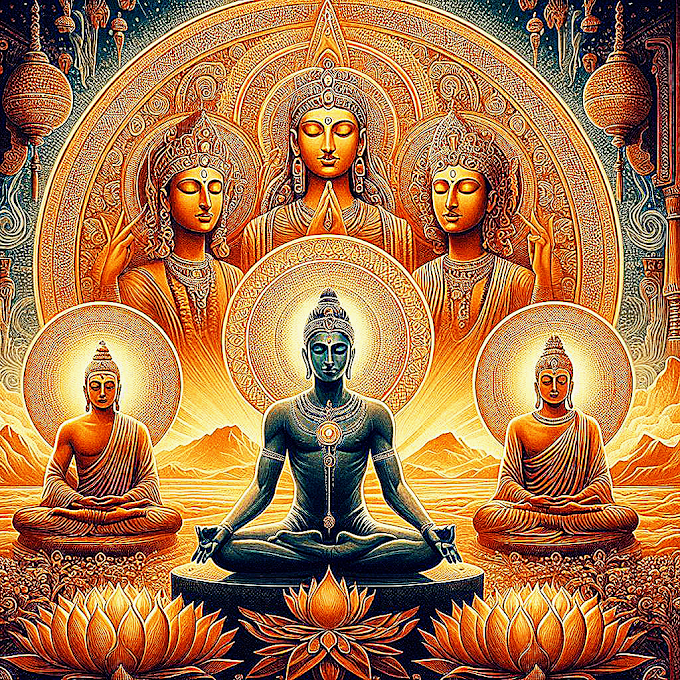
Explore various types of meditation—mindfulness, mantra, transcendental, and more—each offering unique paths to inner peace and self-awareness.
 |
| Types of Meditation in Indian Philosophy |
Meditation, or Dhyana, is far more than a wellness trend—it is a timeless spiritual discipline rooted in the depths of Indian philosophy. From the Vedic hymns to the Yoga Sutras of Patanjali, from the Upanishadic vidyas to the Tantric mantras, meditation has evolved into a rich tapestry of techniques, each tailored to different temperaments and spiritual goals. This blog explores the major types of meditation as outlined in classical texts and contemporary interpretations, offering a panoramic view of how seekers across traditions engage with the inner world.
The Universal Role of Meditation Across Paths: A Deeper Convergence
Swami Bhajanananda, in Types of Meditation – Part 2, articulates a profound insight: meditation is not a standalone technique but a shared spiritual milestone across diverse paths of Indian philosophy. Whether one begins with intellectual inquiry, devotional surrender, disciplined practice, or selfless action, each path eventually converges at the meditative stage—a state of single-pointed awareness that transcends the multiplicity of methods.
Jnana Yoga: Nididhyasana as Inner Inquiry
In Advaita Vedanta, meditation takes the form of Nididhyasana—a sustained contemplation on the mahavakyas (great Upanishadic statements) like Tat Tvam Asi (“That Thou Art”). As Shankara explains in his commentary on the Brihadaranyaka Upanishad, Nididhyasana is not mere repetition but a deep, unwavering absorption in the truth of non-duality. It follows Sravana (listening) and Manana (reflection), culminating in direct realization of the Self as Brahman.
“When these three—Sravana, Manana, and Nididhyasana—are combined, then only true realization of the unity of Brahman is accomplished.” — Shankara Bhashya on BU 2.4.5
 |
| Types of Meditation in Indian Philosophy |
Bhakti Yoga: Upasana as Devotional Meditation
In Bhakti traditions, Upasana means “sitting near” the Divine. It is both intimate worship and meditative absorption, often involving visualization of deities, chanting of names (Nama Upasana), or symbolic contemplation (Pratika Upasana). The Bhagavad Gita (Chapter 12) extols both personal and impersonal Upasana, affirming that devotion—when deepened into meditation—leads to union with the Divine.
“Fix your mind on Me alone, rest your intellect in Me; then you shall live in Me hereafter.” — Bhagavad Gita 12.8
Raja Yoga: Dhyana as Mental Discipline
Patanjali’s Yoga Sutras define Dhyana as the uninterrupted flow of consciousness toward a chosen object. It is preceded by Dharana (concentration) and followed by Samadhi (absorption). Unlike Vedantic Upasana, which is conceptually framed, Patanjali’s Dhyana is experiential and technique-driven, aiming at the isolation of Purusha (pure consciousness) from Prakriti (matter).
 |
| Types of Meditation in Indian Philosophy |
Karma Yoga: Meditation in Action
Even in the path of action, meditation finds its place. The Gita encourages Karma Yoga with Brahmaarpanam—offering every action as worship. This transforms work into a meditative act, where the doer remains detached and aware. Zen Buddhism echoes this in its concept of walking meditation or action meditation, where mindfulness permeates every movement.
Cross-Cultural Convergence: Zazen and Muraqaba
Zen Buddhism: Zazen as Just Sitting
Zazen, meaning “seated meditation,” is the cornerstone of Zen practice. It emphasizes Shikantaza—“just sitting”—without striving or conceptualization. Master Dogen taught that Zazen is not a means to enlightenment but enlightenment itself expressed in posture. It mirrors the Vedantic idea of Nididhyasana, where the meditator abides in the truth already heard and reflected upon.
 |
| Types of Meditation in Indian Philosophy |
Sufism: Muraqaba as Divine Watchfulness
In Sufi mysticism, Muraqaba means “watchfulness” or “vigilance.” It is a meditative state where the seeker becomes aware of the Divine’s constant presence. Rooted in the Hadith, “Worship Allah as if you see Him,” Muraqaba cultivates God-consciousness (taqwa) through silent contemplation. Like Upasana, it involves devotional proximity, but with an emphasis on inner surrender and mystical union.
Meditation as the Shared Highway
Swami Bhajanananda beautifully compares meditation to a broad highway with many lanes—each spiritual path enters through its own gate but travels the same road of meditative awareness. Whether one chants the name of Krishna, contemplates the Self, visualizes a deity, or simply sits in silence, the essence remains: stilling the mind to awaken the soul.
“Meditation thus acts as a great junction where all spiritual paths converge, meet, go together for a short distance—and then diverge again to their respective goals.” — Swami Bhajanananda
Subjective vs. Objective Meditation
Objective Meditation (Upasana)
Objective meditation centers the mind on an external symbol or quality—whether a deity’s form, the brilliance of light, the vastness of sky, or virtues like love and compassion. In this practice, the aspirant deliberately “sits near” the chosen object, using visualization, mantra, or prayer to hold the mind fixed and to cultivate devotional energy.
Examples of Upasana in practice:
- Devotional visualization of Krishna’s blue form in Bhakti traditions, accompanied by chanting the Hare Krishna maha-mantra.
- Tantric deity meditation, where the practitioner mentally constructs the yantra and recites the deity’s seed-syllable (bīja) to invoke inner presence.
- Vedic “substitute sacrifice” meditations (Aranyakas), where the ritual fire, sun, or breath become focal points for inward worship, as seen in the Īśāvāsyopaniṣad’s contemplation of Satya Brahman.
READ MORE:
Subjective Meditation (Nididhyasana)
In subjective meditation, the seeker turns the gaze inward to trace the source of the “I”-thought back to the Self (Ātman). Known in Advaita Vedānta as Nididhyāsana, it is a sustained, unforced dwelling on the mahāvākyas—great Upaniṣadic statements such as “Tat Tvam Asi” (“That Thou Art”). Through repeated reflection and absorption, Nididhyāsana transforms intellectual knowledge into direct realization of non-duality.
Key features of Nididhyāsana:
- Rather than erecting a mental boundary around distractions, the meditator simply holds on to the “I”-center, letting all other thoughts subside naturally.
- It follows śravaṇa (listening to the teaching) and manana (reflective reasoning) and culminates in effortless abiding (dhyāna) and even samādhi.
 |
| Types of Meditation in Indian Philosophy |
Complementary Practice: Balancing Devotion and Inquiry
Swami Bhajanananda advises that Objective and Subjective meditations are two wings of the same bird—one purifies the heart through devotion and form, the other severs attachments through self-inquiry. When woven together, Upasana and Nididhyāsana guide the aspirant from loving surrender to the dawn of Self-knowledge, ensuring growth that is both expansive and penetrating.
Yogic Meditation: Patanjali’s Eightfold Path
The Yoga Sutras of Patanjali map out meditation as the culminating arc of an eight-limb practice—Ashtanga Yoga. The first five limbs prepare body and mind through ethical observances (Yama, Niyama), posture (Asana), breath control (Pranayama) and sense withdrawal (Pratyahara). The final three—Dharana, Dhyana and Samadhi—form Antaranga Yoga, the inner path from scattered thought to unified awareness.
1. Dharana: The Art of Fixing the Mind
In Sutra 3.1, Patanjali defines Dharana as the binding of the mind to a single support—be it the breath, a mantra, a visual form, or an inner point of focus. The practice consists of gently returning attention each time distractions arise, until the mind abides steadily in one place.
Example
- Candle-flame meditation: The practitioner holds gaze on the flame’s tip. Gradually the dance of flicker and shadow fades, leaving a calm inner steadiness.
2. Dhyana: The Flow of Unbroken Awareness
When one-pointed concentration ripens into a smooth, uninterrupted stream, it becomes Dhyana. Patanjali’s Sutra 3.2 describes this as “the uninterrupted flow of awareness toward the chosen object,” akin to a river that glides without obstruction.
Example
- Mantra immersion: Repetition of “Om” shifts from effortful chanting to a living vibration. Attention rests in the resonance, undisturbed by-passing thoughts.
3. Samadhi: Transcending Duality
In Sutra 3.3, Samadhi is portrayed as the state where the meditator and the object of meditation merge. All sense of separation dissolves. Only the essence of the object remains, shining forth in pure awareness.
Example
- Breath absorption: Watching inhalation and exhalation leads to a point where breath itself becomes the sole reality. The witness-witnessed distinction vanishes.
 |
| Types of Meditation in Indian Philosophy |
4. Samyama: Integration and Insight
Patanjali names the seamless integration of Dharana, Dhyana and Samadhi Samyama. He calls it the “master key” to intuitive wisdom (Prajñā) and to unfolding the mind’s hidden capacities (Siddhis). Yet he warns that these powers are incidental; the ultimate goal remains Self-realization, freedom from ignorance.
Hatha Yoga Techniques: Sound, Elements, and Light
The classical Hatha Yoga texts—Hathapradipika, Gheranda Samhita, and Hatharatnavali—offer a rich tapestry of meditative techniques that bridge the physical and subtle dimensions of yogic practice. These methods are not merely preparatory but are designed to lead the practitioner toward Samadhi, the ultimate absorption of consciousness.
Nāda Anusandhāna: Meditation on Inner Sound
Nāda Anusandhāna, or the pursuit of inner sound, is a profound auditory meditation described in the Hathapradipika (Chapter IV). It involves tuning into subtle sounds perceived during deep meditation, progressing through four stages:
- Ārambha: The initial stage where external sounds are heard, often resembling ocean waves or buzzing.
- Ghata: The merging of the mind with the sound; distractions begin to fade.
- Parichaya: Familiarity with the inner sound deepens; the practitioner hears more refined tones like flute or bell.
- Nispatti: The culmination where the sound dissolves into silence, leading to Samadhi.
The Shiva Samhita also references Nāda as a gateway to liberation, stating that “when the mind becomes absorbed in Nāda, it becomes free from all distractions.”
Panch Dharanas: Elemental Concentrations
The Gheranda Samhita (Chapter V) outlines Panch Dharanas, meditations on the five elements—Prithvi (Earth), Apas (Water), Agni (Fire), Vayu (Air), and Akasha (Ether). Each element is visualized in a specific location in the body and associated with a bija mantra:
| Element | Location | Bija Mantra | Visualization |
|---|
| Earth (Prithvi) | Muladhara Chakra | Lam | Yellow square |
| Water (Apas) | Svadhisthana Chakra | Vam | Silver crescent |
| Fire (Agni) | Manipura Chakra | Ram | Red triangle |
| Air (Vayu) | Anahata Chakra | Yam | Blue circle |
| Ether (Akasha) | Vishuddha Chakra | Ham | Black oval or void |
These Dharanas purify the Pancha Mahabhutas (five great elements) and stabilize the mind, preparing it for higher states of meditation.
Threefold Dhyana: Gross, Light, and Subtle
The Hatharatnavali and Gheranda Samhita describe a threefold approach to Dhyana (meditation):
- Sthula Dhyana (Gross): Meditation on a physical form, such as a deity or symbol. This anchors the mind and cultivates devotion.
- Jyoti Dhyana (Light): Visualization of inner light, often at the Ajna Chakra. This practice is said to awaken intuition and dissolve mental fog.
- Sukshma Dhyana (Subtle): Meditation on abstract concepts like space, silence, or pure consciousness. It leads the practitioner beyond form into the realm of Nirguna Brahman (formless reality).
The Gheranda Samhita (Chapter VI) emphasizes that these meditations refine the Antahkarana (inner instrument), allowing the yogi to transcend duality.
Final Integration: Kundalini and Nadi Purification
All these techniques serve a unified purpose: the purification of Nadis (energy channels) and the awakening of Kundalini Shakti. The Hathapradipika asserts that without purified Nadis, the ascent of Kundalini is obstructed. Practices like Bhastrika Pranayama, Mudras (e.g., Mahamudra, Khechari), and Bandhas (e.g., Mula Bandha, Jalandhara Bandha) are often integrated with meditation to facilitate this energetic transformation.
Once Kundalini rises through the Sushumna Nadi, the practitioner experiences Dhyana not as a technique but as a spontaneous absorption into pure awareness.
Tantra and Symbolic Meditation: The Alchemy of Inner Transformation
Tantric traditions, both Śaiva and Śākta, redefined the landscape of meditation by embracing the symbolic, sonic, and self-reflective dimensions of consciousness. Unlike purely abstract or ascetic approaches, Tantra celebrates the manifest world as sacred, using its forms and energies as gateways to transcendence. The three primary modes—Pratika Upasana, Nama Upasana, and Ahamgraha Upasana—offer tailored meditative paths for diverse temperaments.
Pratika Upasana: Visual Meditation on Sacred Symbols
Derived from the Sanskrit pratika (symbol or representation), Pratika Upasana involves meditating on visual forms that embody divine principles. These may include:
- Yantras: Geometric diagrams like the Sri Yantra, representing the cosmos and the Divine Feminine. The Tripurarnava Tantra and Bhavanopanishad describe yantra meditation as a method to internalize cosmic order.
- Deity Forms: Visualization of deities such as Kali, Shiva, or Ganesha, often accompanied by mudras and ritual offerings. The Kularnava Tantra emphasizes that the form is not merely symbolic—it is alive with Shakti.
- Natural Elements: Fire, moon, lotus, or sky are used as meditative anchors, echoing Vedic pratikas like Agni and Surya.
 |
| Types of Meditation in Indian Philosophy |
“The purpose of Pratika Upasana is not mere concentration but the direct vision of the deity represented by the symbol.” — Swami Bhajanananda
This form-oriented meditation is ideal for those drawn to aesthetic devotion, ritual precision, and visual imagination.
Nama Upasana: Mantra and Sacred Sound Meditation
Nama Upasana centers on sound as the bridge to the Divine. Mantras—sacred syllables or names—are repeated with reverence, rhythm, and mental focus. Examples include:
- Bija Mantras: Seed sounds like Om, Aim, Hrim, each resonating with specific deities and chakras.
- Nama Japa: Repetition of divine names such as Om Namah Shivaya or Sri Lalita Sahasranama, often practiced with a mala (rosary).
- Tantric Mantras: Complex sonic formulas from texts like the Vamakeshwari Tantra, used in Sri Vidya Upasana to invoke the Goddess in her dynamic aspect.
The Gheranda Samhita and Rudra Yamala Tantra affirm that sound is not symbolic—it is vibrationally real, capable of transforming consciousness and awakening latent energies.
“Nama is not just a name—it is the presence of the Divine in sonic form.” — Sri Vidya Upasana tradition
This path suits auditory-oriented seekers, those who resonate with rhythm, chant, and vibrational healing.
Ahamgraha Upasana: Meditation on the Self as Divine
Ahamgraha Upasana, from aham (I), graha (grasping), and upasana (worship), is a subjective-objective meditation where the practitioner identifies the Self with the Supreme. It is described in Vedantic and Tantric texts as a double meditation:
- On the Self as part of God: Recognizing the individual soul (jivatman) as a spark of the infinite (paramatman).
- On God as immanent in all beings: Cultivating awareness of divine presence in creation.
The Yogapedia defines it as “meditation in which the person identifies with the object of meditation, becoming one with Brahman”. The Vedanta texts elaborate that this leads to non-dual realization, where the meditator, the act of meditation, and the object all dissolve into pure awareness.
“Ahamgraha Upasana is not ego inflation—it is ego transcendence.” — Swami Bhajanananda
This path is ideal for introspective seekers, philosophers, and those drawn to self-inquiry and mystical union.
Final Integration: Choosing the Right Symbolic Path
Tantra’s genius lies in its psychological inclusivity. Whether one is drawn to form, sound, or pure awareness, there is a meditative gateway tailored to their nature. These methods are not mutually exclusive—they can be layered and sequenced:
- Begin with Pratika Upasana to stabilize the mind.
- Transition into Nama Upasana to refine inner vibration.
- Culminate in Ahamgraha Upasana to dissolve boundaries and realize unity.
In advanced Tantric sadhana, these three are often practiced in tandem, forming a triple helix of transformation—symbol, sound, and Self—leading the aspirant from outer ritual to inner realization.
Dhyana in the Bhagavad Gita and Upanishads: The Inner Bridge to Brahman
Meditation (Dhyana) in Indian philosophy is not merely a mental exercise—it is a sacred discipline that leads the seeker from individual identity to cosmic unity, from form to formlessness, and ultimately to Self-realization. Both the Bhagavad Gita and the Upanishads present Dhyana as a central spiritual practice, each offering unique perspectives on its purpose and method.
Dhyana Yoga in the Bhagavad Gita: The Path of Inner Equilibrium
Chapter 6 of the Bhagavad Gita, titled Dhyana Yoga, outlines a comprehensive framework for meditation. Krishna presents it as the culmination of disciplined living, ethical conduct, and mental purification.
Key Verses and Insights:
- BG 6.11–12: “Let the yogi prepare a firm seat in a clean place... seated there, let him focus the mind for self-purification.”
- BG 6.13–14: “Holding the body, head, and neck erect... serene-minded, fearless, and celibate, let him meditate on Me.”
- BG 6.17: “He who is temperate in eating, sleeping, working and recreation can mitigate all material pains by practicing the yoga system.”
- BG 6.19: “As a lamp in a windless place does not flicker, so is the yogi whose mind is steady in meditation.”
Krishna emphasizes moderation, solitude, and one-pointed focus as prerequisites. The ultimate goal is Samadhi—a state of absorption where the yogi experiences infinite bliss, untouched by sorrow or desire.
“Let this be known as Yoga—the severance from union with pain.” — BG 6.23
Upanishadic Dhyana: Symbolic Meditations on Brahman
The Upanishads elevate Dhyana to a metaphysical practice, using vidyas—symbolic contemplations—to guide the seeker from the tangible to the transcendent.
Sandilya Vidya (Chandogya Upanishad 3.14)
This vidya begins with the declaration:
“Sarvam khalvidam Brahma—All this is verily Brahman.”
The meditation involves contemplating Brahman as:
- Origin: That from which all arises.
- Sustenance: That in which all lives.
- Dissolution: That into which all returns.
The practitioner is instructed to meditate on Brahman as the inner Self, smaller than an atom yet greater than the cosmos. This vidya bridges Saguna Brahman (with attributes) and Nirguna Brahman (formless reality), making it accessible to both devotional and philosophical seekers.
Antaryami Vidya (Brihadaranyaka Upanishad 3.7)
This vidya explores the Indwelling Controller (Antaryamin)—the unseen presence within all beings and elements. The Upanishad lists various entities (earth, water, fire, mind, etc.) and declares:
“He who dwells in the earth, yet is other than the earth... who controls the earth from within—He is your Self, the Inner Controller.”
This meditation cultivates awareness of divine immanence, training the mind to perceive Brahman as the silent witness and governor within all forms. It dissolves duality and fosters universal empathy and reverence.
Final Elaboration: From Discipline to Realization
Both the Gita and the Upanishads converge on a central insight: true meditation is not about effort—it is about surrender. Whether one begins with a mantra, a deity, or a philosophical inquiry, the goal is the same: to transcend the ego and merge with the Self.
A suggested progression for modern seekers might be:
- Lifestyle Preparation: Follow Gita 6.17—moderate habits and ethical living.
- Symbolic Anchoring: Begin with Sandilya Vidya—meditate on Brahman as cosmic source.
- Inner Expansion: Practice Antaryami Vidya—see the Divine within all beings.
- Silent Absorption: Culminate in Dhyana Yoga—rest in pure awareness, beyond thought and form.
This layered approach honors the Tantric inclusivity and Vedantic depth, offering a complete path from ritual to realization, from symbol to silence.
Choosing Your Path: Meditation for Every Mind
Based on temperament and orientation, meditation can be personalized:
| Mind Type | Preferred Meditation | Example Practice |
|---|
| Form-Oriented | Pratika Upasana | Visualizing deity or light |
| Sound-Oriented | Nama Upasana | Chanting mantras or sacred names |
| Self-Oriented | Ahamgraha Upasana / Nididhyasana | Meditating on the Self or “I am Brahman” |
This flexibility ensures that meditation is not a rigid formula but a living, breathing path to inner freedom.
Final Thoughts: Meditation as Transformation
Meditation is not just a technique—it is a transformation. Whether through sound, form, breath, or inquiry, it leads us from fragmentation to wholeness, from ego to essence. As the Gita reminds us, “To nourish the soul, we must purify our intake—one thought, one breath, one moment at a time.”
In the words of Swami Vivekananda:
“Meditation is the means of unification of the soul with the Absolute.”
So choose your lane, enter the highway of awareness, and let meditation be your guide to the luminous realm of the Spirit.
FAQ
Q1. What are the 7 types of meditation?
Ans: The seven common types of meditation include mindfulness, mantra, transcendental, spiritual, movement (like yoga), focused attention, and loving-kindness. Each cultivates awareness through different techniques—breath, sound, visualization, or intention.
Q2. What are the three major types of meditation?
Ans: The three major types of meditation are mindfulness, focused attention, and open monitoring. Each trains the mind differently—through present awareness, concentration on a single object, or observing thoughts without judgment.
Q3. Which meditation is very powerful?
Ans: Transcendental Meditation (TM) is often considered one of the most powerful forms, using a personalized mantra to reach deep states of rest and awareness. It’s backed by research for reducing stress, enhancing focus, and improving overall well-being.
Q4. What are the 9 stages of meditation?
Ans: The 9 stages of meditation in Shamatha practice include: placement, continuous attention, repeated attention, close attention, taming, pacifying, complete pacifying, single-pointed attention, and balanced attention. Each stage deepens focus and calms the mind toward stable, effortless awareness.
Q5. Which is the highest form of meditation?
Ans: The highest form of meditation is often considered Samadhi, a state of complete absorption where the meditator merges with pure consciousness. In Tibetan Buddhism, Mahamudra is revered as the pinnacle practice for realizing the nature of mind.
Q6. What are the 4 pillars of meditation?
Ans: The 4 pillars of meditation, known as the Four Foundations of Mindfulness, are: mindfulness of the body, feelings, mind, and mental objects (dhammas). These guide practitioners from physical awareness to deep insight and liberation.


.png)


.png)