.png)
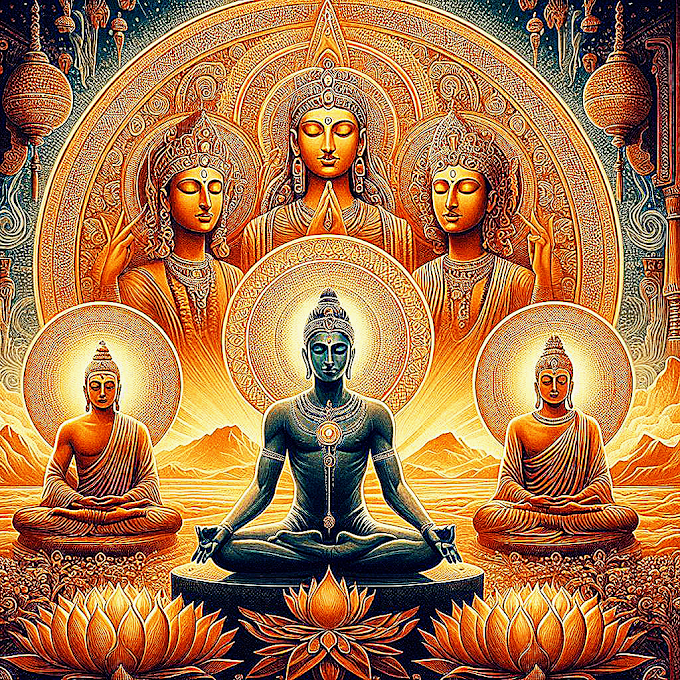
Steady wisdom of Sthitha Prajña in the Bhagavad Gita—embodies inner balance, freedom from ego, and equanimity amid life’s dualities.
 |
| Steady wisdom of Sthitha Prajña in the Bhagavad Gita |
A Question That Changed the Gita’s Tone
In the Bhagavad Gita’s second chapter, Krishna has just unveiled the eternal nature of the soul (ātman), the inevitability of change, and the call to act without attachment. Yet Arjuna, still caught in the turbulence of grief and moral confusion, interrupts with a deeply human question:
“O Keshava, what is the language of one who is established in wisdom? How does such a person speak, sit, and walk?” (Bhagavad Gita 2.54)
This is not a request for more metaphysics—it is a plea for embodied wisdom. Arjuna wants a living portrait of the jīvan-mukta—the liberated one who has mastered the inner battlefield.
Krishna’s reply, from verses 2.55 to 2.72, is the celebrated Sthitha Prajña Lakṣaṇa—a psychological, ethical, and spiritual profile of the person of steady wisdom.Textual Anchors: Verse-by-Verse Foundations
2.55 – Prajahāti yadā kāmān sarvān pārtha mano-gatān…“When one discards all selfish desires born of mental constructs, and is satisfied in the Self alone, such a person is called steady in wisdom.”
- Key idea: Desire-renunciation is not suppression but transcendence—desires lose their pull because the Self is experienced as complete.
- Metaphor: Like a river reaching the ocean, the mind finds its home in the infinite and no longer seeks scattered streams.
“He whose mind is undisturbed in sorrow, free from longing in joy, and who is free from attachment, fear, and anger, is called a sage of steady mind.”
- Key idea: Emotional symmetry—neither elated by gain nor crushed by loss.
- Metaphor: The mind as a polished mirror, reflecting events without distortion.
Modern Scientific Parallels: Equanimity and Emotional Regulation
Contemporary psychology has begun to map what Krishna described millennia ago:- Equanimity as Emotional Regulation:
- Neuroscience of Detachment:
- Cultivation Pathways:
- Emotional Intelligence Link:
Philosophical Insight: From Conduct to Consciousness
Arjuna’s phrasing—“How does he speak, sit, and walk?”—is deceptively simple. In Vedantic hermeneutics, these are metonymies for the entire spectrum of human behavior:- Speak → How one expresses truth without ego.
- Sit → How one rests in the Self, unmoved by external agitation.
- Walk → How one acts in the world without losing inner stillness.
Symbolic Imagery: The Ocean Metaphor (2.70)
“As rivers flow into the ocean, which is ever being filled yet remains unmoved, so too the one who is steady in wisdom is unmoved by desires.”
This is both poetic and psychologically precise: the ocean’s depth represents cognitive-emotional capacity—the ability to absorb life’s inputs without overflow or turbulence.Etymology and Core Meaning
Sthitha (स्थित) – from the Sanskrit root sthā (“to stand, to remain”), meaning stable, unmoved, anchored, firmly established. In Vedantic usage, it implies a mind that is not swayed by the dualities of life—pleasure and pain, gain and loss, praise and blame.
Prajña (प्रज्ञ) – from pra (“before, higher, complete”) + jñā (“to know”), meaning wisdom, higher intelligence, discriminative awareness (viveka-jñāna). It is not mere intellectual knowledge (śāstra-jñāna), but the direct, experiential insight into the Self (ātma-jñāna).Put together, Sthitha Prajña (स्थितप्रज्ञ) literally means:
“One whose wisdom is firmly established.”Scriptural Context
The term appears in Bhagavad Gita 2.54–2.72, where Arjuna asks Krishna to describe the lakṣaṇas (characteristics) of such a person. Commentators like Adi Shankaracharya explain that sthitha prajña is one whose intellect is unwavering because it is rooted in the Self, not in transient objects.Verse 2.55 – prajahāti yadā kāmān sarvān pārtha mano-gatān…
“When one abandons all desires arising in the mind and is satisfied in the Self alone, that person is said to be of steady wisdom.”- Here, sthitha refers to the anchoring of consciousness in the Self, and prajña to the clarity of discrimination that arises from it.
Verse 2.56 – duḥkheṣu anudvigna-manāḥ sukheṣu vigata-spṛhaḥ…
“Unaffected by sorrow, free from longing in joy, without attachment, fear, or anger—such a sage is steady in wisdom.”- This verse links sthitha prajña directly to emotional regulation and freedom from reactive patterns.
Modern Scientific Parallels
The sthitha prajña state aligns closely with what contemporary psychology and neuroscience describe as emotional stability, resilience, and non-reactivity:- Resilience and Emotional Disengagement:
- Emotional Stability as a Protective Factor:
- Neurobiological Basis:
Symbolic Essence
A sthitha prajña is not merely a scholar or mystic. They are a living embodiment of balance—like the ocean in Gita 2.70:“As rivers flow into the ocean, which is ever being filled yet remains unmoved, so too the one of steady wisdom remains unmoved by desires.”
Here, the ocean’s depth symbolizes cognitive-emotional capacity—the ability to absorb life’s inputs without losing inner stillness.Philosophical Essence
The Sthitha Prajña is the Bhagavad Gita’s living answer to one of humanity’s oldest questions:What does it mean to be inwardly free while still fully engaged in the world?
Krishna’s portrait of the Sthitha Prajña (2.55–2.72) is not of a recluse who abandons life, but of a master who moves through it with unshakable clarity.Freedom from Ego-Driven Impulses (Ahamkāra-nirmuktaḥ)
Textual Anchor:“That person who abandons all desires, lives free from longing, without the sense of ‘mine’ and without ego, attains perfect peace.”
Vedantic Insight:- Ego (ahamkāra) is the false identification with body, mind, and roles. Freedom from ego is not self-negation but the dissolution of the false self into the awareness of the true Self (ātman).
- Studies on self-transcendence show that reducing ego-centered thinking increases empathy, prosocial behavior, and subjective well-being. fMRI research reveals that meditation practices aimed at ego-dissolution reduce activity in the brain’s default mode network—the neural hub of self-referential thought—leading to greater present-moment awareness.
Harmony with the Cosmic Order (Ṛta)
Textual Anchor:“Ihaiva tair jitaḥ sargo yeṣāṁ sāmye sthitaṁ manaḥ, nirdoṣaṁ hi samaṁ brahma tasmād brahmaṇi te sthitāḥ” (5.19)
“Those whose minds are established in equality of vision conquer the cycle of birth and death in this very life. They are flawless like Brahman and are established in the Absolute.”- Vedantic Insight:
- Scientific Parallel:
Equanimity in Dualities (Sama-darśana)
Textual Anchor:
“Duhkheṣu anudvigna-manāḥ sukheṣu vigata-spṛhaḥ, vīta-rāga-bhaya-krodhaḥ sthita-dhīr munir ucyate” (2.56)
“One whose mind is undisturbed in sorrow, free from longing in joy, and who is free from attachment, fear, and anger, is called a sage of steady wisdom.”
- Equanimity (samatva) is not emotional numbness but the capacity to experience life’s highs and lows without being enslaved by them. It is the stillness of a deep lake—waves may ripple on the surface, but the depths remain unmoved.
- Research in Frontiers in Psychology (2021) identifies equanimity as a measurable psychological trait linked to reduced stress reactivity and improved decision-making under pressure.
- Long-term mindfulness practitioners show lower amygdala activation when exposed to emotional triggers, indicating a neurobiological basis for the Gita’s “undisturbed mind” state.
Not Withdrawal, but Mastery Within Life
Krishna’s Sthitha Prajña is not a renunciate fleeing the world, but a yogi in action—one who participates fully yet remains inwardly free.
Textual Anchor:- Flow-state research shows that when ego-concerns drop away, individuals can act with greater creativity, precision, and joy—mirroring the karma-yoga ideal of effortless, selfless action.
Core Image
The Sthitha Prajña is like a clear mountain lake:- Fed by streams of experience, yet never overflowing.
- Reflecting reality exactly as it is, without the distortions of ego, fear, or craving.
- Anchored in the bedrock of Self-awareness, unmoved by the storms above.
The Five Core Qualities of the Sthitha Prajña (Bhagavad Gita 2.55–2.61)
Krishna’s description of the Sthitha Prajña is not a list of moral rules—it’s a psychological profile of inner mastery. Each quality is both a spiritual attainment and a measurable mental state, echoed in modern neuroscience and psychology. |
| Steady wisdom of Sthitha Prajña in the Bhagavad Gita |
Freedom from Desires (2.55)
“Prajahāti yadā kāmān sarvān pārtha mano-gatān, ātmany evātmanā tuṣṭaḥ sthita-prajñas tadocyate.”
“When one gives up all desires arising in the mind and finds satisfaction in the Self alone, he is called Sthitha Prajña.”
- Shankaracharya explains that this is not suppression (nirodha) but transcendence (uparati). Desires lose their grip because the Self is experienced as complete—like a cup already full, no drop from outside can add to it.
- A musician who once played for applause now plays because music overflows from within.
- Studies on intrinsic motivation show that when actions are driven by internal satisfaction rather than external rewards, performance quality and well-being increase.
- Neuroscience links this to dopaminergic reward pathways shifting from extrinsic to intrinsic triggers, reducing dependency on external validation.
Equanimity in Pleasure and Pain (2.56)
“He is not disturbed by sorrow, nor elated by joy; free from attachment, fear, and anger.”
Vedantic Insight:- This is emotional homeostasis—the ability to feel emotions without being enslaved by them. The sthita-dhī is like a deep lake: surface ripples do not disturb the depths.
- In the Ramayana, Rama receives news of his coronation and his exile with the same calm dignity.
- Research in Frontiers in Psychology shows that mindfulness-based emotion regulation reduces amygdala reactivity, allowing emotions to arise and pass without hijacking behavior.
- Equanimity is now recognized as a measurable trait linked to resilience and reduced stress reactivity.
Detachment from Outcomes (2.57)
“He neither rejoices in the good nor hates the unpleasant; his wisdom is firmly established.”
Vedantic Insight:- This is the essence of Karma Yoga—acting fully, but letting go of the fruits (phala-tyāga). The mind is free because it is not chained to results.
- Bal Gangadhar Tilak, imprisoned in Mandalay, continued writing Gita Rahasya without bitterness—his joy was in the act of writing, not in its reception.
- Studies on goal detachment show that releasing rigid attachment to outcomes reduces anxiety and increases adaptive persistence.
- Flow-state research confirms that immersion in the process, rather than fixation on results, enhances creativity and satisfaction.
Control Over the Senses (2.58)
“Like a tortoise withdrawing its limbs, he withdraws his senses from sense objects.”
Vedantic Insight:- This is pratyāhāra—not repression, but intelligent redirection of attention. The senses are tools, not masters.
- A meditator in a noisy city who can turn inward at will, like a tortoise retreating into its shell.
- Research on sensory emotion regulation shows that strategic control of sensory input can modulate emotional states rapidly.
- High sensory processing sensitivity, if unmanaged, can lead to emotional overload; training in attentional control mitigates this effect.
Anchored in Self-Knowledge (2.61)
“Having restrained all senses, he sits focused on Me; his wisdom is steady.”
Vedantic Insight:- Krishna adds a devotional dimension—the anchor is not mere self-control, but union with the divine (mat-paraḥ). Self-knowledge here is inseparable from God-consciousness.
- A devotee who sees every act—cooking, working, speaking—as an offering to the divine.
- Studies on self-transcendence show that a sense of connection to something greater than oneself increases meaning in life, reduces stress, and enhances prosocial behavior.
- Neuroimaging links devotional meditation to activation of brain regions associated with empathy, compassion, and sustained attention.
The Ocean Metaphor (Bhagavad Gita 2.70)
“Āpūryamāṇam acala-pratiṣṭhaṁ samudram āpaḥ praviśanti yadvatTadvat kāmā yaṁ praviśanti sarve sa śāntim āpnoti na kāma-kāmī.” (BG 2.70)
“Just as the ocean remains undisturbed by the incessant flow of rivers entering it, likewise the sage into whom all desires enter attains peace—not the one who strives to satisfy desires.”
Scriptural and Commentarial Depth
Key Sanskrit Terms:- Āpūryamāṇam – “ever being filled”
- Acala-pratiṣṭham – “steadily established, unmoving”
- Samudram – “ocean”
- Kāmāḥ – “desires”
- Śāntim āpnoti – “attains peace”
- Adi Shankaracharya’s View:
- Prabhupada’s Commentary:
- Vishvanatha Chakravarthi Thakur:
Scientific Parallels: Emotional Regulation and Inner Abundance
Emotional Regulation as “Cognitive Shorelines”
- A 2024 Frontiers in Psychology review on emotion regulation models notes that effective regulation involves stable cognitive frameworks that prevent emotional “overflow” even when stimuli are intense.
- This mirrors the ocean’s shoreline—firm boundaries that keep the mind from spilling over into reactivity.
- Neuroimaging studies show that long-term meditators exhibit reduced amygdala activation when exposed to emotionally charged stimuli, indicating that desires and aversions can “flow in” without destabilizing the mind.
- This is akin to the ocean receiving rivers without losing its depth or clarity.
- Research in Affective Science (2023) distinguishes between hedonic pursuits (pleasure-seeking) and eudaimonic well-being (meaning and self-realization). The sthitha prajña embodies the latter—already inwardly abundant, they are not dependent on external “streams” for fulfillment.
Self-Transcendence and Inner Fullness
- Studies on self-transcendence link a sense of connection to something greater than oneself with reduced compulsive desire-seeking and greater life satisfaction. This aligns with Krishna’s teaching that peace comes not from fulfilling desires, but from being anchored in the Self or the Divine.
Symbolic Resonance
- Ocean as Consciousness: Vast, deep, and self-contained—capable of receiving without being altered.
- Rivers as Desires: Constant, varied, and inevitable—yet powerless to disturb the depth of realized awareness.
- Shoreline as Discipline: The ethical and meditative boundaries that keep the mind from “overflowing” into chaos.
Why This Metaphor Endures
The ocean metaphor is not just poetic—it is psychologically precise. It captures:- Capacity – A mind expanded through wisdom can hold the full range of human experience without being overwhelmed.
- Stability – Emotional homeostasis that persists despite changing conditions.
- Sufficiency – Inner abundance that makes external grasping unnecessary.
The Ego-Free State (Bhagavad Gita 2.71)
 |
| Steady wisdom of Sthitha Prajña in the Bhagavad Gita |
Scriptural and Commentarial Depth
- Vihāya kāmān – “abandoning all desires”
- Niḥspṛhaḥ – “free from craving or hankering”
- Nirmama – “without the sense of ‘mine’”
- Nirahankāra – “without the false ‘I’ as the doer”
- Śāntim adhigacchati – “attains supreme peace”
The peace described here is not a temporary calm but the śānti of liberation (mokṣa). Nirmama dissolves the illusion of ownership—recognizing that nothing in the phenomenal world truly belongs to us. Nirahankāra dissolves the illusion of agency—realizing that the Self is the witness, not the doer.
- Swami Mukundananda’s Insight:
- Vishvanatha Chakravarthi Thakur’s View:
Scientific Parallels: Ego Dissolution, Non-Attachment, and Peace
Modern research increasingly validates what Krishna taught millennia ago:
Quiet Ego and Resilience- A 2024 study on young Indians found that a “quiet ego” (less self-centered identity) and non-attachment strongly predicted resilience and adaptability.
- Participants scoring high in these traits reported lower stress and greater life satisfaction, mirroring the sthitha prajña’s inner stability.
- Psychological research defines nonattachment to self as the ability to engage with self-related thoughts and feelings without clinging or avoidance.
- This flexibility is linked to higher well-being, reduced anxiety, and better emotional regulation—modern correlates of nirahankāra.
- An empirical study in India found that anāsakti (non-attachment) significantly increased life satisfaction and positive emotions, while ahamkāra (ego) predicted negative affect.
- This supports the Gita’s assertion that ego and possessiveness are direct obstacles to peace.
- fMRI studies on advanced meditators show reduced activity in the default mode network—the brain’s self-referential processing hub—during states of ego-dissolution.
- This quieting of the “narrative self” aligns with the nirahankāra state, freeing cognitive resources for present-moment awareness and compassion.
Philosophical Essence
The Ego-Free State is the culmination of the sthitha prajña journey:- Nirmama – The end of possessiveness; nothing is “mine” because all is part of the whole.
- Nirahankāra – The end of false doership; the Self is the witness, not the actor.
Symbolic Image
Imagine a clear sky:- Clouds (desires, ego-claims) may pass, but they do not belong to the sky.
- The sky does not say “this cloud is mine” (nirmama) nor “I made this cloud” (nirahankāra).
- In this openness, there is peace—vast, unshakable, and free.
Pathways to Becoming a Sthitha Prajña
Krishna’s portrait of the sthitha prajña is not an unattainable ideal—it is a state cultivated through deliberate inner work. The Gita outlines multiple complementary pathways, each addressing a different dimension of human nature: desire, ethics, mind, heart, and intellect.Vairāgya (Detachment)
“The restless mind is controlled by practice and detachment.”
Vedantic Insight:Vairāgya is not indifference but freedom from compulsive craving. As Madhusūdana Sarasvatī notes, it is the gradual clearing of mental conditioning so that the Self’s radiance is unobstructed.
Scientific Parallel:- Research on non-attachment shows it predicts higher life satisfaction, lower anxiety, and greater resilience.
- Studies in Frontiers in Psychology link reduced materialism to improved well-being and prosocial behavior, echoing the Gita’s teaching that letting go of possessiveness opens space for peace.
Yama & Niyama (Ethical Discipline)
While the Gita does not list Patañjali’s yamas and niyamas explicitly, its ethical core aligns with them:- Yamas: Ahimsa (non-violence), Satya (truthfulness), Asteya (non-stealing), Brahmacharya (self-restraint), Aparigraha (non-hoarding).
- Niyamas: Shaucha (purity), Santosha (contentment), Tapas (discipline), Svādhyāya (self-study), Īśvara-pranidhāna (surrender to God).
“Free from malice toward any being, friendly and compassionate…”
- Ethical living is correlated with higher trust networks and lower stress biomarkers.
- A 2024 review in Journal of Positive Psychology found that practicing compassion and truthfulness increases oxytocin release, enhancing social bonding and emotional stability.
Dhyāna (Meditation)
“The yogi should constantly engage the mind in meditation, dwelling alone in a secluded place.”
Vedantic Insight:- Meditation (dhyāna) is the laboratory of equanimity—training the mind to rest in the Self. Krishna acknowledges the mind’s restlessness but assures that practice (abhyāsa) and detachment (vairāgya) make mastery possible.
- Mindfulness meditation reduces amygdala reactivity and strengthens prefrontal regulation, supporting emotional balance.
- Longitudinal studies show that daily meditation increases trait equanimity, making emotional disturbances less frequent and less intense.
Bhakti (Devotion)
“Fix your mind on Me, be devoted to Me, worship Me, bow to Me.”
Vedantic Insight:- Bhakti dissolves the ego’s restlessness by shifting the center of identity from “I” to the Divine. In the Gita, bhakti is not sentimentalism but focused love that integrates action, thought, and feeling.
- Studies on self-transcendent emotions (awe, gratitude, devotion) show they reduce self-focus, increase prosociality, and enhance meaning in life.
- Devotional chanting and prayer have been linked to increased parasympathetic activity, lowering stress and improving heart-rate variability.
Jñāna (Knowledge)
“Know Me as the knower of the field in all bodies.”
Vedantic Insight:- Jñāna is the direct recognition of the Self as distinct from the body-mind and identical with Brahman. Contemplating impermanence (anitya-bhāvanā) and the eternal Self (nitya-bhāvanā) loosens the grip of illusion.
- Contemplative practices that emphasize impermanence (e.g., Buddhist anicca meditation) reduce attachment anxiety and increase acceptance of change.
- Cognitive reframing—seeing events in the context of a larger, unchanging reality—has been shown to reduce stress and improve decision-making under uncertainty.
Integration: The Fivefold Path
These five pathways are not sequential steps but interwoven disciplines:- Vairāgya clears the ground.
- Yama–Niyama enriches the soil.
- Dhyāna waters the seed.
- Bhakti warms it with the sun of love.
- Jñāna ripens it into the fruit of steady wisdom.
- Ancient and Modern Parallels
Stoicism: The Art of Inner Citadel
Parallel with the Gita:
- Stoicism, like the Gita, teaches that external events are beyond our control, but our judgment and response are within our power. Krishna’s counsel—“Be equal in success and failure” (BG 2.48)—is a direct echo of the Stoic principle of focusing on what is “up to us” (eph’ hēmin).
- Self-Mastery: Both traditions emphasize training the mind to remain undisturbed by fortune or misfortune.
- Duty Without Attachment: Marcus Aurelius’ call to “do the work of a human being” mirrors the Gita’s karma yoga.
- Stoicism leans on rational self-governance; the Gita integrates reason with devotion (bhakti) and Self-knowledge (jñāna).
Buddhism: Upekkhā and the Four Brahmavihāras
Upekkhā – Equanimity, one of the Four Divine Abodes (Brahmavihāras):Loving-kindness (mettā), compassion (karuṇā), sympathetic joy (muditā), and equanimity (upekkhā).
 |
| Steady wisdom of Sthitha Prajña in the Bhagavad Gita |
- Upekkhā is the Buddhist cultivation of even-mindedness toward all beings and experiences, free from attachment and aversion. This is essentially the samatva Krishna praises in BG 2.56—remaining undisturbed in sorrow and unelated in joy.
- Both traditions see equanimity as the fruit of ego-transcendence—loosening the bonds of “I” and “mine.”
- Both emphasize meditative cultivation: in Buddhism through Brahmavihāra bhāvanā, in the Gita through dhyāna yoga.
- In Buddhism, upekkhā is often framed as impartiality toward all beings.
- In the Gita, equanimity is also tied to devotional anchoring—seeing all as pervaded by the Divine.
Neuroscience: Prefrontal Mastery Over the Limbic System
Modern brain science offers a physiological lens on the sthitha prajña state: |
| Steady wisdom of Sthitha Prajña in the Bhagavad Gita |
The Yogic Parallel:
Yogic mastery over the senses and emotions (indriya-nigraha) parallels the prefrontal cortex’s regulation of the limbic system (especially the amygdala).
Key Findings:- Yoga and Meditation Reduce Emotional Reactivity:
- Neuroplasticity Through Practice:
- Uncoupling Stimulus and Reaction:
- Scientific Translation of the Gita’s Ideal:
- BG 2.70’s ocean metaphor—desires flowing in without disturbing the mind—maps neatly onto the neural decoupling of emotional triggers from behavioral responses.
- BG 6.35’s prescription—practice (abhyāsa) and detachment (vairāgya)—aligns with the neuroscience of repeated attentional training and cognitive reframing.
Why These Parallels Matter
The Sthitha Prajña is not just a spiritual archetype—it’s a cross-cultural, cross-disciplinary model of human flourishing:- Philosophy gives it ethical and existential grounding.
- Contemplative traditions give it practical methods.
- Neuroscience gives it measurable correlates in the brain and nervous system.
Relevance in Modern Life
The Sthitha Prajña is not a relic of ancient philosophy—it is a living archetype for navigating the complexities of the 21st century. Krishna’s description in the Bhagavad Gita offers a blueprint for mental clarity, emotional balance, and spiritual depth that modern psychology and neuroscience increasingly affirm.Stress Management – The Calm in the Storm
“O son of Kunti, the contact between the senses and sense objects gives rise to fleeting feelings of heat and cold, pleasure and pain. They are temporary—endure them bravely.”
Vedantic Insight:The sthitha prajña is like a seasoned sailor—storms may come, but the helm is steady. Stress is reframed as a passing wave, not a permanent reality.
Scientific Parallel:- A 2024 study in the World Journal of Advanced Research and Reviews found that spiritual practices such as meditation and scriptural contemplation significantly reduce perceived stress and improve emotional balance.
- Mindfulness-based stress reduction (MBSR) programs—rooted in similar principles of non-reactivity—are shown to lower cortisol levels and improve coping under pressure.
Emotional Resilience – Freedom from Emotional Whiplash
“One who is undisturbed in sorrow, free from longing in joy, and free from attachment, fear, and anger is called a sage of steady wisdom.”
Vedantic Insight:Emotional resilience here is not suppression—it is the ability to feel fully without being thrown off course.
Scientific Parallel:- Research in Frontiers in Behavioral Neuroscience (2022) shows that resilience is strongly correlated with mental well-being, and that spiritual or philosophical coping strategies can buffer against stress-related disorders.
- Neuroimaging studies reveal that long-term meditators have stronger prefrontal regulation over the amygdala, enabling them to process emotions without reactive escalation.
Conflict Resolution – Clarity Over Reactivity
Vedantic Insight:
The sthitha prajña responds, never merely reacts. By anchoring in clarity, they transform conflict into dialogue.
Scientific Parallel:- Studies on emotional regulation in interpersonal conflict show that individuals who pause before responding—engaging the prefrontal cortex—are more likely to reach constructive resolutions.
- Compassion-based training, akin to the Gita’s maitrī (friendliness) and karuṇā (compassion), reduces hostility and increases cooperative problem-solving.
Spiritual Fulfillment – Peace Beyond Validation
Vedantic Insight:
True fulfillment is not dependent on applause, possessions, or status—it arises from the recognition that the Self is already whole.
Scientific Parallel:- Research on self-transcendence shows that a sense of connection to something greater than oneself increases life satisfaction and reduces anxiety.
- A 2024 quantitative study found that spiritual engagement significantly enhances meaning in life and emotional well-being, especially under stress.
Why This Matters Today
In a world of constant notifications, shifting economies, and social polarization, the sthitha prajña mindset is a mental technology for:Staying calm under pressure.Recovering quickly from setbacks.
Navigating disagreements without escalation.
Finding peace that no algorithm or market fluctuation can take away.
The Sthitha Prajña in Action: A Modern Example
Imagine a trauma surgeon in a bustling emergency room. The air is thick with urgency—monitors beeping, nurses calling out vitals, family members waiting in tense silence. In this crucible, the surgeon embodies the sthitha prajña ideal.Full Focus in Action – Karma Yoga in the Operating Theatre
Vedantic Insight:
The surgeon’s scalpel is guided not by fear of failure or hunger for praise, but by the discipline of karma yoga—acting with total presence, free from the mental noise of “what if.”
Scientific Parallel:- High-stakes professionals who train in mindfulness-based attention control show improved decision-making under pressure and reduced cognitive errors.
- In healthcare, this translates to fewer surgical mistakes and better patient outcomes, as focus remains anchored in the present task rather than drifting to imagined futures.
Accepting Outcomes Without Ego – Nirmama & Nirahaṅkāra
“Renouncing all desires, free from longing, without possessiveness and ego, such a person attains supreme peace.”
Vedantic Insight:Whether the patient survives or not, the surgeon does not collapse into self-blame or inflate with pride. She knows she is an instrument—responsible for effort, not for the ultimate outcome.
Scientific Parallel:- A 2025 BMC Nursing randomized controlled trial found that reflective mindfulness training significantly improved healthcare workers’ ability to process both positive and negative outcomes without emotional burnout.
- This “quiet ego” stance reduces compassion fatigue and sustains long-term professional resilience.
Treating Success and Failure as Equal Teachers – Samatva
Vedantic Insight:
Every case—whether a triumph or a tragedy—offers insight. The sthitha prajña surgeon learns from both without clinging to one or recoiling from the other.Scientific Parallel:
- Studies on growth mindset in medicine show that physicians who frame both success and failure as learning opportunities report lower stress and higher job satisfaction.
- This mindset aligns with the Gita’s teaching that both “gain” and “loss” are transient waves on the ocean of life.
Returning to Stillness – Dhyāna as Recovery
- Vedantic Insight:
After the adrenaline fades, the surgeon sits in meditation—not as an escape, but as a way to replenish the inner reservoir from which her equanimity flows.
Scientific Parallel:- A 2025 literature review on mindfulness in nursing found that regular meditation improves emotional regulation, reduces anxiety, and enhances professional resilience.
- Neuroimaging shows that meditation strengthens the prefrontal cortex’s regulation of the amygdala, allowing healthcare professionals to return to baseline calm more quickly after high-stress events.
Sthitha Prajña in Scrubs – The Essence
In this surgeon, we see the sthitha prajña not as a distant ascetic, but as a modern professional:- Karma Yoga – Precision in action without attachment.
- Nirmama/Nirahaṅkāra – Freedom from possessiveness and ego.
- Samatva – Equal regard for success and failure.
- Dhyāna – A disciplined return to stillness.
Sthitha Prajña vs. Sthita Dhee
Swami Bhoomananda Tirtha draws a subtle but profound distinction between two states described in the Bhagavad Gita:- Sthitha Prajña (स्थितप्रज्ञ) – The state of absorbed wisdom: the inner stillness of samādhi, where consciousness is steady, silent, and absorbed in the Self.
- Sthita Dhee (स्थितधी) – The intellect functioning in the world post-realization: the awakened mind engaging with life’s duties, relationships, and challenges while retaining the serenity of realization.
Textual Foundations
The distinction emerges from Arjuna’s question in BG 2.54:Sthita-dhīḥ kiṁ prabhāṣheta kim āsīta vrajeta kim?”
Swami Bhoomananda Tirtha’s interpretation:
- Sthitha Prajña refers to the inner absorption—the state in which the mind is withdrawn from sensory input and rests in the Self.
- Sthita Dhee refers to the post-samādhi state—when the realized person re-engages with the world, yet their intellect (dhee) remains steady, unshaken by external events.
Philosophical Essence
- Sthitha Prajña = Being → The silent summit of realization.
- Sthita Dhee = Doing from Being → The descent into daily life without losing the summit’s clarity.
Modern Scientific Parallels: Post-Absorption Integration
Contemplative science is beginning to study what the Gita described 2,500 years ago: the difference between peak meditative states and trait-level transformation that persists in everyday life.State vs. Trait in Meditation Research
- Neuroscientists distinguish between state effects (temporary brain changes during meditation) and trait effects (lasting changes in perception, emotion, and cognition).
- Sthitha Prajña aligns with the state effect of deep absorption; Sthita Dhee aligns with the trait effect—wisdom embodied in daily functioning.
Post-Meditative Cognitive Stability
- Studies show that long-term meditators maintain reduced amygdala reactivity and enhanced prefrontal regulation even outside formal practice, enabling calm, clear decision-making under stress.
- This mirrors the sthita dhee’s ability to remain steady in the “marketplace” of life.
Integration and Prosocial Behavior
- Research in The Humanistic Psychologist (2021) notes that mature mindfulness practice leads to ethical attunement and compassionate action, not just inner calm—echoing the Gita’s call to return from samādhi to serve the world.
Contemplative Science on Post-Samādhi Functioning
- A PLOS One review on meditation research urges more study of post-conventional stages of development—how realization shapes relationships, work, and creativity. This is essentially the sthita dhee domain.
Symbolic Imagery
Sthitha Prajña: The still lake at dawn—no ripples, only reflection of the sky.Sthita Dhee: The same lake at midday—boats crossing, winds blowing, yet the depths remain unmoved.
Why This Matters Today
In modern terms, sthitha prajña is the inner reset—the meditative absorption that clears the mind. Sthita dhee is applied wisdom—bringing that clarity into boardrooms, classrooms, operating theatres, and family dinners.The Gita’s message is timeless:
Realization is proven not in retreat, but in return.Conclusion: Living the Ideal
The Sthitha Prajña is not a mythical sage in a cave. They can be a teacher, a parent, a leader, or an artist. What defines them is inner anchoring—a mind like a deep ocean, a heart free from compulsive grasping, and actions flowing from clarity.
In Krishna’s final verse of the section (2.72):“Established in this state, even at the moment of death, one attains Brahman.”
This is not just a promise for the end of life—it’s an invitation for every moment: to live steady, clear, and free.REFERENCES ON STHITAPRAJÑA
Chapter 2, Verses 54–72
2.54 – Arjuna’s question about the marks of sthita-prajña
2.55 – Renunciation of desires, satisfaction in the Self
2.56 – Equanimity in adversity, freedom from fear and anger
2.57 – Detachment from outcomes, balance in good and evil
2.58 – Control of senses (tortoise metaphor)
2.59–2.61 – Mastery over desires and senses through discipline
2.62–2.63 – Warning: desire → anger → delusion → downfall
2.64–2.65 – Self-control brings peace and steady intellect
2.66–2.68 – Without discipline, wisdom cannot be steady
2.69–2.71 – The sage transcends dualities, free from craving and ego
2.72 – Conclusion: the state of Brahman-realization, liberation at death
FAQ
Q1. What is the concept of Sthitapragya in Bhagavad Gita?
Ans: Sthitaprajña in the Bhagavad Gita refers to one whose wisdom is unwavering—free from desire, ego, and emotional turbulence.Such a person remains inwardly fulfilled and balanced, unaffected by pleasure, pain, or external outcomes.
Q2. What is the verse 9.29 in the Gita?
Ans: Bhagavad Gita 9.29 says: "I am equal to all beings; none is hateful or dear to Me. But those who worship Me with devotion dwell in Me, and I in them."It reveals Krishna’s impartiality, yet affirms a reciprocal bond with devoted souls.
Q3. What is Chapter 7.27 of the Bhagavad Gita?
Ans: Bhagavad Gita 7.27 states that all beings are born into delusion, bewildered by the dualities of desire and aversion.This illusion clouds their true nature, keeping them from realizing the divine.
Q4. Who is referred to as the man of steady wisdom in chapter 2 of Geeta?
Ans: In Chapter 2 of the Bhagavad Gita, the man of steady wisdom—Sthitaprajña—is one who remains undisturbed in sorrow, free from craving in joy, and detached from fear, anger, and desire.Krishna calls such a sage enlightened, anchored in the Self beyond all dualities.
Q5. What is Chapter 18 verse 47 of the Gita?
Ans: Chapter 18, verse 47 of the Gita teaches: “Better is one’s own duty, though imperfectly done, than another’s duty well performed.”Acting according to one’s nature avoids inner conflict and spiritual harm.
Q6. What is the chapter 9 verse 22 of Geeta?
Ans: Bhagavad Gita 9.22 declares: “To those who worship Me with unwavering devotion, I personally provide what they lack and protect what they have.”It’s Krishna’s intimate promise of divine care for those absorbed in single-minded love.


.png)